The Meek
The Meek are the people who fly your rockets. You hire them once, seat them in a pod, fly them, and bring them home tougher than they left. A pod with none of your Meek in it does not fly at all.
Every Meek has a name, a face, a trade and five stats from 1 to 10. They are yours for good once hired: the hire is the only credits a Meek ever costs you, and nothing is charged again for flying them. What they cost you is the risk. A Meek lost with a ship is lost for good.
You start with one already on the roster, before you have flown anything: an Astronaut with piloting 5 and nerve 6, who blacks out past 6.4 G. Everyone after them is hired at the Astronaut Center, which is also where you look at them, let them go, and read the list of the ones you lost.
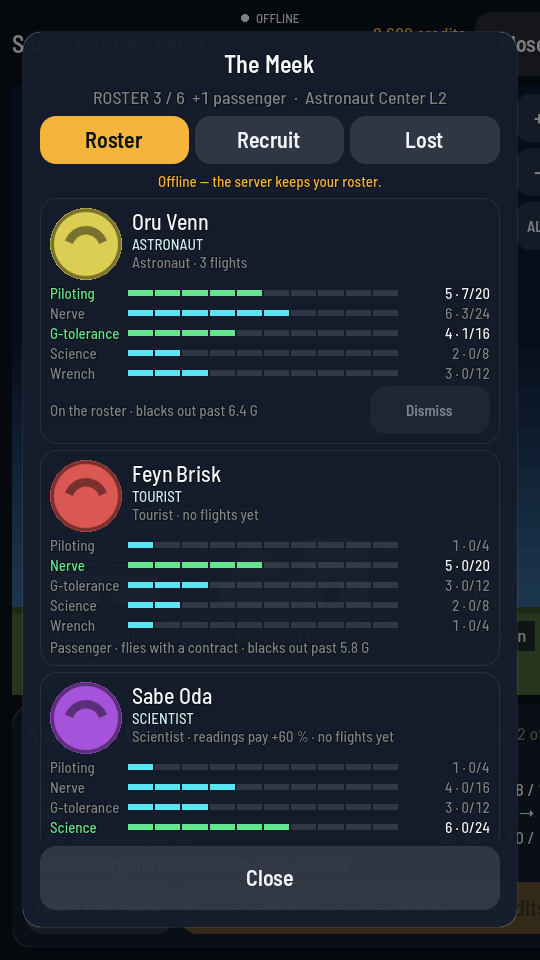
A pod flies only with an astronaut in it
A pod is a part with a seat and the controls in it, and it needs an astronaut strapped into one of those seats before the rocket may leave the pad. Tap Fly with an empty pod and the hangar opens the pod's sheet on its Crew row instead of launching (shutting the staging list first, if it is open), and the line under the ship's mass reads "Seat an astronaut in the Command Pod"; an amber arrow stands on the empty seat until somebody is in it (on the Meek tile, when nobody is free to fly). Seating them is Seat crew on a pod.
A probe core needs nobody. That is the whole of the choice: fly a rocket with people in it and it can be flown by hand, or fly it unmanned and risk no one.
The pod that needs the astronaut is the one you are flying from. A ship carrying both a Sat Controller and a capsule is flown by whichever of the two holds Control from here: turn that switch on in the Sat Controller's sheet and the capsule becomes an ordinary cabin, empty and unmanned, and the rocket flies. Turn it back on the capsule and it wants its pilot again. If you never touch the switch, the first command part on the ship holds it. See Rendezvous and docking.
Everyone aboard is cargo the ship has to lift. A seated Meek adds 80 kg to the part they sit in, suit and all, and the hangar's mass figure counts them.
Passengers and astronauts
Only the astronaut trade flies a ship. Everyone else rides. That gives three rules, and they are all the game checks:
- The pod you fly from needs an astronaut of its own. A scientist alone in a Command Pod keeps it on the pad. A command part you are not flying from counts as a cabin.
- A Passenger Cabin may hold anyone, of any trade, so long as an astronaut is aboard the ship somewhere in a pod.
- An empty cabin is freight. It keeps nothing on the pad and does nothing in flight.
Every seat takes anybody, the single seat in a greenhouse included. What a greenhouse grows by is the botanists aboard the ship, wherever they happen to be sitting: with none aboard nothing grows, one works every greenhouse on the ship, and each further botanist raises every harvest.
Nobody may be in two places at once: a Meek already aboard a ship in orbit cannot be seated in a second one until that ship comes home. The cabins and pods themselves are in Parts: Pods.
Where somebody sits is settled in the hangar but not fixed there. A ship with two crew modules can move people between them in flight — a pod and a cabin, a lander and the ship that carried it, or the two halves of a docked pair, which are one ship for as long as the joint holds. The same three rules are checked on every move, which is why the last astronaut in a pod may not leave it: that would be a crewed ship with nobody able to fly it. Steps are in Transfer crew between modules.
An astronaut can go further: out of the hatch and across open space into another ship of yours floating within 50 m, with no docking at all — so long as the two are drifting apart at under 2 m/s, above the air, with no engine burning. Nobody else goes outside. See Walk across to another ship.
Food and power aboard
A filled seat eats. An empty one does not. Food is drawn from the whole ship rather than from the part the seat is in, so a cabin eats out of the pod's larder, or a tank's, as readily as out of its own. The crew chip in flight tells you how many days are left.
Under one day of food the chip turns amber and reads HUNGRY. Run the larder dry and everyone who was eating out of it is lost. Electricity is different: each passenger in a cabin draws a little of it for air, warmth and light, and a cabin that goes dark still keeps its people. Power is comfort. Food is life.
G, greying out and blacking out
Acceleration presses on a body as much as on a hull, and the Meek have a limit of their own that has nothing to do with the parts'. It is their G-tolerance stat: they stay awake through 4 G plus 0.6 G for every point of it, so the frailest hold out to 4.6 G and the hardiest to 10 G. Every card and every crew chip says the figure outright.
Everyone aboard is judged on their own limit, and what you see is the pilot's. From two G under their limit the world darkens in from the sides of the screen, most of the way shut at the limit itself. Three seconds past it and they are out. They come to five seconds after the load has dropped a G back under.
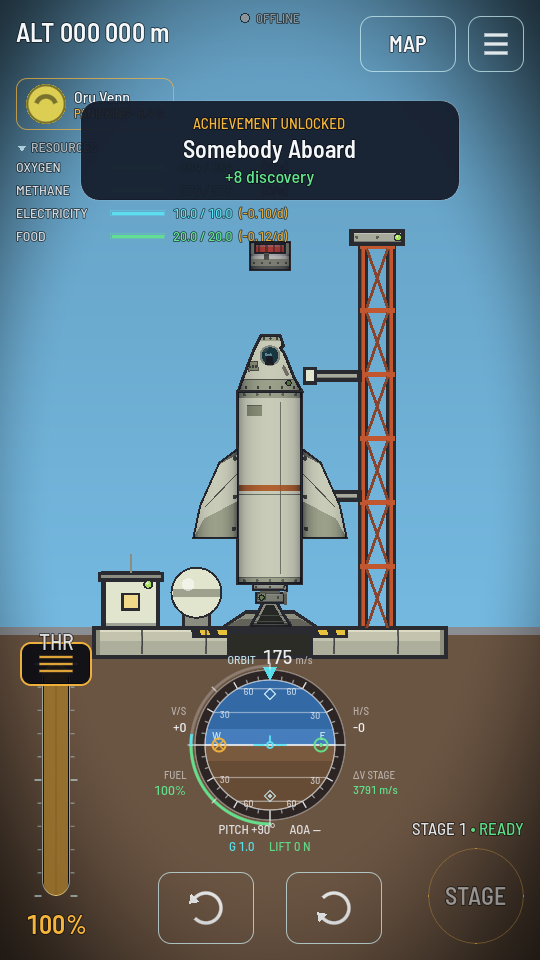
The pilot's blackout is the one the ship feels. While they are under, the controls read zero, the throttle freezes, nothing stages, and the world goes black but for a trace. Every instrument stays readable, so you can watch what the ship does without you. A passenger's blackout is theirs alone and costs the ship nothing.
Spinning
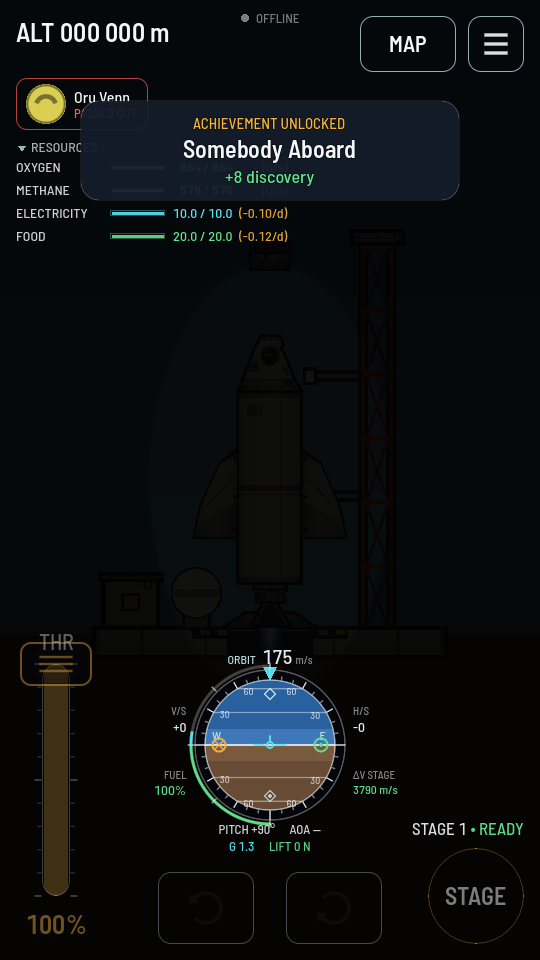
A body does not need weight to give out. A tumbling ship swills the inner ear whatever the accelerometer reads, so rate of turn is a second way to the same blackout, and a ship coasting at one G can put its whole crew under.
The same G-tolerance stat sets it. The frailest keep their bearings to about 19 rpm and the hardiest to about 34 rpm — roughly a third of a turn a second at the top end. Past that the screen closes in exactly as it does under load, and the chip goes amber and reads DIZZY beside the rpm that Meek gives out at. Six seconds past their limit and they are out: twice as long as a hard burn takes, because vertigo builds where a grey-out arrives. They come to five seconds after the ship has settled well under the figure, and settling means both the load and the spin.
Spinning never kills. A tumble fast enough to hurt a body tears the ship apart first, and that is the hull's limit, not theirs. What it does is take the controls away at the worst possible moment, so a ship that starts turning after a separation is worth catching early — on the reaction wheels, on fins in air, or on the thrusters.
The scientist's bonus
A Scientist aboard makes every science reading pay more. Each reading's credits and discovery go up by 10 % for each point of that scientist's science stat, so a scientist with science 6 pays +60 % and one with science 10 doubles the reward. Only the scientist trade pays it: an astronaut's science stat earns nothing.
The figure follows them everywhere so you can price a hire against what they will earn: on their card at the Astronaut Center, on the seat you put them in, on the toast when a reading is taken, and on the toast that pays it. What a reading is, and which instruments take them, is Science and readings.
Growing, and coming home
Stats grow by use, and only when the Meek comes home. Recovering a landed ship is what brings them back and what moves their counters; a flight that crashed, was terminated, or was left in the air grows nobody, because nobody came back. See Landing and recovery.
What grows depends on what they did. Piloting grows for whoever was at the controls, by the hardest thing the flight reached. Nerve grows for everyone aboard, and grows more the first time they reach something new. G-tolerance grows from a flight that pressed near their limit, from every blackout they survive, and from every full hour they spend aboard: the body hardens to the load the longer it flies. Science grows for a scientist each time a reading is filed with them aboard.
Ten is the ceiling and nothing ever falls. The exact figures are in Crew.
What each of them has done
Every Meek keeps a history: a dated list of the things that happened to them. Signing on. Every launch, and which pad it left from. The first time they reached space, made orbit, flew at a new world, flew in a new world's air. A new personal altitude record. Every landing, with the ground they came down on. Readings taken, spacewalks made, dockings, blackouts. Coming home from a flight, and which stats it moved. And, at the end, how they were lost.
To read it, open Open the Meek and tap any face. The whole list changes: the portraits become large, and beside each one stands a line saying the highest that Meek has ever been, which worlds they have flown at and whose air they have flown in, then their stats, then the newest eight lines of their history. Tap a face again and the list goes back to the short cards. It stays the way you left it the next time you open the sheet.
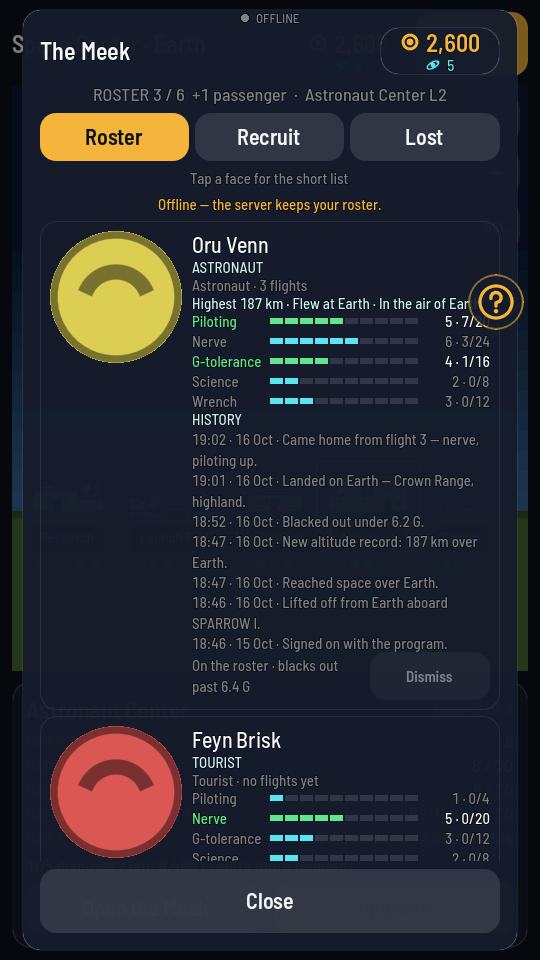
The history is kept for you with your account, so it follows you onto any device. In sandbox the flight still writes its lines and you can read them while you play, but they are not kept once the flight is over, and stats do not grow there either.
The Meek in sandbox
Sandbox has a crew of its own, kept on this phone and never mixed with your account's (except the Meek already aboard your ships, below). The first time you play in sandbox one astronaut signs on for you, and from then on the Astronaut Center's sheet in sandbox is theirs: the Recruit tab signs more on for nothing (the card says "free in sandbox"), up to 5 at a time, and Dismiss lets one go. The trades on the board are the ones your Astronaut Center opens.
The five count wherever they are. A Meek who launches is aboard that ship until you recover it or they are lost, and while they are away nobody else can sit in their seat and they cannot be let go. With all five in flight, no crewed capsule can leave the pad until one of them comes home. A ship that leaves the sandbox world without a loss, as everything you flew there does when you switch sandbox off, brings its crew home with it.
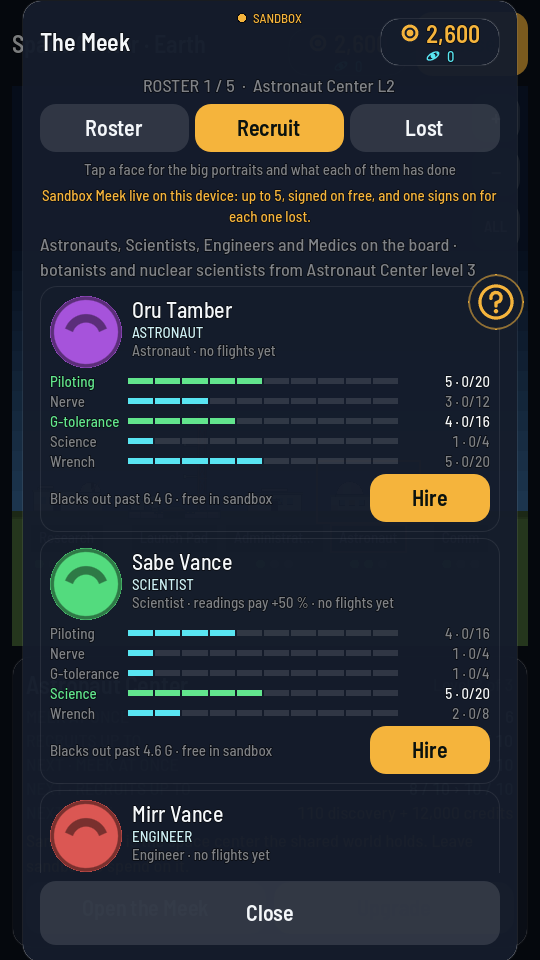
A Meek lost in sandbox is lost for good there: they go to that crew's own Lost tab, with how and where. But a sandbox is never left without a pilot: the moment one is lost, another of the same trade signs on in their place, and the flight says who. Sandbox Meek get no obituary, and their stats do not grow. Leaving sandbox brings your account's crew back exactly as it was.
Your own crew come along on ships already flying. Switch to sandbox while a ship of yours is out in the shared world, and the Meek aboard it are still aboard it in sandbox: the capsule flies with your own astronaut, with their name and their stats, so you can try that ship's next move first. It is only a rehearsal. Nothing they do there reaches their history, and if they are lost in sandbox, they are lost only there. Your account's crew are never on sandbox's board, and nobody from your account can be seated in a new sandbox launch. Switch sandbox off and the ship and its crew are back where the shared world has them, untouched.
The memorial
A crash, an empty larder, too much G, or a ship abandoned in the air loses everyone aboard. They leave the roster for the Lost tab, which records how they went and over which world. Nothing brings them back, and the seat they were in is part of what a surviving pilot carries home.
Each of them is also remembered in words. Every Meek who dies gets a short obituary, written for them out of the history they left behind — the flights they made, the world they reached first, the record they set, the thing that finally went wrong — and it sits on their card under how and where they went. It is written once, it is kept for good, and no two are alike. Expect it to be funny; the Meek would have wanted that. It takes a minute or so to arrive after a loss, and until it does the card says so.
A Meek on that tab is remembered by a picture of their own. The card does not show the face from the roster: it shows their farewell — a soft little ghost of themselves, hands folded round a flower, a halo, two small wings, a last salute — and which of those they wear was settled when that face was drawn, so a memorial of six is six different goodbyes.
It is the module that has to survive, not the ship. A crew module destroyed on its own — struck too hard on landing, overloaded, burned through — takes everyone in it while the rest of the ship flies on with the rest of the crew. And a pod you have separated and left behind is its own vessel from that moment: whoever is strapped into it goes wherever it goes, and if it meets the ground too fast, you lose them even though you are still flying.
Word gets round, too. Every Meek you lose puts 5 % on every price the recruit board asks from then on, and every crewed flight you bring home takes 0.5 % back off, so ten safe flights pay for one loss. A line above the board's cards says the current rate. The figures are in the crew reference.
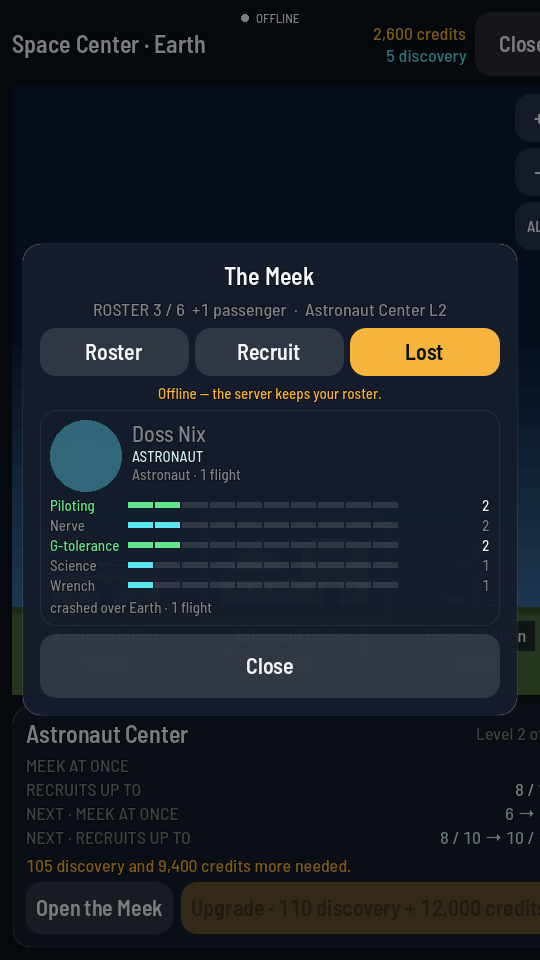
The loss reaches the rest of the game at once. The roster in the Roster tab is one shorter the moment you are back in the hangar, and any ship on the canvas that had a seat holding them comes up with that seat empty — the sheet says so in red and the readout goes back to asking for an astronaut. Nobody flies out on a design that still names the dead.
The recruit board always carries at least one raw astronaut, so losing your only pilot never leaves you unable to fly.
Passengers a contract lends you
Some contracts hand you passengers the moment you accept them: Tourists, who cost nothing at all. They sit on your roster like anyone else, and you seat them, fly them and bring them home the same way, but they are not yours. They ride outside the Astronaut Center's limit, so they never take a place from a Meek you hired; they cannot be let go; and they leave on their own when the contract ends, however it ends.
A tourist still needs a seat beside an astronaut. A tourist run is over when you recover the ship, not when you land it, because a recovery is what gets them off the ship. See Contracts.