Landing and recovery
Touching down is not one pass-or-fail check. Every part on your ship survives a landing on its own terms, the ground is never quite flat, and only a ship that comes to rest in one piece can be brought home for its money back.
Every part has its own landing speed
A hard landing is over in a heartbeat, so it is judged nothing like the g-forces of a hard ascent or a steep turn. Instead, every part carries its own IMPACT figure on its info card: the closing speed that part can take when it is the one that meets the ground. Only the part that actually strikes is judged, so what matters is what your ship is standing on, not what it is made of everywhere else. An Engine takes 14 m/s on its bell before it gives way, a Heat Shield takes 28 m/s on its dish, and an LT-1 Landing Strut takes 30 m/s through its foot. A rocket set down on its engine bell is far more fragile than the same rocket set down on legs.
Legs soak up the landing
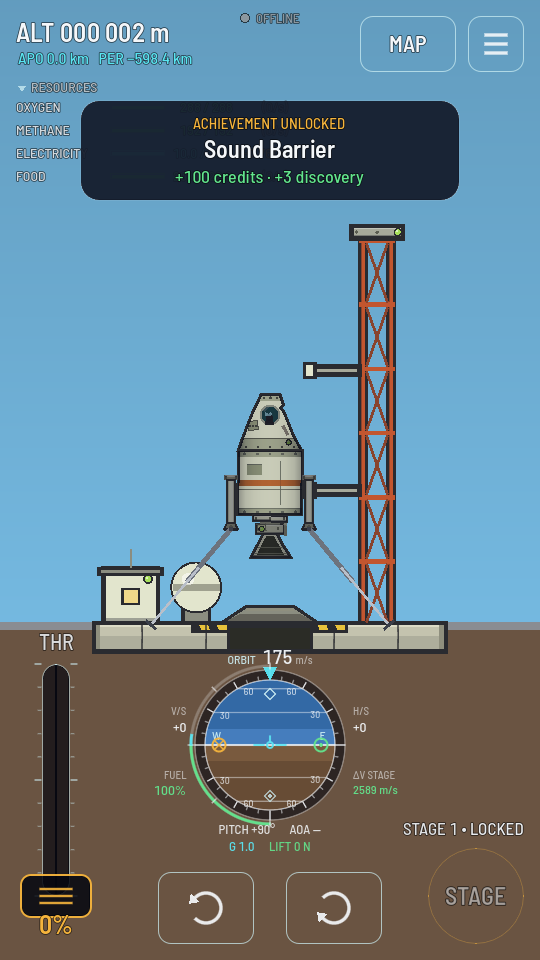
A landing strut carries the ship on a sprung, damped piston that swings out when staged or tapped. It takes the weight over its own travel before the leg ever bottoms out onto the hard ground beneath it, which is what turns a landing no bare hull would survive into one every part walks away from. Like a shock absorber, the piston pushes back gently as it extends again, so the ship settles instead of bouncing, even on the Moon, where a bounce would carry it six times longer than on Earth. The card's SUSPENSION line names how stiff and how damped that piston is; a heavier lander wants the sturdier LT-2 Landing Strut, rated to 45 m/s at its foot, over the lighter LT-1.
Where a leg stands is remembered. Put one down in flight and the ship keeps it down: leave the lander parked on a moon and it is still on its legs when you come back to it. You can also stand a ship on its legs in the hangar, with the Deployed switch on the leg's properties sheet, and it will leave the pad that way — worth doing for a short hop, where there is nothing to gain by folding them.
Parachutes and drogues
A Parachute opens over a second and a half once staged or tapped in the air, and drags the ship down through a canopy far larger than the ship itself: its info card's PARACHUTE AREA row reads 400 m², against the Drogue Chute's 20 m². That size difference is the point of flying two: a drogue is small enough to survive opening at high speed, its PARACHUTE MAX Q row allows far more dynamic pressure than the main chute's, so it opens first to slow a fast descent, and the bigger canopy follows once the air is safe for it. Stage a drogue to deploy high and a main chute to open lower, and the ship arrives far slower than either canopy could manage alone. A chute will not open while the ship is standing still — on the pad or landed — because there is no airflow to fill it, so deploy while you are still coming down.
Neither canopy needs a tap if you would rather it opened itself. Every chute has an Auto deploy row on its sheet — an altitude, Off until you set one — and it opens there on the way down. Set the drogue's high and the main chute's low and the whole descent flies itself, which is also how a dropped stage comes home under its own canopy. That altitude is above sea level, never above the ground under you: the release is a pressure gauge, and pressure only tells it how high it is over the world's datum. Landing on high ground means setting it above the high ground.
Once a canopy has done its work it is spent: it collapses at touchdown, or you tap Cut and it drifts away. Either way the empty canister stays bolted to the ship, and the chute will not open again — unless there is an Engineer aboard. Their sheet grows a Repack button on any spent chute, and a repacked one opens like new, which is what makes a second descent on the same ship possible. With no engineer aboard, plan on one canopy per chute per flight.
The ground has hills, and a ship can lean or fall
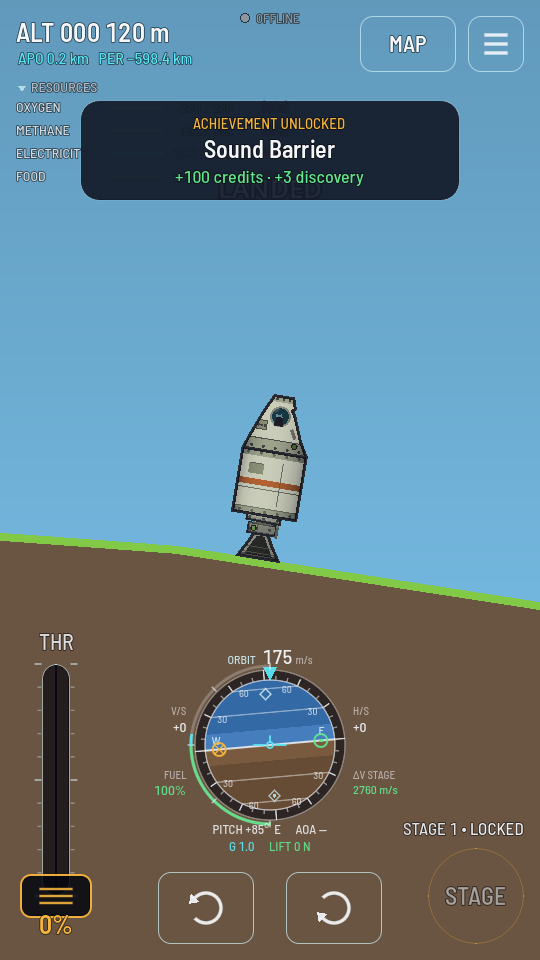
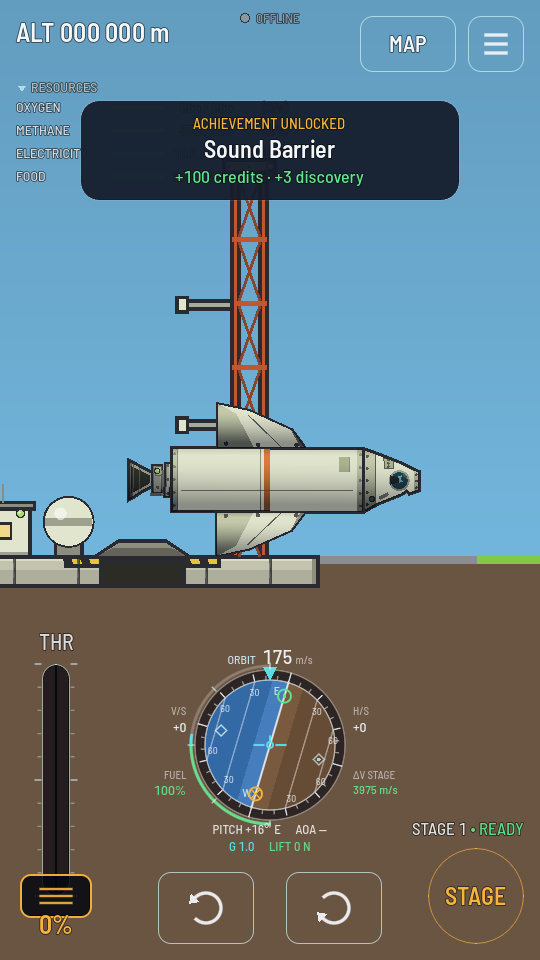
The ground under your ship is rarely flat. A landing on a slope makes every corner of your ship meet the ground at a different depth, and the game leans the ship to match rather than snapping it upright. Whether it holds that lean or goes over depends on the ship's own shape: a bare stack has a narrow footprint and little to hold it, while legs push the centre of mass down and spread the footprint wide. A legged lander holds a slope up to 31°, the ground's own grip limit, before it slides. Past its own limit, a ship topples, and it slams down hardest at whichever end the fall swings furthest, which is judged on that part's own impact speed just like any other landing.
Splashing down
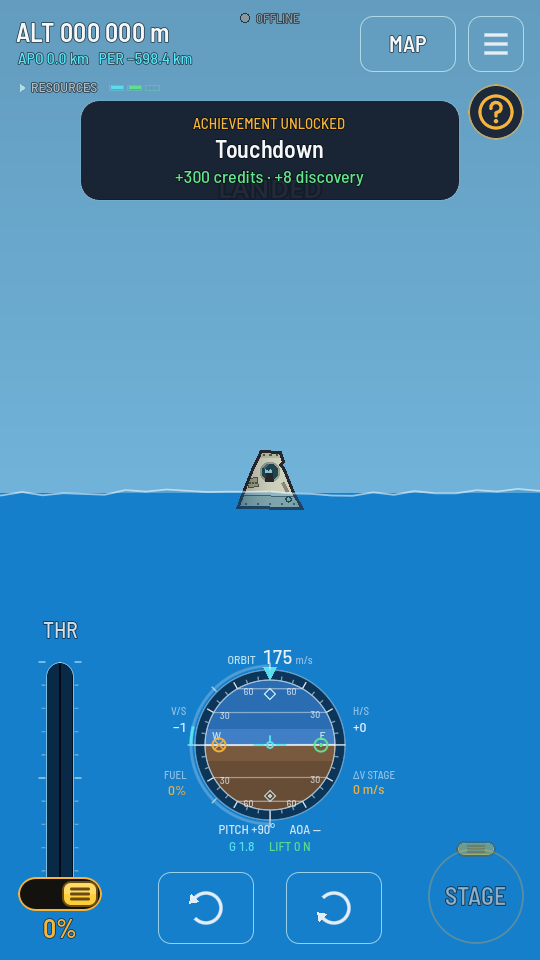
The sea is not ground. A ship that comes down on water goes into it with a splash you hear as well as see, louder the faster it hits and deeper the wider the hull, throws up spray and a ring of ripples, and then floats at its own waterline: the water carries whatever weight the ship's sealed hull displaces, so a light pod rides high with most of it showing, and a stage with its tanks still full sits deep. A ship heavier than the water it can push aside sinks, and comes to rest on the sea floor far below. Whatever is under the surface is seen through the water.
Not every sea is water. On Gazorpazorp the seas and lakes are liquid methane, at 450 kg/m³ less than half the weight of Earth's seawater (1,025 kg/m³): a pod floats with most of it under, and a stage with full tanks that would float at home goes to the bottom. The lava lakes of Lookatme go the other way: lava at 2,700 kg/m³ carries a ship high, and it is so thick that whatever comes down on it is stopped almost at once and barely bobs. Every liquid takes the blow of a landing the way water does.
Water is kinder than rock. Every part is still judged on its own IMPACT figure, but meeting the sea spreads the blow, so a part survives about twice the speed on water that it would on hard ground: the Command Pod, rated 20 m/s on the ground, comes through a splashdown at about 40 m/s whole. Come in much faster than that and the part breaks up all the same. The water also rights a ship: the part that floats highest ends up on top, and a capsule settles upright on its broad base.
A ship that has stopped bobbing has landed, the same as on the ground: it parks, its landing counts, and on Earth it can be recovered from the sea.
Recovering a ship
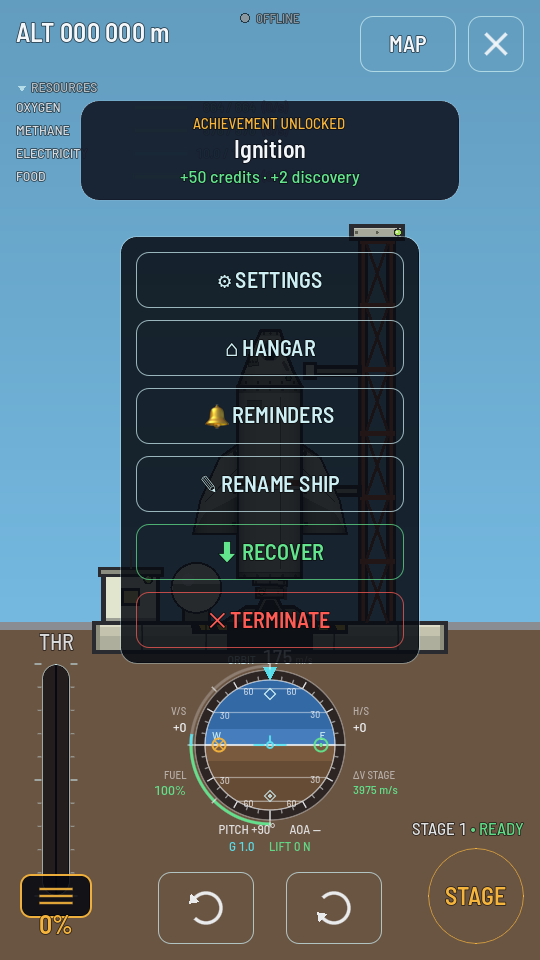
The flight menu's RECOVER chip only appears once your ship is launched, alive, and standing still on the ground of Earth — there is nobody to fetch a ship from the Moon or Mars, so a ship landed there stays where it stands. It never shows while the ship is still falling or drifting. Confirming it brings the ship home to the hangar and refunds every part still aboard in credits; the flight ends there. Your debris lying on the ground within 2 km of the ship — a stage that came down under a chute nearby, say — comes home with it and is refunded too. A part torn off in a hard strike, or a stage that broke up on landing, is gone and pays nothing, and a ship that never comes to rest in one piece cannot be recovered at all. See Recover a landed ship for the steps.
A wreck
A ship that loses its command part before it comes to rest never gets the chance: the ship is lost there, banner reading CRASHED, and nothing comes back. The flight ends with it unless another ship you can fly is still in the flight — then control passes to that one a moment later (If the ship you are flying is lost). That is the one outcome recovery can never reach, and the reason it pays to bring a fragile part down on legs instead of its own bell. What is left standing is not thrown away, though: it stays on the ground as a wreck, and a later recovery beside it on Earth brings it home as debris. See Debris and dropped stages.