Debris and dropped stages
Nothing you drop is deleted. A separated stage, a jettisoned shell and a part torn off in a collision all keep flying under their own weight, their own engines and their own air, and some of them end up in the world as ships of their own.
What a dropped stage is
Fire a separator, a decoupler or a docking port and whatever comes off becomes a piece: a ship with nobody at the controls. It still has everything it had a second ago. Its tanks feed its own engines, its own parts still run, and gravity and the air treat it exactly as they treat you.
So a solid booster dropped while its grain is still burning flies on under thrust until the case is spent. A liquid stage dropped with its engine lit burns at whatever throttle it was on when it left. A parachute that was already open keeps dragging. What a piece does not have is a hand on the controls: it will not turn, it will not stage, and its throttle is frozen where you left it.
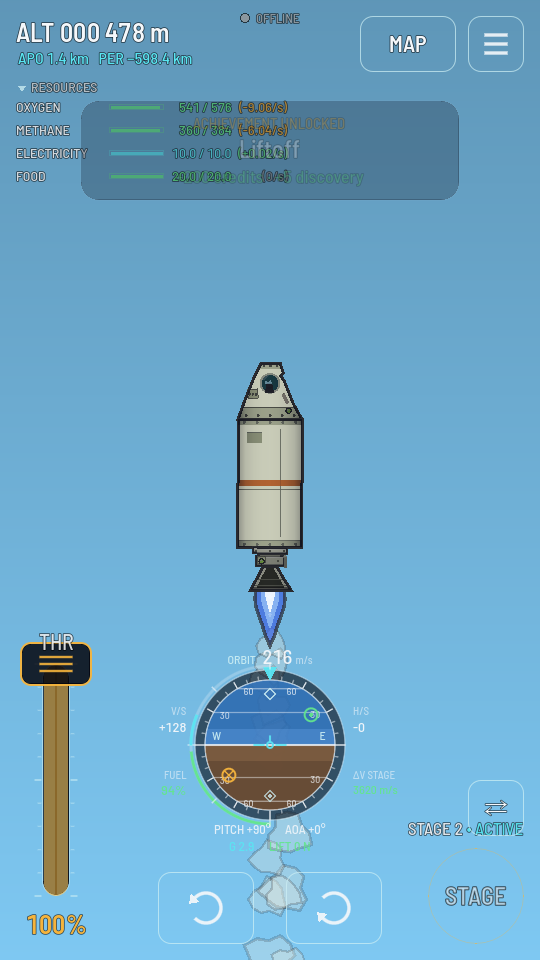
A strap-on booster is the usual offender. A Decoupler springs the two sides apart as it goes — about 2.5 m/s between them, shared by weight, so a light case takes nearly all of it — but that is a shove off the flank, not a throw: a case leaves with the turn your rocket had, and in the airstream an empty one can still swing back into the stage it left. Which way a stage goes is yours to decide, and the Separation Motor is how: a one-second solid cluster bolted to the booster's flank that fires as the booster lets go and shoves it straight outward. Throw a booster clear has the placement.
Debris is solid, and it can hit you
A piece is not scenery. If it touches your ship, or another piece, the two collide part against part: the game finds which parts actually met, shoves both ships at that point and sets them turning. Each part that was hit is judged on its own, on how much of the closing speed it had to take, against its STRIKE figure — the same as its IMPACT unless its card lists a STRIKE of its own. A part takes the blow as if it were loose, its own mass against the other ship, so a fragile part is fragile whatever it is bolted to.
A gentle drift back into the stack is a nudge and nothing breaks. An open solar panel or an open dish breaks at a touch. A fin, a thermometer or a whip antenna goes at a few metres a second. A case ramming you at thirty breaks whatever it struck. A part that breaks takes most of the blow with it, so a case that snaps off a panel barely nudges your ship and goes on through where the panel was, and a piece that loses parts falls apart into whatever still holds together.
Parts that have just let go of each other are not judged against each other until they have come apart once, so a stage that separates flush against the one above it is not a collision.
How a part breaks
A part that breaks — hit by debris, past its temperature or its G, striking the ground too hard, or built into another part on the pad — is destroyed, never knocked loose to drift on. It breaks into pieces of its own drawing that tumble away from where it was hit and fade over a few seconds, and a ring runs out from the point of impact, as wide as the part was. A part that holds something to burn — a tank, a booster, a pod, a battery — explodes as well, and the blast shoves whatever it was bolted to. A part that holds nothing, like an engine, a fin or a sensor, only shatters.
An explosion reaches every part near it, not only the parts it is bolted to. What is bolted to it takes the whole blast; anything else within its reach takes less the further away it is, down to nothing at the edge. That counts parts of your ship, a stage you just dropped, and another ship flying beside you. A part hit hard enough for its G limit is destroyed, and goes up in turn if it holds something to burn; anything the blast does not break is shoved away from it, and a ship hit off-centre is set turning. The blast is not felt everywhere at once: its shock wave runs out from it to the edge of its reach in under half a second, fast at first and slowing, and a part is hit only when the wave gets to it — so a ship pulling away fast enough, like a capsule escaping a failing booster, outruns it untouched. You can watch it: the pale wave you see is the one doing the damage.
How big the explosion is depends on the propellant still in the part. An empty tank only pops, reaching a few metres. A full one adds a blast for every kilogram of fuel, solid grain or hypergolic it holds. A full Fuel Tank reaches about 18 m; a full Fuel Tank L, 5 100 kN over nearly 50 m, takes the whole ship with it, and every full tank it destroys goes up in turn. A part card lists both as force and reach: BLAST for the part empty, BLAST FULL for it full. A stage that has burned its tanks dry is far safer to lose than one that failed on the pad, and a booster you destroy with an FTS Charge while it still holds fuel can take your core stage with it: let it fall clear first, or burn it out. The charge itself only cuts what it is bolted to, and throws nothing further.
The ones you can fly
A piece carrying a Sat Controller, or a Command Pod or Crew Capsule with one of your own Meek seated in it, can be taken over: a switch button appears in the flight and control jumps to it. Anything else is debris — a spent tank, a booster case, and an empty capsule too, since a pod needs somebody in it to fly. A pod whose seat holds nobody of yours, such as a Meek you lost or one from another program, is debris as well. VIEW still opens it, but nothing on it answers the controls. See Switch to a dropped stage for the button.
On the map, debris of yours offers VIEW where a ship offers CONTROL, and it does the same thing: the flight screen opens on the debris, so you can watch it up close and see where it is going. Nothing on it answers the controls, since nobody aboard can command it. Leave it the way you leave any ship, and it stays in the world as debris. On another player’s ship, VIEW only locks the camera on it and closes in. The map's SHIPS chip leaves debris off the chart until you ask for it — tap it and its choices open in a ring around it, then tap one: HIDDEN, NEARBY (the ships around the world you picked, no debris), MINE (your own ships and your own debris, nobody else’s), SHIPS and +DEBRIS.
A piece that stops pushing becomes a ship in the world
The moment a piece is coasting in space, above the air, with nothing pushing it, the world takes it: it gets an entry of its own, with a name and a card on the map, and it goes on orbiting whether or not you are looking. A flyable piece is named after the ship it left with a number after it. One nobody can fly gets the ship's name and the word DEBRIS.
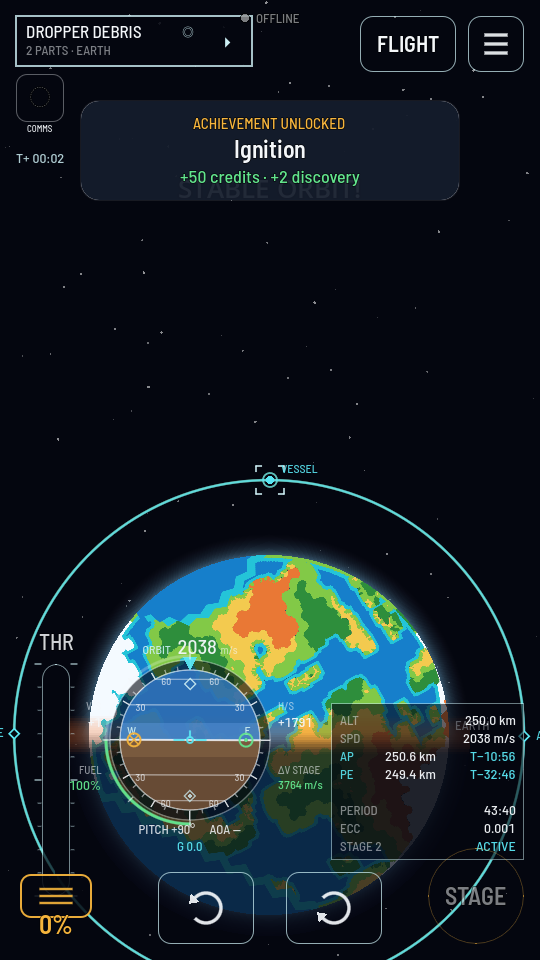
That only happens once nothing is pushing it. A piece still under thrust has no settled orbit yet, so it waits until its burn is over. Leaving the flight while a piece is still burning shuts its engines down first and stores it as it is, because nothing burns while you are away. A piece still in the air when you leave the flight is lost.
Debris falling through the air is not followed for long, either. Once it is more than 10 km from the ship you are flying, a piece with no Sat Controller, no capsule and nobody aboard is destroyed where it is — nothing could reach it before it lands. A capsule, crewed or not, is always kept.
What reaches the ground has to survive the landing
A piece that falls all the way to the surface is judged on how fast it is coming down, against the weakest part aboard it — the same impact figure on every part's info card. Come down slower than that and the piece lands where it came down — a spent tank under its chute as much as a capsule — and one carrying a command part can still be switched to while the flight lasts. Come down faster and the piece breaks up where it hit.
That rule is the whole rule, and it does not care which half you are flying. A pod you separated and left behind still falls, and the Meek inside it do not survive it hitting the ground. If you want a crewed module back, give it a parachute and enough canopy to bring it under its impact speed — the crew chip reads a safe descent when it is slow enough for every part aboard.
What comes to rest on the ground stays there
Once a piece is lying still on the ground, the world keeps it, exactly where it lies, on any world: leave the flight, close the game, come back next week, and it is still there. The same goes for a ship you park, and for what is left standing after a crash — a stack whose pod was torn off stays on the ground as a wreck. Nothing you leave at rest on a surface is taken away.
The one exception is the launch pad. Debris lying within 60 m of the pad's centre is cleared away, so the next rocket never starts in a scrapyard. A ship parked there, or anything with somebody seated in it, is left alone.
Debris on the ground near home is worth something too. When you recover a ship on Earth, every piece of your debris lying within 2 km of it comes home with it and is refunded at the price of its parts — so a stage that came down under its own chute beside the capsule pays back. Debris anywhere else, and a stage that broke on landing, pays nothing. See Landing and recovery.
Fairing halves and broken-off parts
Staging is not the only thing that makes a piece. Jettisoning a Payload Fairing splits the shell into two half-shells, and those are flown like anything else: each is blunt to the air whichever way it tumbles, so the pair falls behind the rocket rather than chasing it, and they break when they land. Parts knocked off in a collision or an explosion become pieces the same way. Whatever comes off, the rule is the same: it is still there, it is still solid, and nobody is flying it.
Parts you never joined stay on the pad
The hangar lets you set parts down without attaching them to the rocket, and it says so in amber under the mass: 2 loose pieces. Those are separate bodies from the moment your ship reaches the pad: each stands on the ground where it was built, a piece of its own, and a ship set on top of one rests on it rather than through it. When the first stage fires, the rocket you fly lifts off and everything not joined to it stays behind. A frame of beams you set a lander on is still on the pad after the lander leaves. It is solid, so the rocket can knock it over on the way up. Once the flight is over it is cleared away like any other debris on the pad; only a piece somebody can fly stays there. Nothing is charged while you stand on the pad; the launch price, taken when the first stage fires, covers every part you built, loose pieces included, because they left the hangar with you.