Every engine and thruster you can bolt to a rocket, from a first stage to a cold-gas block, plus the three warp drives that share the drawer with them, and its figures from the info card.
An engine's thrust is quoted as a range, sea level to vacuum: the same flow makes less push at the pad than it does with nothing behind the nozzle. Read Air, heat and speed for why, Flying for the throttle and ignition, and Staging for lighting one from the staging list.
Three engines are not in this drawer. The PR-9 Propeller Nose, an aeroplane's engine, is in the Planes tab with the rest of the aeroplane. It is quoted by its power rather than a thrust range, because it pushes on the air instead of throwing propellant. The JE-1 Jet Engine and the JT-1 Jet Tail are there too: they burn methane in air swallowed through an intake, so they run only in Earth's air.
The last three entries are not engines. A warp drive makes no thrust, burns no propellant and adds nothing to your Δv: it closes a bubble and puts the ship where its own orbit would have carried it after a span you set. It shares this drawer because it is the other thing that moves a ship. See Warp drives.
Engine
Part · Engines · sold by Rocketry
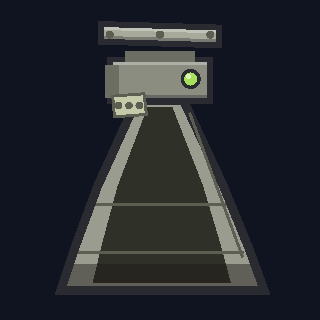
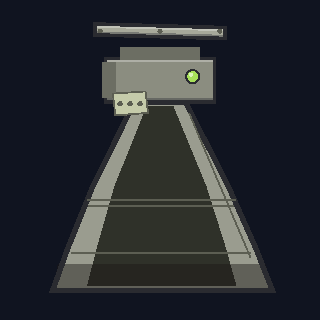
The rocket's first engine, and the one most first stages use: a middling thrust that lifts a stack off the pad before anything fancier is needed.
Figure
Value
MASS
600 kg
COST
200 cr
CONSUMES OXYGEN
9.06 u/s
CONSUMES METHANE
6.04 u/s
PRODUCES ELECTRICITY
0.02 u/s
THRUST
215 – 250 kN
ISP
290 – 338 s
QUOTED
SEA LEVEL – VACUUM
PROPELLANT
METHALOX
GIMBAL
±3°
DRAG NOSE-ON
1.0× (blunt)
MAX TEMP
2600 K
MAX G
30 g
IMPACT
14 m/s
BLAST
60 kN
NODES
2
STAGEABLE
YES
It attaches under a tank, and takes a separator or decoupler at its own base for the stage below it to fall away from.
Tap it, or its sheet, for Ignite or Shut down, worded by whether it is burning. Its properties sheet carries a Max power slider and an RCS control toggle, both usable in flight.
Pairs with a Fuel Tank above it. Instead of it, the Vacuum Engine trades sea-level thrust for a much better burn once you are above the air.
Vacuum Engine
Part · Engines · sold by Vacuum Engines
A wide vacuum bell: weak at the pad, but it turns the same flow into far more thrust once the air behind the nozzle is gone. Fly it on an upper stage, never a first one.
Figure
Value
MASS
560 kg
COST
450 cr
CONSUMES OXYGEN
4.37 u/s
CONSUMES METHANE
2.91 u/s
PRODUCES ELECTRICITY
0.02 u/s
THRUST
60 – 150 kN
ISP
168 – 420 s
QUOTED
SEA LEVEL – VACUUM
PROPELLANT
METHALOX
GIMBAL
±4°
DRAG NOSE-ON
1.0× (blunt)
MAX TEMP
2600 K
MAX G
25 g
IMPACT
12 m/s
BLAST
60 kN
NODES
2
STAGEABLE
YES
It attaches under a tank, and takes a separator or decoupler at its own base for the stage below it to fall away from.
Tap it, or its sheet, for Ignite or Shut down. Its properties sheet carries a Max power slider and an RCS control toggle, both usable in flight.
Pairs with a stage that lights above the atmosphere. Instead of it, the plain Engine works at the pad, where a vacuum bell over-expands and loses thrust.
Solid Booster
Part · Engines · sold by Solid Boosters
A case of propellant with the nozzle cast into its base: light it and it burns flat out until the grain is spent, with no shutdown and no throttle.
Figure
Value
DRY MASS
350 kg
FULL MASS
2078 kg
COST
180 cr
STORES SOLID_FUEL
144 u · 1728 kg
CONSUMES SOLID_FUEL
2.4 u/s
THRUST
67 – 76 kN
ISP
237 – 269 s
QUOTED
SEA LEVEL – VACUUM
PROPELLANT
SOLID
DRAG NOSE-ON
1.0× (blunt)
HEAT EXPOSURE
1.3×
BODY LIFT CL
0.25
MAX TEMP
2400 K
MAX G
100 g
IMPACT
14 m/s
BLAST
200 kN · 4.9 m
BLAST FULL
632 kN · 15.4 m
NODES
3
STAGEABLE
YES
BURN TIME
60 s at its base length
THROTTLES
NO
It stacks like a tank on top, and straps to the flank of another stage on the rails down its sides, the way a decoupler lets it fall away.
Note
The nozzle is cast into the base, so it is the same size whatever the case above it holds. Lengthening the booster packs in proportionally more grain and the motor pushes just as hard for proportionally longer: at 288 on the Length slider it burns 135 s instead of 60, and at the slider's top of 576 — twice as long as the Solid Booster S can be cast — 270 s, still at 67 kN. Burn rate is the other dial, and it works the opposite way — see Solid boosters.
Tap it, or its sheet, for Ignite; there is no Shut down once it is lit. Its properties sheet carries a Length slider and a Burn rate slider (50–100–150%), both hangar only.
Pairs with an Engine as strap-on boosters off the pad. Instead of it, an Engine of your own gives you a throttle and a shutdown, at more mass for the same push.
Solid Booster S
Part · Engines · sold by Solid Boosters
The Solid Booster's smaller sibling: less push and less propellant, for a stage that only needs a kick.
Figure
Value
DRY MASS
175 kg
FULL MASS
1039 kg
COST
95 cr
STORES SOLID_FUEL
72 u · 864 kg
CONSUMES SOLID_FUEL
1.2 u/s
THRUST
34 – 38 kN
ISP
241 – 269 s
QUOTED
SEA LEVEL – VACUUM
PROPELLANT
SOLID
DRAG NOSE-ON
1.0× (blunt)
HEAT EXPOSURE
1.3×
BODY LIFT CL
0.25
MAX TEMP
2400 K
MAX G
100 g
IMPACT
14 m/s
BLAST
120 kN · 3.8 m
BLAST FULL
336 kN · 11 m
NODES
3
STAGEABLE
YES
BURN TIME
60 s at its base length
THROTTLES
NO
It stacks like a tank on top, and straps to the flank of another stage on the rails down its sides, the way a decoupler lets it fall away.
Note
Its Length slider is the duration dial, exactly as the full-size booster's is: at 288, as long as it can be cast, it burns 135 s, still at 34 kN. The full-size booster stretches twice as far. Solid boosters explains both dials.
Tap it, or its sheet, for Ignite; there is no Shut down once it is lit. Its properties sheet carries a Length slider and a Burn rate slider (50–100–150%), both hangar only.
Pairs with a light stage, or a pair mirrored either side of it. Instead of it, the full-size Solid Booster pushes twice as hard on the same rails, for the same burn.
RCS Thruster Block
Part · Engines · sold by Attitude Control
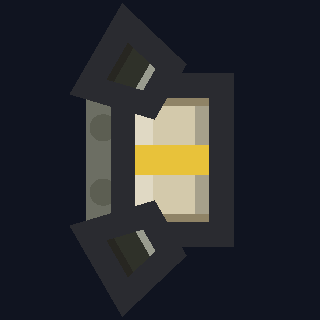
A block of four cold-gas nozzles: it answers your turn and slide commands directly, firing only the nozzles whose geometry actually turns or slides the ship.
Figure
Value
MASS
40 kg
COST
120 cr
CONSUMES HYPERGOLIC
0.02 u/s
DRAG NOSE-ON
0.9×
HEAT EXPOSURE
0.9×
MAX TEMP
3400 K
MAX G
20 g
IMPACT
10 m/s
BLAST
4 kN
NODES
1
NOZZLES
4
THRUST / NOZZLE
1.5 kN
GAS / NOZZLE
0.16 kg/s
ISP
937 s
OVERHEATS AFTER
5 s firing
COOLS DOWN IN
10 s
It bolts to a single point on a flank, wherever the ship needs a push, on a mount that carries hypergolic propellant.
Distance is the whole of its turning power. Each nozzle pushes where it is bolted, so what turns the ship is that push times its distance from the centre of mass — a block out on the end of a beam, or at the very nose or tail, turns a ship several times harder than the same block beside the tank, and one bolted level with the centre of mass turns it not at all. The game works this out every step and fires only the nozzles that help, which is why a badly placed block sits there doing nothing while you hold the key down. The fix is always to move it further out, never to add more of them in the same place.
Put them in opposing pairs. A single pair can only turn the ship by shoving it at the same time, which drifts you off a docking approach. A pair near the nose and a pair near the tail turn against each other instead: the turning adds up and the shove cancels, leaving the ship spinning on the spot.
It is not an engine. Five seconds of firing at full overheats it, and it then fires nothing until it has cooled for ten. See Thrusters heat up.
It has no actions to tap. Its only property is a Thrusters toggle, usable in flight, so you can switch that one block off without cutting the whole RCS system.
Pairs with a Hypergolic Sphere or Pod on the same flank. Instead of one, wire an engine's RCS control toggle for a single strong nozzle rather than four small ones.
Heavy Engine
Part · Engines · sold by Heavy Engines
The biggest throttled engine in the palette: built for a stage too heavy for the plain Engine to lift.
Figure
Value
MASS
1700 kg
COST
900 cr
CONSUMES OXYGEN
39.32 u/s
CONSUMES METHANE
26.21 u/s
PRODUCES ELECTRICITY
0.06 u/s
THRUST
900 – 1000 kN
ISP
280 – 311 s
QUOTED
SEA LEVEL – VACUUM
PROPELLANT
METHALOX
GIMBAL
±5°
DRAG NOSE-ON
1.0× (blunt)
MAX TEMP
2600 K
MAX G
28 g
IMPACT
14 m/s
BLAST
200 kN
NODES
2
STAGEABLE
YES
It attaches under a tank, and takes a separator or decoupler at its own base for the stage below it to fall away from.
Tap it, or its sheet, for Ignite or Shut down. Its properties sheet carries a Max power slider and an RCS control toggle, both usable in flight.
Pairs with the largest tanks for a heavy first stage. Instead of it, a cluster of plain Engines spreads the same thrust over more mounting points.
Lander Engine
Part · Engines · sold by Lander Engines
A small throttled engine tuned for gentle burns: light enough for a lander stage, with the finest gimbal of the throttled engines for careful landings.
Figure
Value
MASS
70 kg
COST
90 cr
CONSUMES OXYGEN
0.61 u/s
CONSUMES METHANE
0.41 u/s
PRODUCES ELECTRICITY
0.01 u/s
THRUST
12 – 20 kN
ISP
240 – 400 s
QUOTED
SEA LEVEL – VACUUM
PROPELLANT
METHALOX
GIMBAL
±6°
DRAG NOSE-ON
1.0× (blunt)
MAX TEMP
2600 K
MAX G
25 g
IMPACT
12 m/s
BLAST
12 kN
NODES
2
STAGEABLE
YES
It attaches under a tank, and takes a separator or decoupler at its own base for the stage below it to fall away from.
Tap it, or its sheet, for Ignite or Shut down. Its properties sheet carries a Max power slider and an RCS control toggle, both usable in flight.
Pairs with a lander stage over the Moon or Mars. Instead of it, the Vacuum Engine pushes harder for the same weight class when you don't need as fine a touch.
Escape Motor
Part · Engines · sold by Escape Motors
A hypergolic torch bolted to a capsule's flank: enormous thrust for a few seconds, enough to throw a crew clear and nowhere near enough to fly anywhere on.
Figure
Value
MASS
120 kg
COST
290 cr
CONSUMES HYPERGOLIC
5.43 u/s
PRODUCES ELECTRICITY
0.02 u/s
THRUST
115 – 130 kN
ISP
270 – 305 s
QUOTED
SEA LEVEL – VACUUM
PROPELLANT
HYPERGOLIC
GIMBAL
±12°
DRAG NOSE-ON
0.85×
HEAT EXPOSURE
0.85×
MAX TEMP
2600 K
MAX G
25 g
IMPACT
12 m/s
BLAST
30 kN
NODES
1
STAGEABLE
YES
Its one attachment point is on its side, so it mounts radially and its bell points down the vessel's axis wherever you stick it. Mirror a second one on the opposite flank.
Note
Its 5.43 u/s draw empties a full HT-2 Hypergolic Tank in about seven seconds. It is built to fire once, not to fly on.
Tap it, or its sheet, for Ignite or Shut down. Its properties sheet carries a Max power slider and an RCS control toggle, both usable in flight, like any throttled engine.
Pairs with a Crew Capsule and a Hypergolic Tank on the same flank for an abort system. Instead of it, nothing else in the catalog is built for the same job.
Separation Motor
Part · Engines · sold by Radial Staging
A thumb-sized solid cluster bolted to a booster's flank, whose whole job is one second of shove the moment the booster lets go, so the spent case leaves the stack instead of drifting back into it.
Figure
Value
DRY MASS
10 kg
FULL MASS
11 kg
COST
12 cr
KICK
3 – 3.4 kN
ISP
240 – 272 s
BURN TIME
1.0 s
NOZZLES
2
THROTTLES
NO
STORES SOLID_FUEL
0.11 u · 1 kg
CONSUMES SOLID_FUEL
0.11 u/s
DRAG NOSE-ON
0.9×
HEAT EXPOSURE
0.9×
MAX TEMP
2400 K
MAX G
100 g
IMPACT
12 m/s
BLAST
6 kN · 0.9 m
BLAST FULL
6.33 kN · 0.9 m
KICK CANT
60°
NODES
1
STAGEABLE
YES
Its one attachment point is on its side, so it mounts on any rail. Its two nozzles, one at each end, are turned 60° in toward whatever it is bolted to, so their jets play across its skin and the push goes the other way: straight out from the mount. Where it sits on the rail decides the rest. Level with the booster's middle it is a clean sideways shove; high on the case it also swings the booster's nose out. Mirror a second one on the other booster; the mirror turns its nozzles the other way for you.
Note
It is not counted as thrust. The hangar's Δv and TWR figures, the fuel ring and the flight's idea of whether you are burning all leave it out: a kick is not a burn. Its 3 kN for one second gives an empty Solid Booster S about 18 m/s sideways and the full-size Solid Booster about 9 m/s; drag in thick air takes some of that back. A Decoupler adds only its own 2.5 m/s spring, shared by weight and spent letting go of the flank, so without a motor a case leaves with very nearly the speed and exactly the turn the rocket had.
Tap it, or its sheet, for Fire; there is no Shut down once it is lit, and on the pad the tap does nothing. It has no properties sheet to edit. Put it in the same stage as the booster's Decoupler and it lights first, so the booster leaves already pushing.
Pairs with a Solid Booster or Solid Booster S on a Decoupler. Instead of it, nothing else in the catalog is built for the same job; a Decoupler alone gives a gentler push. Throw a booster clear has the steps.
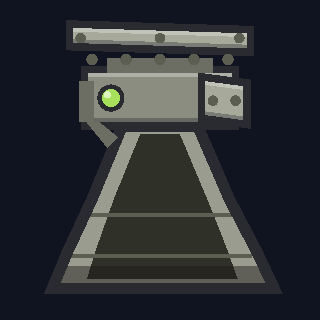
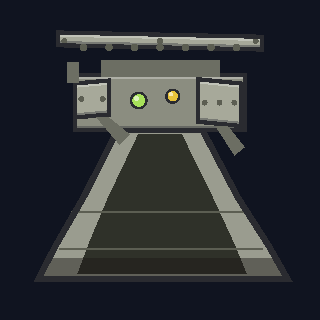
One bell for the whole 8 m stage: four times the Heavy Engine's thrust on the Heavy Engine's Isp, and the hardest push per tonne of any first-stage engine in the palette.
Figure
Value
MASS
6000 kg
COST
3400 cr
CONSUMES OXYGEN
157.27 u/s
CONSUMES METHANE
104.85 u/s
PRODUCES ELECTRICITY
0.2 u/s
THRUST
3600 – 4000 kN
ISP
280 – 311 s
QUOTED
SEA LEVEL – VACUUM
PROPELLANT
METHALOX
GIMBAL
±4°
DRAG NOSE-ON
1.0× (blunt)
MAX TEMP
2600 K
MAX G
26 g
IMPACT
14 m/s
BLAST
300 kN
NODES
2
STAGEABLE
YES
It attaches under a Fuel Tank L, and takes a Separator L, a Separator or a Decoupler at its own base for the stage below it to fall away from.
Tap it, or its sheet, for Ignite or Shut down. Its properties sheet carries a Max power slider and an RCS control toggle, both usable in flight.
Pairs with one or two Fuel Tanks L for a first stage that lifts 130 t off the pad. Instead of it, the Nine Cluster trades push per tonne for a better burn, and the Quad Cluster is the cheaper way to a Heavy Engine's thrust.
Quad Cluster
Part · Engines · sold by Wide Engines
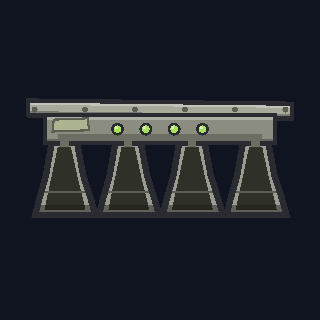
Four Engines on one 8 m thrust structure, flown as one engine: the Engine's Isp with a Heavy Engine's push, heavier than the single bell and cheaper. A flame burns under every bell.
Figure
Value
MASS
2300 kg
COST
760 cr
CONSUMES OXYGEN
36.24 u/s
CONSUMES METHANE
24.16 u/s
PRODUCES ELECTRICITY
0.08 u/s
THRUST
860 – 1000 kN
ISP
290 – 338 s
QUOTED
SEA LEVEL – VACUUM
PROPELLANT
METHALOX
GIMBAL
±3°
DRAG NOSE-ON
1.0× (blunt)
MAX TEMP
2600 K
MAX G
28 g
IMPACT
14 m/s
BLAST
150 kN
NODES
2
STAGEABLE
YES
BELLS
4
It attaches under a Fuel Tank L, and takes a Separator L, a Separator or a Decoupler at its own base. One lever, one gimbal and one fuel draw serve all four bells: to the ship it is a single engine.
Tap it, or its sheet, for Ignite or Shut down. Its properties sheet carries a Max power slider and an RCS control toggle, both usable in flight.
Pairs with a Fuel Tank L above it for an 8 m stage of about a Heavy Engine's push. Instead of a Heavy Engine on a narrow stack: 600 kg heavier, 140 cr cheaper, and 27 s more Isp in vacuum.
Nine Cluster
Part · Engines · sold by Heavy Lift
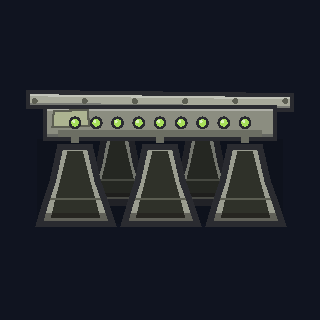
Nine Engines in three rows on one 8 m thrust structure, seen edge-on as three bells in front and two showing between them behind. Half a Giant Engine's thrust for five sixths of its mass and half its price, on the Engine's better Isp.
Figure
Value
MASS
5000 kg
COST
1700 cr
CONSUMES OXYGEN
81.54 u/s
CONSUMES METHANE
54.36 u/s
PRODUCES ELECTRICITY
0.18 u/s
THRUST
1935 – 2250 kN
ISP
290 – 338 s
QUOTED
SEA LEVEL – VACUUM
PROPELLANT
METHALOX
GIMBAL
±3°
DRAG NOSE-ON
1.0× (blunt)
MAX TEMP
2600 K
MAX G
28 g
IMPACT
14 m/s
BLAST
300 kN
NODES
2
STAGEABLE
YES
BELLS
9
It attaches under a Fuel Tank L, and takes a Separator L, a Separator or a Decoupler at its own base. Like the Quad Cluster it is one engine to the ship, with a flame under each of its five drawn bells.
Tap it, or its sheet, for Ignite or Shut down. Its properties sheet carries a Max power slider and an RCS control toggle, both usable in flight.
Pairs with a Fuel Tank L stretched to 24 m: the first stage of a wide-stack Mars ship. Instead of the Giant Engine when the stage is lighter and the burn matters more than the push.
Vacuum Engine L
Part · Engines · sold by Heavy Lift
The Vacuum Engine at 8 m: four times its thrust on the same Isp, for the stage above a wide first stage. Weak at the pad, and never meant to be there.
Figure
Value
MASS
2100 kg
COST
1700 cr
CONSUMES OXYGEN
17.47 u/s
CONSUMES METHANE
11.65 u/s
PRODUCES ELECTRICITY
0.08 u/s
THRUST
240 – 600 kN
ISP
168 – 420 s
QUOTED
SEA LEVEL – VACUUM
PROPELLANT
METHALOX
GIMBAL
±4°
DRAG NOSE-ON
1.0× (blunt)
MAX TEMP
2600 K
MAX G
25 g
IMPACT
12 m/s
BLAST
200 kN
NODES
2
STAGEABLE
YES
It attaches under a Fuel Tank L, and takes a Separator L, a Separator or a Decoupler at its own base.
Tap it, or its sheet, for Ignite or Shut down. Its properties sheet carries a Max power slider and an RCS control toggle, both usable in flight.
Pairs with a Fuel Tank L above it as the second stage of a wide stack, above the air. Instead of four Vacuum Engines under four narrow tanks, in one part.
Ion Engine
Part · Engines · sold by Ion Propulsion
An engine with no flame: it strips xenon of its electrons and fires the ions off a charged grid, a faint violet beam behind the ship. It gets about ten times as much speed out of each kilogram as any chemical engine, and pushes with barely anything, so a burn lasts minutes. It runs on electricity as much as on xenon, and in air it does next to nothing.
Figure
Value
MASS
250 kg
COST
1200 cr
CONSUMES XENON
0.05 u/s
CONSUMES ELECTRICITY
2 u/s
THRUST
0.05 – 2 kN
ISP
105 – 4200 s
QUOTED
SEA LEVEL – VACUUM
PROPELLANT
XENON
DRAG NOSE-ON
1.0× (blunt)
MAX TEMP
1800 K
MAX G
12 g
IMPACT
10 m/s
BLAST
8 kN
NODES
2
STAGEABLE
YES
It attaches under a tank, and takes a Separator or a Decoupler at its own base. Xenon reaches it from any xenon tank aboard, through every joint, with no fuel line.
Tap it, or its sheet, for Ignite or Shut down. Its properties sheet carries only a Max power slider, usable in flight: it has no RCS control toggle and no gimbal, so an ion ship turns on its reaction wheels or thrusters.
Heads up
With the batteries flat it stops, however full the xenon tank is, and the game says so once. At full thrust it empties a B-400 Battery Bank in 200 seconds, and an SP-6 Twin Array makes only 0.24 u/s in sunlight, so a continuous burn takes nine of them. Without that many, burn in pulses and let the arrays recharge the batteries between them, or turn Max power down.
Pairs with an XT-1 Xenon Tank, a Sat Controller and solar arrays, above the air: a probe on one base-length tank, with the nine SP-6 Twin Arrays it takes to burn in sunlight, weighs about 2.3 tonnes and gets close to 1,450 m/s, at under 0.9 m/s², over some 27 minutes. Instead of a Vacuum Engine when the Δv matters more than how fast you get it, and never on a stage that has to leave the ground.
Ion Engine L
Part · Engines · sold by Wide Ion Propulsion
The Ion Engine at 8 m: one wide grid with four times the thrust and four times the power bill, on the same Isp. Still a whisper of push, for a heavy ship with the arrays to feed it.
Figure
Value
MASS
940 kg
COST
4400 cr
CONSUMES XENON
0.19 u/s
CONSUMES ELECTRICITY
8 u/s
THRUST
0.2 – 8 kN
ISP
105 – 4200 s
QUOTED
SEA LEVEL – VACUUM
PROPELLANT
XENON
DRAG NOSE-ON
1.0× (blunt)
MAX TEMP
1800 K
MAX G
12 g
IMPACT
10 m/s
BLAST
24 kN
NODES
2
STAGEABLE
YES
It attaches under a wide tank, and takes a Separator L, a Separator or a Decoupler at its own base.
Tap it, or its sheet, for Ignite or Shut down. Its properties sheet carries only a Max power slider, usable in flight: it has no RCS control toggle and no gimbal, so an ion ship turns on its reaction wheels or thrusters.
Pairs with an XT-8 Xenon Tank, which it burns in about 55 minutes, and the power to match: a B-1600 Battery Bank runs it for 200 seconds, and a continuous burn takes a field of 34 SP-6 Twin Arrays. Instead of four Ion Engines under four narrow tanks, in one part.
WC-4 Warp Coil
Part · Engines · sold by Warp Theory
The first warp drive: a thirty-metre bubble, which is a probe and what a probe carries. Put it in the MIDDLE of a ship that has antimatter, a way to shed its heat, and a coast worth skipping — the wall destroys anything outside it. It makes no thrust and never will. It is sold on tier 4, a tier after the small mine that makes its fuel: every microgram it burns was mined.
Figure
Value
MASS
700 kg
COST
9000 cr
CONSUMES ELECTRICITY
0.02 u/s
DRAG NOSE-ON
0.9×
HEAT EXPOSURE
1.2×
MAX TEMP
1600 K
MAX G
12 g
IMPACT
12 m/s
BLAST
16 kN
EXPLODES
NO
NODES
4
BUBBLE
30 m across
WALL
350 K — a radiator must be hotter to shed into it
LONGEST SKIP
30 days
IGNITION
0.5 μg, ×1 in deep space to ×1.7 in low orbit
HOLDING
0.5 μg a day skipped
WASTE HEAT
4 kW
WINDINGS UP IN
30 s
BUYS
time, never speed: the ship arrives on the same orbit
It joins the 4 m stack top and bottom, and offers a rail along each side for radial parts. It is 3 m tall and the only warp drive on the narrow stack.
Its sheet carries a Skip slider, read in hours, a greyed line pricing the span you have set, and one button reading Warp and that span. The button opens the Warp sheet, where the jump is actually made. The slider is the same control in the hangar, so a span can be dialled in before launch. It cannot be staged.
Its 350 K wall is the coolest of the three, which is the one thing it is best at: it is the only bubble an RW-3 Water Radiator can shed into.
Pairs with an AR-4 Antimatter Reactor, RW-3 Water Radiators and two AM-4 Antimatter Containers on a probe: that is the ship that warps to Mars, about 94 μg for the leg. See The first warp. Instead of it, the WR-8 Warp Ring once a crewed ship with its vanes out needs more room than twelve metres.
WR-8 Warp Ring
Part · Engines · sold by Warp Rings
A forty-five-metre bubble: room for a crewed ship, its reactor, the vanes that reactor needs and a hold on the back — measured from the Ring itself, so it goes amidships. The working drive of the three, and the first whose wall is too hot for water pipes.
Figure
Value
MASS
3400 kg
COST
40000 cr
CONSUMES ELECTRICITY
0.08 u/s
DRAG NOSE-ON
0.9×
HEAT EXPOSURE
1.2×
BODY LIFT CL
0.2
MAX TEMP
1600 K
MAX G
10 g
IMPACT
12 m/s
BLAST
40 kN
EXPLODES
NO
NODES
4
BUBBLE
45 m across
WALL
600 K — a radiator must be hotter to shed into it
LONGEST SKIP
90 days
IGNITION
2 μg, ×1 in deep space to ×1.7 in low orbit
HOLDING
3 μg a day skipped
WASTE HEAT
18 kW
WINDINGS UP IN
60 s
BUYS
time, never speed: the ship arrives on the same orbit
It joins the 8 m stack top and bottom, and offers a rail along each side for radial parts. It is 4 m tall. There is no 4 m version.
Its Skip slider is read in days, and its greyed line prices the span. Everything else works as the Warp Coil's does. It cannot be staged.
Its thirty-day skip costs 317 μg, which is nearly two full containers, so in practice a Ring is flown on spans of a few days at a time.
Pairs with an AR-8 Antimatter Reactor and one RK-6 Potassium Radiator, which carries both their heat inside the bubble. Instead of it, the WC-4 Warp Coil on anything small enough, or the WL-8 Warp Lattice for a station.
WL-8 Warp Lattice
Part · Engines · sold by Warp Lattices
A bubble a hundred and seventeen metres across, wider than the tallest ship the third Launch Pad will ever release in one piece. It holds a station whole with room to spare, and its 800 K wall can only be shed into by sodium.
Figure
Value
MASS
9800 kg
COST
120000 cr
CONSUMES ELECTRICITY
0.25 u/s
DRAG NOSE-ON
0.9×
HEAT EXPOSURE
1.2×
BODY LIFT CL
0.2
MAX TEMP
1600 K
MAX G
8 g
IMPACT
10 m/s
BLAST
80 kN
EXPLODES
NO
NODES
4
BUBBLE
117 m across
WALL
800 K — a radiator must be hotter to shed into it
LONGEST SKIP
365 days
IGNITION
8 μg, ×1 in deep space to ×1.7 in low orbit
HOLDING
8 μg a day skipped
WASTE HEAT
52 kW
WINDINGS UP IN
120 s
BUYS
time, never speed: the ship arrives on the same orbit
It joins the 8 m stack top and bottom, and offers a rail along each side for radial parts. It is 6 m tall and 9.8 t empty, the heaviest part in this drawer. There is no 4 m version.
Its Skip slider is read in days, up to ninety of them. It cannot be staged.
It is dear to hold as well as to buy: 34.56 μg a day empties a full AM-8 Antimatter Container in 4.9 days. It is also the thirstiest of the three at rest, drawing 0.25 u/s just to keep its windings up, which is a little more than an SP-6 Twin Array where there is sun and two fifths of a reactor where there is not.
Pairs with an AR-8 Antimatter Reactor and an RS-8 Sodium Radiator, which is the only fin that sheds anything into its wall. Instead of it, the WR-8 Warp Ring on anything that fits in thirty metres, at half the mass and a third of the holding charge.