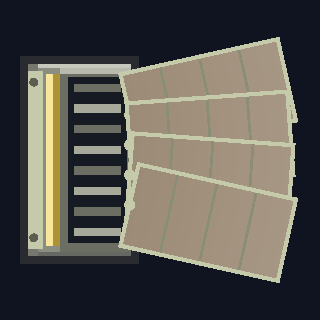
Every part in the Electrical category: the three panels that make charge, the four batteries that hold it, the small generator that trickles charge day and night, the reactor that makes power without the Sun, the three radiators that throw its heat away, and their figures from the info card.
Charge runs along every joint, so where you put these is a question of balance and airflow, never of wiring. Read Electricity for what makes and spends it, Reactors and heat for the plant and its fins, and Deploy a solar panel for getting a wing out.
A panel or a fin has two sets of tolerances, and the card shows both. Stowed is the folded housing riding the ascent; open is the wing out on its boom, which is far more fragile. One caught half out is half as strong.
SP-1 Solar Panel
Part · Electrical · sold by Solar Power
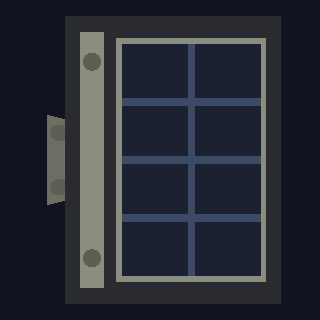
The first panel, and the cheapest way to keep a small probe alive past its battery. One wing of one cell, out of a housing barely wider than the antenna beside it.
Figure
Value
MASS
20 kg
COST
70 cr
PRODUCES ELECTRICITY
0.03 u/s
DRAG NOSE-ON
0.85×
HEAT EXPOSURE STOWED
0.42×
HEAT EXPOSURE OPEN
0.85×
MAX TEMP STOWED
2600 K
MAX TEMP OPEN
800 K
MAX G STOWED
20 g
MAX G OPEN
3 g
IMPACT STOWED
10 m/s
IMPACT OPEN
0.5 m/s
BLAST
2 kN
SOLAR PANEL DEPLOY
1.2 s
NODES
1
STAGEABLE
YES
ARRAY
1 wing × 1 panel
Its one attachment point is radial: it bolts to the flank of a tank or a hull, and the wing swings out of that flank. Mirror a second one across the ship to keep the drag even.
Its sheet offers Deploy while stowed and Stow once it is out, and the same action can be put in a stage. It has no editable settings.
Pairs with a PB-20 Battery on a small probe: the panel covers the sunlit half of an orbit and the battery covers the dark half. Instead of it, the SP-3 Solar Array makes three times as much for less than three times the mass.
SP-3 Solar Array
Part · Electrical · sold by Solar Arrays
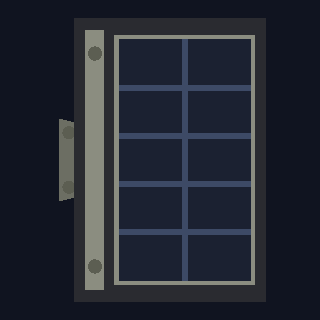
A three-cell concertina off one flank: the working panel for a satellite that has to run a dish as well as its own avionics.
Figure
Value
MASS
55 kg
COST
180 cr
PRODUCES ELECTRICITY
0.09 u/s
DRAG NOSE-ON
0.85×
HEAT EXPOSURE STOWED
0.42×
HEAT EXPOSURE OPEN
0.85×
MAX TEMP STOWED
2500 K
MAX TEMP OPEN
750 K
MAX G STOWED
18 g
MAX G OPEN
2.5 g
IMPACT STOWED
10 m/s
IMPACT OPEN
0.5 m/s
BLAST
3 kN
SOLAR PANEL DEPLOY
2.2 s
NODES
1
STAGEABLE
YES
ARRAY
1 wing × 3 panels
One radial point, like the SP-1. The wing that unfolds from it is three cells long, so leave room on that flank for it.
Its sheet offers Deploy and Stow, tapped or staged. It has no editable settings.
Pairs with a CD-2 Dish and a B-90 Battery, which is roughly what a relay satellite wants. Instead of it, the SP-6 Twin Array for something that draws more than this can cover.
SP-6 Twin Array
Part · Electrical · sold by Solar Arrays
The biggest panel: an inline bus that throws a wing out of each flank at once, for a station or a deep-space relay that has to run a big dish through long nights.
Figure
Value
MASS
160 kg
COST
420 cr
PRODUCES ELECTRICITY
0.24 u/s
DRAG NOSE-ON
0.9×
HEAT EXPOSURE STOWED
0.45×
HEAT EXPOSURE OPEN
0.9×
MAX TEMP STOWED
2400 K
MAX TEMP OPEN
700 K
MAX G STOWED
16 g
MAX G OPEN
2 g
IMPACT STOWED
10 m/s
IMPACT OPEN
0.5 m/s
BLAST
8 kN
SOLAR PANEL DEPLOY
3 s
NODES
2
STAGEABLE
YES
ARRAY
2 wings × 2 panels
It stacks inline, with a point at the top and one at the bottom, and both carry fuel and thruster propellant through: it can sit in the middle of a stack without cutting the plumbing. The two wings come out sideways, one each way, so it needs clear flanks rather than a clear end.
Its sheet offers Deploy and Stow, tapped or staged. Both wings move together. It has no editable settings.
Pairs with a B-400 Battery Bank and a CR-3 Deep Space Relay. Instead of it, two SP-3 Solar Arrays mirrored across a hull cost less and weigh less for less output.
PB-20 Battery
Part · Electrical · sold by Batteries
A small can that bolts on anywhere and adds 20 u to whatever the ship already holds. The cheapest fix for a probe that runs its command part's own reserve flat.
Figure
Value
MASS
30 kg
COST
60 cr
STORES ELECTRICITY
20 u
DRAG NOSE-ON
0.85×
HEAT EXPOSURE
0.85×
MAX TEMP
1200 K
MAX G
20 g
IMPACT
14 m/s
BLAST
2 kN · 0.5 m
NODES
1
One radial point: it bolts to the flank of anything. Its casing carries a two-cell charge gauge that fills upwards, so you can read the ship's charge off the part in flight.
It has no actions and no settings. A battery holds charge and does nothing else.
Pairs with an SP-1 Solar Panel on a small probe. Instead of it, the B-90 Battery holds four and a half times as much for less than four times the mass, if there is room in the stack for an inline part.
B-90 Battery
Part · Electrical · sold by Batteries
A flat inline tray that slots into a stack: the ordinary battery for a satellite that has to sit out an eclipse with a dish running.
Figure
Value
MASS
110 kg
COST
170 cr
STORES ELECTRICITY
90 u
DRAG NOSE-ON
0.8×
HEAT EXPOSURE
0.8×
MAX TEMP
1200 K
MAX G
16 g
IMPACT
14 m/s
BLAST
8 kN · 1 m
NODES
2
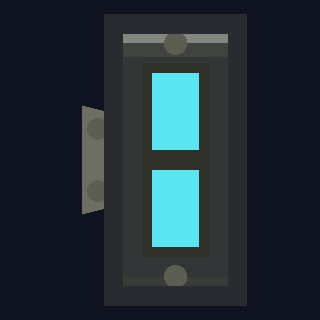
It stacks inline between two parts, top and bottom, and both points carry fuel and thruster propellant through, so it does not cut a stack's plumbing. Its face carries a four-cell gauge that fills left to right.
It has no actions and no settings.
Pairs with an SP-3 Solar Array. Instead of it, the PB-20 Battery when there is no room in the stack, or the B-400 Battery Bank when a night on the far side is longer than 90 u will cover.
B-400 Battery Bank
Part · Electrical · sold by Power Banks
The heavy bank: enough charge to run a deep-space relay through hours of dark, and enough mass that a small probe should not carry one.
Figure
Value
MASS
380 kg
COST
520 cr
STORES ELECTRICITY
400 u
DRAG NOSE-ON
0.8×
HEAT EXPOSURE
0.8×
MAX TEMP
1200 K
MAX G
14 g
IMPACT
14 m/s
BLAST
14 kN · 1.3 m
NODES
4
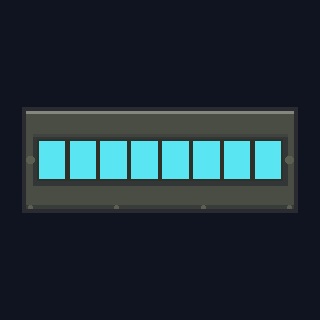
It stacks inline like the B-90, top and bottom, carrying fuel and thruster propellant through, and it is the same width as a tank. Unlike the B-90 it also offers a rail along each side for radial parts, so legs, thrusters and arrays can hang off the bank itself. Its face carries a six-cell gauge.
It has no actions and no settings.
Note
Its 400 u runs a CR-2 Relay Dish that is only listening for two hours and forty-six minutes, and one carrying its full twenty-five ships for twenty-eight. That is the figure a relay's orbit gets planned against.
Pairs with an SP-6 Twin Array on a relay meant to be left alone for weeks. Instead of it, the B-90 Battery on anything that comes home the same day.
B-1600 Battery Bank
Part · Electrical · sold by Wide Storage
The B-400 at 8 m across: four times the charge in one inline bank, for a wide stack or a station that has to ride out a long eclipse.
Figure
Value
MASS
1400 kg
COST
1900 cr
STORES ELECTRICITY
1600 u
DRAG NOSE-ON
0.8×
MAX TEMP
1200 K
MAX G
14 g
IMPACT
14 m/s
BLAST
40 kN · 2.2 m
NODES
4
It stacks inline like the B-400, top and bottom, carrying fuel and thruster propellant through, and it is the same width as a Fuel Tank L. Like the B-400 it also offers a rail along each side for radial parts, so a bank in the middle of a wide stack is somewhere to hang legs, thrusters and arrays rather than a dead length of hull. Its face carries an eight-cell gauge.
It has no actions and no settings.
Pairs with a Fuel Tank L or a Cargo Bay L in a wide stack. Instead of four B-400s: a little lighter per unit, and one part where four would be.
RTG-1 Radioisotope Generator
Part · Electrical · sold by Power Banks
A small sealed drum that makes charge all the time: by day, by night, in a world's shadow and far from the sun. It makes very little, but it never stops, so a probe built around it never goes dark.
Figure
Value
MASS
45 kg
COST
600 cr
PRODUCES ELECTRICITY
0.06 u/s
POWER
Makes charge day and night, in sunlight or shadow, with nothing to unfold and nothing to switch on
OUTPUT
Enough for a Sat Controller turning at full command and a whip antenna, never much more
DRAG NOSE-ON
0.85×
MAX TEMP
1800 K
MAX G
20 g
IMPACT
14 m/s
BLAST
2 kN
EXPLODES
NO
NODES
1
One radial point: it bolts to the flank of anything. It holds no charge of its own, so what it makes goes into the batteries and the command part's reserve; with nowhere to put it, the charge is lost.
It has no actions and no settings. It starts the moment the ship is built and never stops: there is no switch, and nothing to fold away before you meet air.
Pairs with a Sat Controller and a CW-1 Whip on a small probe that has to keep working through every night: 0.06 u/s covers the controller's wheels turning at full command, 0.05 u/s, and the whip's 0.004 u/s together. Instead of it, an SP-3 Solar Array makes half as much again in sunlight for less than a third of the price, but nothing in the dark.
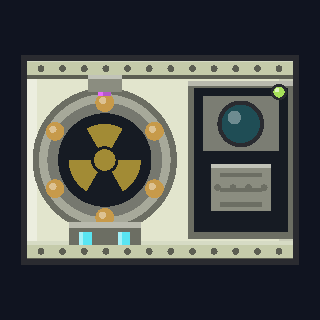
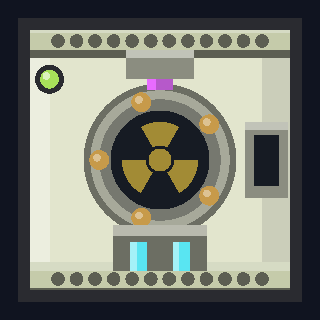
AR-8 Antimatter Reactor
Part · Electrical · sold by Crewed Reactors
A uranium core lit by a trickle of antiprotons: the only part that makes a crew's worth of power where there is no sunlight. It will not run without a nuclear scientist aboard, it carries a shielded seat for one, and what it makes is capped by the heat your radiators can shed.
Figure
Value
DRY MASS
4600 kg
FULL MASS
4620 kg
COST
22000 cr
STORES ELECTRICITY
20 u
STORES FOOD
20 u · 20 kg
STORES WASTE
20 u · launches empty
PRODUCES ELECTRICITY
0.6 u/s
CONSUMES ELECTRICITY
0.86 u/day
CONSUMES FOOD
1 u/day
DRAG NOSE-ON
0.9×
HEAT EXPOSURE
1.3×
BODY LIFT CL
0.2
MAX TEMP
1600 K
MAX G
12 g
IMPACT
12 m/s
BLAST
60 kN
EXPLODES
NO
ASTRONAUTS
1
NODES
4
MAKES
0.6 u/s at full output
BURNS
1 μg of antimatter every 12 h
NEEDS ABOARD
Nuclear Scientist
WASTE HEAT
60 kW
SHED IT
with radiators, or the core is held to what they carry
CORE
1100 K
COMES UP IN
180 s
SEAT POWER
1.73 u/day each
It joins the 8 m stack top and bottom, and offers a rail along each side for radial parts, so the fins it needs can hang on the reactor itself. It is 6 m tall. The 4 m version is the AR-4 below, which is a different machine rather than the same one shrunk. Its 0.6 u/s is two and a half SP-6 Twin Arrays in full sun, made whether there is a star in the sky or not, and one full AM-8 Antimatter Container runs it for 2,040 hours, which is eighty-five days.
It needs a nuclear scientist. No living Meek of that trade aboard and the core stays cold: no power at all. No other trade will do. Its own seat is reserved for a Nuclear Scientist, but the plant reads the whole ship, so one riding anywhere aboard runs it. That seat is a passenger seat: somebody has to be able to fly the ship, which means an astronaut in the pod or a probe core such as a Sat Controller.
Its heat is its ceiling. It makes 60 kW of waste heat against 40 kW of power. The game adds up what every part aboard makes and what every deployed fin can shed, and the reactor is held to the share the fins carry. It never overheats. See Reactors and heat.
Tapped in flight, its sheet has a Start up or Shut down button, a greyed line, and the cabin's own Transfer crew. The line reads the output and who is on watch, with — held to 50 % by heat added when the fins cannot carry the load; or Core coming up: 40 %, No nuclear scientist aboard, No antimatter, or No way to shed 60 kW: deploy a radiator. In the hangar the same switch is the Running toggle, off on a new reactor. It cannot be staged.
Pairs with an AM-8 Antimatter Container, an RK-6 Potassium Radiator and any of the three warp drives. Instead of it, a field of SP-6 Twin Arrays does the same job closer to the Sun for a fraction of the price, and nothing at all inside a warp bubble; or the AR-4 below, if the ship has nobody on it.
AR-4 Antimatter Reactor
Part · Electrical · sold by Antimatter Power
The probe's plant: the same core at a quarter of the size, sealed at the factory and run from the ground. It has no seat and asks for no crew at all, and it makes just enough to keep a WC-4 Warp Coil and the container that feeds it alive. It is the part that makes an unmanned warp probe possible.
Figure
Value
DRY MASS
1250 kg
COST
4500 cr
STORES ELECTRICITY
10 u
PRODUCES ELECTRICITY
0.12 u/s
MAKES
0.12 u/s at full output
BURNS
1 μg of antimatter every 32 h
RUNS
unattended - no crew, no seat
WASTE HEAT
12 kW
CORE
950 K
COMES UP IN
90 s
MAX TEMP
1600 K
MAX G
12 g
IMPACT
12 m/s
BLAST
30 kN
EXPLODES
NO
NODES
4
It joins the 4 m stack top and bottom and offers a rail along each side, so its radiator hangs on the reactor itself. It is 4 m square. The same tech node sells it and the AR-8, so you get both at once and pick per ship.
It needs nobody. There is no seat, no Transfer crew, and no trade to find — the one thing the AR-8 will not do. That is the whole of the difference, and what you pay for it is output: 0.12 u/s is a fifth of the AR-8's, half of one SP-6 Twin Array, and it burns a microgram every thirty-two hours rather than every twelve, so each unit of power costs nearly twice the antimatter.
It runs a Warp Coil and nothing above one. A Coil draws 0.02 u/s and a loaded AM-8 Antimatter Container about 0.05 u/s out where gravity is weak, which leaves a little for avionics and an antenna. A Warp Ring alone draws 0.08 u/s, and with its container that is more than this plant makes: the bigger bubbles are still the crewed ship's, on an AR-8.
Heads up
A loaded container costs more the deeper you are in a gravity well — in a low Earth orbit it alone draws about 0.24 u/s, twice what this plant makes. Carry a battery bank and a solar array for the climb out: near the Sun the panels cover it easily, and out past the gauge's floor the reactor covers everything on its own. It is the same reason a bubble costs more to light down here.
Its heat is its ceiling, like the AR-8's: 12 kW of waste heat against 8 kW of power. One RW-3 Water Radiator sheds that and a Warp Coil's 4 kW together under an open sky; inside the Coil's own 350 K wall one fin is a whisker short of the pair, so fly two if you want full output through a warp. See Reactors and heat.
Tapped in flight its sheet has Start up or Shut down and a greyed status line: the output, or Core coming up: 40 %, No antimatter, or No way to shed 12 kW: deploy a radiator. It never says it wants crew, because it never does. In the hangar the same switch is the Running toggle, off on a new reactor. It cannot be staged.
Pairs with a WC-4 Warp Coil, two AM-4 Antimatter Containers and one or two RW-3 Water Radiators: the probe that warps to Mars. Instead of it, an AR-8 if there are people aboard anyway, or solar arrays anywhere the Sun is still bright.
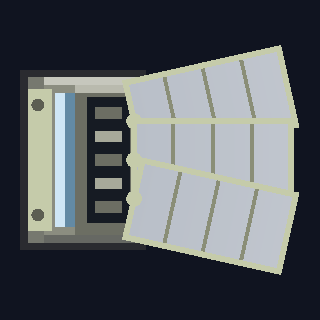
RW-3 Water Radiator
Part · Electrical · sold by Heat Rejection
The first radiator: a stack of three vanes on a water heat pipe that folds out of a housing on any flank. Water runs cool, so it sheds least of the three and sheds nothing at all inside any bubble hotter than a Warp Coil's.
Figure
Value
MASS
110 kg
COST
900 cr
DRAG NOSE-ON
0.85×
HEAT EXPOSURE STOWED
0.43×
HEAT EXPOSURE OPEN
0.85×
MAX TEMP STOWED
2000 K
MAX TEMP OPEN
1400 K
MAX G STOWED
18 g
MAX G OPEN
2 g
IMPACT STOWED
10 m/s
IMPACT OPEN
0.5 m/s
BLAST
3 kN
RADIATOR DEPLOY
3 s
NODES
1
STAGEABLE
YES
VANE AREA
12 m²
WORKING FLUID
Water at 450 K
SHEDS
23.72 kW under an open sky
IN A 350 K BUBBLE
15.04 kW
IN A 600 K BUBBLE
nothing: the wall is hotter
IN A 800 K BUBBLE
nothing: the wall is hotter
Its one attachment point is radial: it bolts to the flank of a tank or a hull, and the vanes fan out of that flank. Mirror a pair across the ship to keep the drag even. There is only one size of every radiator.
Its sheet offers Deploy while stowed and Stow once it is out, and the same action can be put in a stage. It has no editable settings. Its vanes glow orange as they carry heat, hottest at the root of each vane, which is how a working fin reads from outside.
Three of these carry an AR-8 Antimatter Reactor under an open sky, and five carry a reactor and a WC-4 Warp Coil inside the Coil's bubble. Pairs with a reactor on a probe or a small station that never goes past a Warp Coil. Instead of it, the RK-6 Potassium Radiator, which sheds nearly twelve times as much and works under a Warp Ring as well.
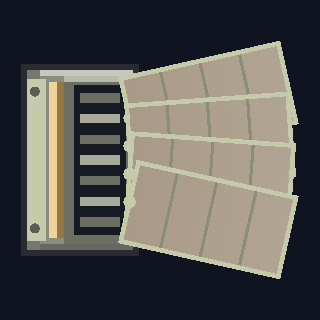
RK-6 Potassium Radiator
Part · Electrical · sold by High-Temperature Radiators
Four vanes on a potassium heat pipe at 700 K. Because rejection climbs as the fourth power of the fluid's temperature, it sheds nearly twelve times what the water fin does on twice the vane area, and it is the first fin that works inside a Warp Ring.
Figure
Value
MASS
240 kg
COST
3400 cr
DRAG NOSE-ON
0.85×
HEAT EXPOSURE STOWED
0.43×
HEAT EXPOSURE OPEN
0.85×
MAX TEMP STOWED
2400 K
MAX TEMP OPEN
2000 K
MAX G STOWED
16 g
MAX G OPEN
2 g
IMPACT STOWED
10 m/s
IMPACT OPEN
0.5 m/s
BLAST
4 kN
RADIATOR DEPLOY
3 s
NODES
1
STAGEABLE
YES
VANE AREA
24 m²
WORKING FLUID
Potassium at 700 K
SHEDS
277.74 kW under an open sky
IN A 350 K BUBBLE
260.38 kW
IN A 600 K BUBBLE
127.82 kW
IN A 800 K BUBBLE
nothing: the wall is hotter
One radial point, like the water fin, and the same Deploy and Stow, tapped or staged. No editable settings.
One of these carries a reactor and a Warp Ring with room to spare. It is the working fin for a crewed ship: the one to fit unless you are going as far as a Warp Lattice. Pairs with an AR-8 Antimatter Reactor and a WR-8 Warp Ring. Instead of it, the RW-3 on a probe that will never leave a Warp Coil, or the RS-8 Sodium Radiator once a Lattice is on the ship.
RS-8 Sodium Radiator
Part · Electrical · sold by High-Temperature Radiators
Sodium heat pipes at 900 K: the only fin that sheds anything at all into the 800 K wall of a Warp Lattice, and the best of the three under every other sky too.
Figure
Value
MASS
340 kg
COST
7200 cr
DRAG NOSE-ON
0.85×
HEAT EXPOSURE STOWED
0.43×
HEAT EXPOSURE OPEN
0.85×
MAX TEMP STOWED
2800 K
MAX TEMP OPEN
2600 K
MAX G STOWED
14 g
MAX G OPEN
2 g
IMPACT STOWED
10 m/s
IMPACT OPEN
0.5 m/s
BLAST
5 kN
RADIATOR DEPLOY
3 s
NODES
1
STAGEABLE
YES
VANE AREA
24 m²
WORKING FLUID
Sodium at 900 K
SHEDS
758.95 kW under an open sky
IN A 350 K BUBBLE
741.59 kW
IN A 600 K BUBBLE
609.03 kW
IN A 800 K BUBBLE
285.14 kW
One radial point, the same Deploy and Stow, no editable settings. Its plumbing runs hottest of the three, so it is also the most delicate on the way up: 14 g stowed against the water fin's 18 g.
One of these carries a reactor and a Warp Lattice with room to spare. Pairs with a WL-8 Warp Lattice, which nothing else can cool. Instead of it, the RK-6 Potassium Radiator at half the mass and half the price on any ship that stops at a Warp Ring.