Electricity
Charge is what keeps a ship awake: the wheels that turn it, the antennas that carry your commands to it, and the instruments that make it worth flying. It is the only resource a ship can make more of, and the only one that weighs nothing.
What makes power
Three things aboard a ship produce charge.
Solar panels are the ones you build for it. There are three, and each is a folded stack of cells that swings out of its housing when you deploy it. The figure on a panel's info card is what it makes with the sun full on it.
| Panel | Makes | Sold by |
|---|---|---|
| SP-1 Solar Panel | 0.03 u/s | Solar Power |
| SP-3 Solar Array | 0.09 u/s | Solar Arrays |
| SP-6 Twin Array | 0.24 u/s | Solar Arrays |
The RTG-1 Radioisotope Generator is the one that never stops. It makes 0.06 u/s day and night, in sunlight or shadow, with nothing to unfold: little, but enough to keep a Sat Controller turning and a whip antenna talking through every night. Sold by Power Banks. See the RTG-1.
A running engine makes charge as a side effect, from 0.01 u/s on the Lander Engine to 0.06 u/s on the Heavy Engine. That covers an ascent and nothing after it: the moment the engine shuts down, so does the supply. Anything meant to sit in orbit for a while needs a panel or an RTG.
What holds it
Charge lives in batteries, and in the small reserve every command part carries built in. A battery does nothing else: it holds units and hands them out.
| Part | Holds | Sold by |
|---|---|---|
| B-400 Battery Bank | 400 u | Power Banks |
| B-90 Battery | 90 u | Batteries |
| PB-20 Battery | 20 u | Batteries |
| Crew Capsule L | 30 u | Wide Capsules |
| Crew Capsule | 15 u | Crew Capsules |
| Command Pod | 10 u | Rocketry |
| Passenger Cabin | 10 u | Passenger Cabins |
| Sat Controller | 5 u | Probe Control |
A battery in flight wears its own gauge: a lit slot on its casing that empties as the charge goes, amber under a quarter and red under a tenth. You can read a satellite's state off the ship itself without opening anything.
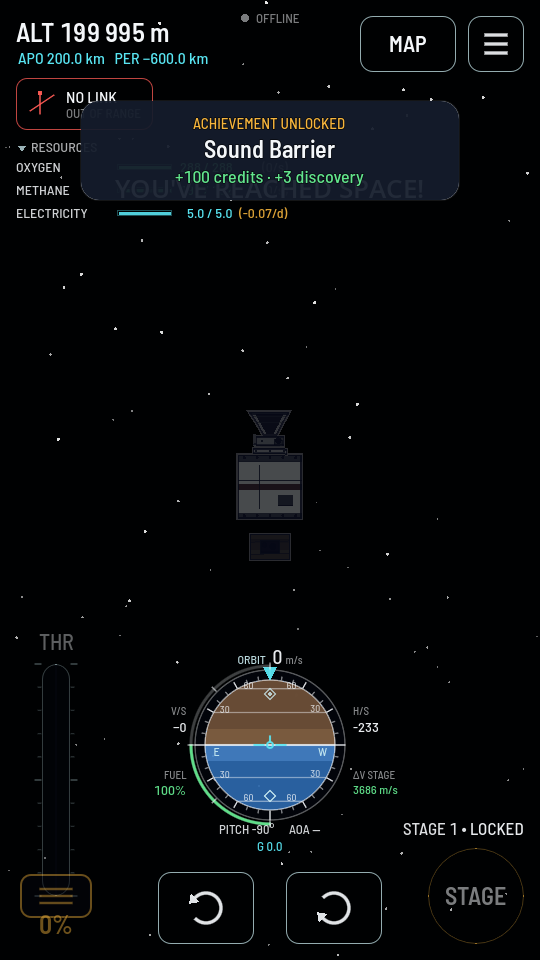
The flight readout at the top left carries an ELECTRICITY row: the level, then the load as current over maximum, then in brackets which way it is going. A row reading 5.0 / 5.0 with (-0.07/d) beside it is a full ship spending charge rather than making it. The header folds the whole list away to a strip of level pips if you want the corner back.
What spends it
Almost nothing spends charge quickly, and that is the trap: a ship parked in orbit drains for days while you are not watching. The one exception is an ion engine, which runs on power as much as on xenon.
| What draws | How much | When |
|---|---|---|
| Command Pod | 0.86 u/day | All the time |
| Crew Capsule | 1.3 u/day | All the time |
| Crew Capsule L | 1.73 u/day | All the time |
| Passenger Cabin | 0.86 u/day | All the time |
| Sat Controller | 0.43 u/day | All the time |
| Each passenger in a cabin | 1.73 u/day | While the seat is filled |
| Command Pod's wheels | 0.02 u/s | Only while you turn |
| Crew Capsule's wheels | 0.03 u/s | Only while you turn |
| Crew Capsule L's wheels | 0.03 u/s | Only while you turn |
| Sat Controller's wheels | 0.05 u/s | Only while you turn |
| Thermometer | 0.2 u | Once per reading |
| Barometer | 0.3 u | Once per reading |
| Mass Spectrometer | 0.8 u | Once per reading |
| Antennas | 345.6 u/day to 0.1 u/s | While switched on and out |
| SL-1 Signal Light | 432 u/day | While on, by its Brightness, blinking or not |
| FL-30 Floodlight | 0.06 u/s | While on, by its Brightness |
| Ion Engine | 2 u/s | While it fires, scaled by the throttle |
| Ion Engine L | 8 u/s | While it fires, scaled by the throttle |
The antennas are the heavy draw, and they are the reason a probe needs a panel rather than a bigger battery. The smallest of them, the CW-1 Whip, spends a PB-20 Battery's whole 20 u in 83 minutes on its own. See Parts: Comms for what each one takes.
An ion engine is the other heavy draw, and a much bigger one: the small one empties a B-400 in 200 seconds of full thrust, and takes more than eight of the biggest solar arrays to run in sunlight. When the charge runs out it simply stops, however much xenon is left. See the Ion Engine.
A lamp is the draw you choose: nothing while it is off, its figure while it is on, and the whole of it while it blinks, because a blinking lamp is a lamp that is on. A floodlight left burning on a parked lander runs its battery flat while you are away. See Night, lamps and shadows.
Two things save you charge you were not spending on purpose. An antenna that is switched off draws nothing, and a dish still folded in its housing draws nothing either. A panel works the same way in reverse: while it is stowed it makes nothing at all.
It reaches every part
Charge runs along every joint on the ship, whatever the joint was built to carry. Fuel is fussy about which attachment points it passes through; electricity is not. A battery bolted to the flank of a booster feeds an instrument at the nose, a pod's reserve pays for a reading taken by a sensor three parts away, and a panel anywhere charges everything.
That means you never have to plan the wiring. Put the battery where the ship balances and the panel where it will not be in the way. See the Electricity entry for the resource itself.
Sunlight, and the dark side
A panel's output follows how much sun actually reaches the ship. In full sunlight it makes its rated figure. Behind a world, in that world's shadow, it makes nothing, and it climbs back as the ship comes round into the light. Every world but the sun casts a shadow, and it is the shadow the ship is really in that counts, not the one you would guess from the map.
Which way a panel faces never matters. A wing pointing at the ground charges exactly as fast as one pointing at the sun. You do not aim panels in this game; you only get them out of their housings and into the light.
This keeps running while you are away. A ship you left in orbit goes on charging on its sunlit half and draining in eclipse on the shared world's clock, so you can come back to a satellite that has been quietly running down for a week. Size the battery for the dark half of the orbit and the panel for the lit half.
A ship standing on a world does the same, whether you have left it or are flying it: its panels charge by day and its loads drain it by night. Only a ship on the launch pad before its launch spends nothing. The heaviest loads that live this way are a Mining Rig on the Moon and an Antimatter Container in orbit, whose power must never run short: see Helium-3 and antimatter.
The hangar checks your sums
A ship that spends more charge than it makes can only ever run down, and you will not find that out in orbit — you will find it out days later, when the satellite you built has gone quiet and nothing on any screen says why. So the hangar adds it up for you while the ship is still on the canvas.
The readout along the top of the hangar carries a Power figure: what the ship gains or loses every second standing still, with the sun full on it and nothing burning. A positive figure is a ship that pays for itself. A negative one is a ship living off its batteries.
When that negative figure would empty the ship's own batteries inside a day, the readout says Power short in amber, behind a warning triangle, under the mass. Tap the readout and the breakdown card spells out both the figure and the warning.
Two things the figure is deliberately generous about, so it never cries wolf: panels count at their full-sun rating whether or not they are deployed, and engines count for nothing at all. An engine's alternator only turns while it burns, so it can never be the thing that keeps a coasting satellite alive — if your power budget balances only because an engine is in the sum, it does not balance.
Clearing the warning means more panel or less load. Remember that the figure is a full sun figure and a low orbit spends part of every lap in shadow, so a ship that only just breaks even in the hangar still runs down over a day. Give it margin.
Running flat
A flat ship is not lost. It is deaf and stiff.
The reaction wheels stop first: with no charge to turn them they make no torque, so the ship will not answer the turn buttons however hard you hold them. An in-line RW-100 or RW-500 is usually what flattened the ship in the first place: turning flat out it draws more than any panel makes, so hard turns come out of the batteries and the panels refill them between. Instruments refuse to read, because a reading is paid for all at once and a ship that cannot cover it takes no measurement and files nothing. Nobody aboard comes to any harm. Charge back up and everything works again.