Science readings
An instrument aboard your rocket measures the air it is flying through, and the measurement is worth money. Where you take it is the whole game: a reading only pays while it is a measurement nobody has filed before.
What an instrument measures
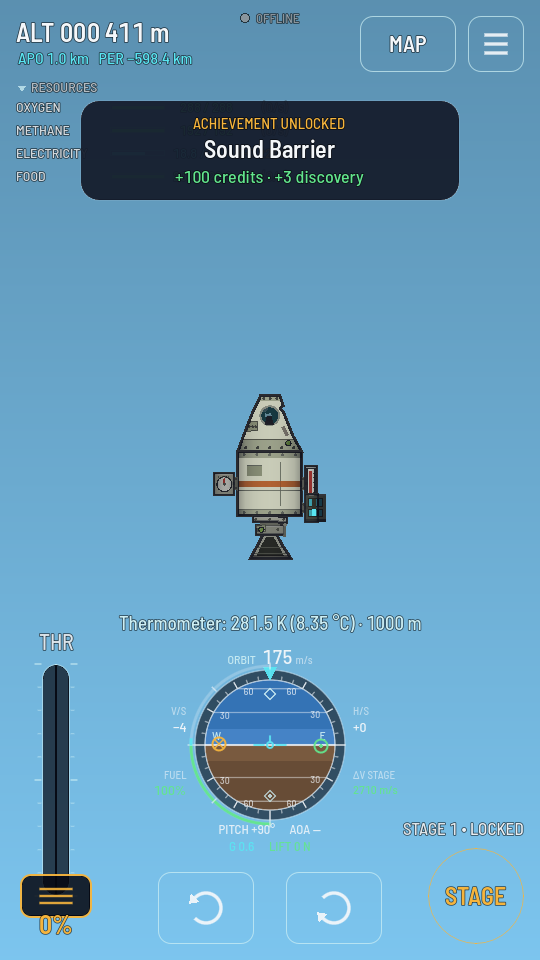
There are three instruments, and each reads one thing. The Thermometer reads the temperature of the air around it, in kelvin, with the same figure in degrees Celsius beside it. The Barometer reads the pressure of the air, in kilopascals. The Mass Spectrometer reads what the air is made of. All three are small parts that bolt to the flank of a stack. They are sold one behind the other on the tech tree: the Thermometer by Instruments, the Barometer by Barometry, the Mass Spectrometer by Spectrometry.
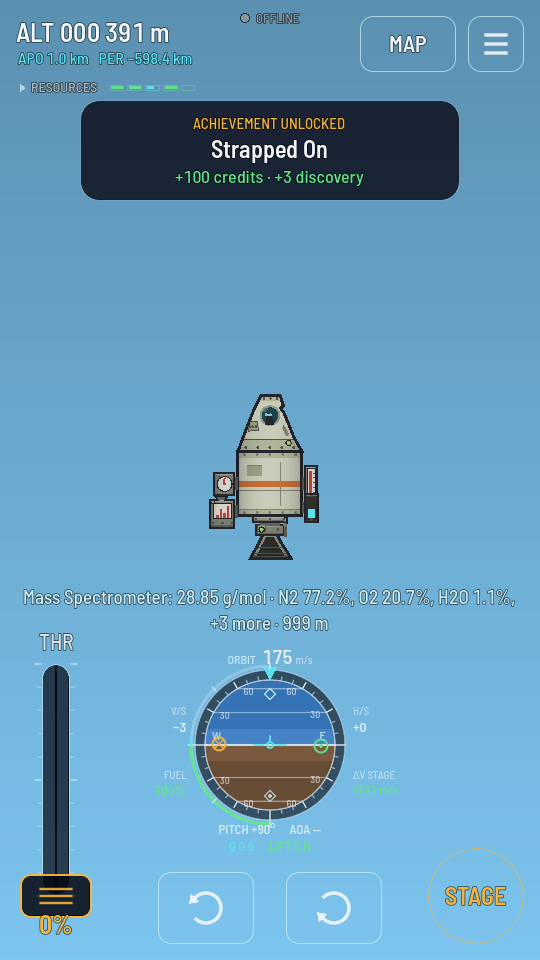
The Mass Spectrometer's figure is the mean molar mass of the mixture, in grams per mole: how heavy an average molecule of that sky is. Earth's nitrogen and oxygen come to 29 g/mol. Mars' carbon dioxide is half again as heavy at 43 g/mol, and a giant's hydrogen is the lightest sky there is. Beside the figure it names the three biggest gases with their shares and counts how many more it found. The mix changes with height, so the same world reads differently at every level you sample it at, which is the whole reason to carry it up instead of reading once on the pad.
Above the air there is nothing to read, and each instrument says so in its own way. The Barometer reports 0 kPa and marks the reading as vacuum. The Mass Spectrometer reports 0 g/mol and says there was nothing to sample. Both of those are measurements, and both survey the place they were taken in. The Thermometer has no air to measure, so it reports how hot its own skin has become instead, which after a hard ascent or a re-entry is a very different number from the air it left behind.
Every reading costs charge
An instrument runs on electricity. Each reading draws a fixed amount from whatever batteries the ship carries: 0.2 u for the Thermometer, 0.3 u for the Barometer, 0.8 u for the Mass Spectrometer. Electricity runs along every joint, so any battery or pod aboard can pay for it. A ship that means to sample a climb level by level needs the battery to match: a full PB-20 Battery buys twenty-five spectrometer readings and a hundred thermometer ones.
The charge is all or nothing. If the ship cannot cover it, no measurement happens at all, and the instrument says no power instead of a figure. Nothing is filed and nothing is paid. Charge is the only thing an instrument ever spends, so it is good for as many readings as the batteries can buy.
It cannot take them all at once, though. After a reading an instrument needs ten seconds before the next one: tap it sooner and it says ready in and how many seconds are left, and it spends nothing. A reading on the launch pad counts like any other for the place it was taken, but only readings taken after launch count toward the achievements for many readings on one flight.
Tapped, or staged
You take a reading two ways, and they do the same thing. Tap the instrument in flight and its sheet offers Take reading. Or put the instrument in a stage in the hangar, and it reads the moment that stage fires, which is how you get a measurement at an exact point in an ascent without taking a thumb off the controls.
Take a reading walks through both.
Where you read it is what you are paid for
A measurement is worth something because of where it was taken, so every reading is filed under a place — and the first time you read a place, you are paid for it. That is the survey, and it is the steady way to earn discovery once the achievements have run out.
A place is a world, a band of altitude, and — on the ground — the biome you are standing in:
| Band | Where you are |
|---|---|
| On the ground | at rest on the surface, in whichever biome you came down in |
| Low in the air | inside the atmosphere, below halfway up it |
| High in the air | inside the atmosphere, above halfway |
| Low space | clear of the air, below half a radius above the datum |
| High space | higher still |
The biome counts only on the ground. Once you are flying, the whole world is one place per band — a thermometer at 300 km is not reading the desert underneath it. A world with no atmosphere has no air bands at all: leave the ground and you are in low space.
Each instrument surveys a place separately, so a Barometer earns at a place your Thermometer has already read, and a Mass Spectrometer earns there again after both. Three instruments are three ledgers over the same list of places. Read the same place twice with the same instrument and the second reading pays nothing; it is still filed in your log.
Once you are flying a Science Lab, the same list of places does a second job: every reading at a place the lab has not analysed hands it samples to work through, which is how a laboratory somewhere far away keeps earning long after the first readings were paid for.
What a place pays climbs steeply with how far from home it is. A place on Earth pays 1 discovery and 20 credits; the same place on the Moon pays double; on Mars, three or four times; on a moon of the outer giants, seven or eight. Earth, the Moon and Mars hold 33 places between them. Reading all of them with all three instruments is 99 first readings and 219 discovery — three tech nodes, for flying somewhere you were going anyway.
When a reading is the first at its place, the game says so: a NEW PLACE SURVEYED banner naming the world and the place, and what it paid. The Readings sheet counts how many places you have surveyed.
What a reading achievement pays
On top of the survey there are achievements: sixteen of them are triggered by a measurement, and each one describes a measurement worth having. Some ask only for a kind of reading, like the first one you ever take. Most ask for a reading somewhere specific: the pressure between 10 and 12 km over Earth, the temperature low over the Moon, air at 217 K or colder inside Earth's atmosphere, the mix of Earth's air above 50 km.
An achievement pays once, ever, exactly as a place does. So the second temperature reading at a thousand metres pays nothing, and neither does the hundredth. The way to earn more is to go somewhere you have not measured yet, or to measure something you have not measured there. That is why a Barometer and a Mass Spectrometer are worth carrying on a flight that already has a Thermometer, and why a Moon lander is worth an instrument even when it is heavy.
The rewards climb with the distance. A first reading pays 100 credits and 3 discovery. Reading the pressure inside Mars' atmosphere pays 3,000 credits and 60 discovery. Two of the sixteen ask for volume rather than distance: ten readings from one instrument in a single flight, and twenty-five. See Achievements for how a reward reaches your account.
A scientist aboard pays you more
The Meek come in trades, and one of them is the scientist. With a scientist strapped into a seat on the ship, every reading achievement pays more credits and more discovery: 10 % more for each point of their science. It does not touch the survey — a place is worth the same whoever is riding along. A scientist with science 6 makes a reading pay 60 % more, and one at the ceiling of 10 doubles it.
Only the scientist trade pays it. An astronaut with a high science stat earns you nothing extra, and neither does a botanist. The bonus is on show wherever the scientist is: on their card at the Astronaut Center, on the seat picker in the hangar, on the line the instrument prints when it reads, and on the toast when the reward lands. Their science grows every time you file a reading with them aboard and bring them home. See The Meek.
Your log
Every reading is written to a log of your own. The log holds what was measured, the place it was taken at, how high, whether there was air, which ship took it, and when. It is kept under your account, so it is the same log on any phone you play on, and it survives the flight that made it however that flight ended.
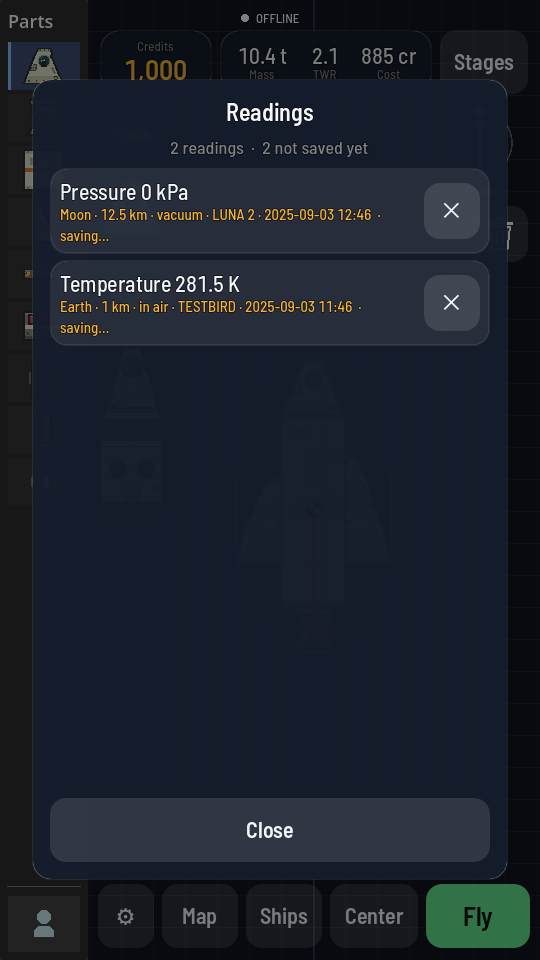
Readings taken while the game could not reach the shared world are kept on the phone and marked saving… until they get through. The log is yours to prune: each row has a delete button, and a reading you throw away is gone from every phone. Deleting it does not take back an achievement it already paid for.