Everything a ship carries and spends: the eleven resources, what holds each one, what drinks it, and how far it can travel through a stack.
A resource is counted in units, written u on a part's info card and in the flight readout. Every unit but electricity has a weight, so a full tank is heavier than an empty one and your ship gets lighter as it burns. Rates are per second where they are large enough to see, and per day where they are a trickle.
How far a resource travels through a ship is fixed per resource, and it is what decides where a tank has to sit. Electricity, food and waste run along every joint, so any battery or larder aboard feeds any part that needs one, and a crew's waste finds room anywhere on the ship. Fuel travels only through the joints that carry it: a tank's, an engine's, a decoupler's or separator's, a fairing's, a docking port's, and those on the parts that stack inline like the bigger batteries. It does not pass through a pod, a cabin, a beam or a solid booster; a fuel line is how it crosses one. Thruster propellant, xenon, helium-3 and antimatter run along every joint, the way electricity and food do. Ablator never moves: a heat shield burns its own and cannot borrow another's.
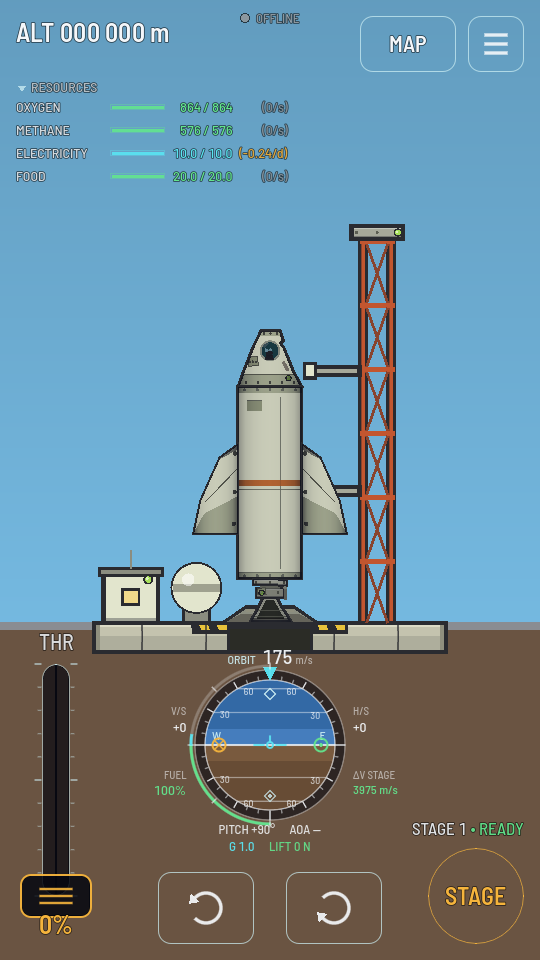
The readout at the top left: one line per resource the stage you are flying can reach, its level, and in brackets which way it is going.
Oxygen
Resource · propellant
Half of what a throttled engine burns. A Fuel Tank holds half as much again of it as of methane, because that is the ratio the engines drink the two in.
Figure
Value
WEIGHT
5 kg per unit
TRAVELS
Joints that carry fuel, and fuel lines; not a pod's, a cabin's or a beam's
STORED BY
Fuel Tank · 288 u at its base length · Cargo Bay · up to 118.8 u at its base length, if you load it
An engine reaches only the tanks its own stage can be plumbed to, which is why the flight readout's fuel rows change as you drop stages. A fuel line changes both which tanks an engine reaches and which of them empties first: see Draw a fuel line. Two ships joined at a docking port become one ship, and then their tanks are one supply.
Methane
Resource · propellant
The other half of what a throttled engine burns. It runs out at the same moment the oxygen does, because the tank holds the two in the ratio the engines drink them.
Figure
Value
WEIGHT
5 kg per unit
TRAVELS
Joints that carry fuel, and fuel lines; not a pod's, a cabin's or a beam's
STORED BY
Fuel Tank · 192 u at its base length · Cargo Bay · up to 118.8 u at its base length, if you load it
Both halves live in the same Fuel Tank, so there is nothing to balance when you build: lengthen the tank and both go up together.
Solid fuel
Resource · propellant
The cast grain inside a solid booster. It is the heaviest resource in the game per unit, and the only one that is sealed into the part that burns it.
Figure
Value
WEIGHT
12 kg per unit
TRAVELS
Nowhere: it stays in its own case
STORED BY
Solid Booster · 144 u at its base length · Solid Booster S · 72 u at its base length · Cargo Bay · up to 36 u at its base length, if you load it
DRAWN BY
Solid Booster 2.4 u/s · Solid Booster S 1.2 u/s
MADE BY
Nothing
REFILLED IN FLIGHT
No
HIGHEST PRICE
Not for sale between players
No joint on a booster carries fuel, so a booster can neither be topped up from a tank nor feed one, and each case burns only its own grain — two boosters on one rocket run down two separate clocks. It lights once, burns at the rate it was cast at, and is dead weight after that. It shows on the flight readout as SOLID FUEL while a booster that still has some is in the stage you are flying. How long a case lasts is set in the hangar: see Solid boosters.
Hypergolic
Resource · propellant
The propellant a thruster block vents and an Escape Motor burns. It ignites on contact with no spark and no pump, which is why the parts that use it are small and instant.
Figure
Value
WEIGHT
8 kg per unit
TRAVELS
Every joint on the ship
STORED BY
HT-2 Hypergolic Tank · 40 u at its base length · HR-4 Hypergolic Pod · 40 u · HR-1 Hypergolic Sphere · 12 u · Cargo Bay · up to 36 u at its base length, if you load it
DRAWN BY
RCS Thruster Block 0.02 u/s per nozzle firing · Escape Motor 5.43 u/s
MADE BY
Nothing
REFILLED IN FLIGHT
Only by docking
HIGHEST PRICE
50 cr a unit, when another player buys or sells it
It runs along every joint on the ship, like electricity, so a hypergolic tank anywhere aboard feeds every thruster block and Escape Motor, across a pod, a beam or a booster alike, with no fuel line. It never mixes with the tank fuel: an engine that burns oxygen and methane is untouched by the hypergolic aboard, and a thruster block cannot drink from a Fuel Tank.
Heads up
A block with no hypergolic left fires nothing, silently. Its keys on the flight pad go dead rather than pushing weakly.
Xenon
Resource · propellant
The propellant an Ion Engine throws. The engine strips the gas of electrons and fires the ions off a charged grid, so a few grams a second go a very long way, as long as there is power to charge the grid.
Figure
Value
WEIGHT
1 kg per unit
TRAVELS
Every joint on the ship
STORED BY
XT-1 Xenon Tank · 80 u at its base length · XT-8 Xenon Tank · 640 u at its base length · Cargo Bay · up to 108 u at its base length, if you load it
DRAWN BY
Ion Engine 0.05 u/s · Ion Engine L 0.19 u/s
MADE BY
Nothing
REFILLED IN FLIGHT
Only by docking
HIGHEST PRICE
75 cr a unit, when another player buys or sells it
It runs along every joint on the ship, like hypergolic and electricity, so a xenon tank anywhere aboard feeds every ion engine with no fuel line, across a probe core, a pod or a beam. It never mixes with anything else: only an ion engine burns it, and an ion engine burns nothing else.
Heads up
An ion engine also draws electricity while it fires. With the batteries flat it stops, however much xenon is left, and says so once.
Electricity
Resource · power
What keeps a pod alive, a wheel turning, an antenna talking and an instrument reading. It is the only resource that weighs nothing and the only one a ship can make more of.
Figure
Value
WEIGHT
None
TRAVELS
Every joint on the ship
STORED BY
B-400 Battery Bank · 400 u · B-90 Battery · 90 u · Crew Capsule L · 30 u · PB-20 Battery · 20 u · Crew Capsule · 15 u · Command Pod · 10 u · Passenger Cabin · 10 u · Sat Controller · 5 u · Cargo Bay · up to 72 u at its base length, if you load it
DRAWN BY
Pods and cabins idling, reaction wheels while turning, every antenna, and each instrument reading
MADE BY
SP-6 Twin Array 0.24 u/s · SP-3 Solar Array 0.09 u/s · SP-1 Solar Panel 0.03 u/s · RTG-1 Radioisotope Generator 0.06 u/s, day and night · any running engine
REFILLED IN FLIGHT
Yes
HIGHEST PRICE
2.5 cr a unit, when another player buys or sells it
A panel's figure is what it makes in full sunlight. Its output follows the light: it falls to nothing in a world's shadow, and a stowed panel makes nothing at all. Which way it faces never matters.
Running engines charge the ship as a side effect, from 0.01 u/s on the Lander Engine up to 0.06 u/s on the Heavy Engine. That covers an ascent and nothing beyond it, so anything meant to sit in orbit needs a panel or a big battery.
A flat ship is not lost, only stiff and blind: the reaction wheels make no torque and the instruments refuse to read. The radio keeps talking, and nobody aboard dies of it.
Food
Resource · life support
The crew's rations. Only a seat with somebody in it eats, and an unmanned ship eats nothing at all.
Figure
Value
WEIGHT
1 kg per unit
TRAVELS
Every joint on the ship
STORED BY
Cargo Bay · up to 360 u at its base length, more as you stretch it · Crew Capsule L · 60 u · Crew Capsule · 40 u · Passenger Cabin · 40 u · Greenhouse L · 40 u · Command Pod · 20 u · Greenhouse · 10 u
DRAWN BY
Each filled seat: Crew Capsule L 2 u/day · Crew Capsule 2 u/day · Command Pod 1 u/day · Passenger Cabin 1 u/day · Greenhouse 1 u/day
MADE BY
Greenhouse · 5 to 10 u a day · Greenhouse L · 20 to 40 u a day, by the botanists aboard the ship; each harvest composts as much waste as it makes food
REFILLED IN FLIGHT
By a greenhouse aboard
HIGHEST PRICE
50 cr a unit, when another player buys or sells it
Food runs along every joint like electricity, so a Passenger Cabin eats out of the pod's larder as readily as its own. That is what makes a long mission possible: add another pod or cabin and the whole ship gets its rations.
A pod's own larder is days, not months — 20 u is about twenty days for the one Meek in it. For anything longer, bolt on a Cargo Bay and load it with food: at its base length it holds 360 u, which feeds one Meek for roughly a year, and stretching it holds proportionally more.
A Greenhouse grows it back: every crop takes 5 u of waste and gives 5 u of food — 8 or 10 u with a second and third botanist aboard — as long as at least one botanist is aboard the ship and its grow lights never lose power. See Grow food in orbit.
Nothing eaten disappears. Every unit of food a crew eats leaves one unit of waste behind, and the two weigh the same, so a ship does not get lighter as its crew eats.
Careful
A crew with no food left to reach dies. Count the days a mission will take against what the ship carries before you launch it.
Waste
Resource · life support
What the crew leaves behind. Every unit of food eaten becomes a unit of waste, and it has to go somewhere.
Figure
Value
WEIGHT
1 kg per unit
TRAVELS
Every joint on the ship
STORED BY
Crew Capsule L · 60 u · Crew Capsule · 40 u · Passenger Cabin · 40 u · Greenhouse L · 40 u · Command Pod · 20 u · Greenhouse · 10 u · Cargo Bay · up to 360 u at its base length, if you load it
MADE BY
Eating: one unit for every unit of food a filled seat eats
DRAWN BY
A greenhouse's harvest: 5, 8 or 10 u a crop, by the botanists aboard the ship
REFILLED IN FLIGHT
It fills up on its own
HIGHEST PRICE
12.5 cr a unit, when another player buys or sells it
A waste store is room, not a load. Every one launches empty, so it adds nothing to the ship's mass on the pad, and it fills as the crew eats. Each pod and cabin keeps exactly as much room for waste as it keeps food, so a crew living off its own larder never runs out of room.
Waste runs along every joint, like food: it goes into whichever store aboard has room. Once every store is full, what the crew leaves behind goes overboard. Nobody is harmed by it, and the crew goes on eating. A long mission that carries extra food in a Cargo Bay should give the bay some room for waste too, or the ship ends the trip venting.
The flight readout's waste line works the other way round from the rest: it turns amber at three quarters full and red at nine tenths, because a waste store is in trouble full, not empty.
Ablation
Resource · heat shield
The layer of char a Heat Shield boils away to carry a re-entry's heat off the ship. It is spent, not cooled, and there is no making more.
Figure
Value
WEIGHT
1 kg per unit
TRAVELS
Nowhere: a shield burns only its own
STORED BY
Heat Shield L · 960 u · Heat Shield · 240 u · Cargo Bay · up to 180 u at its base length, if you load it (a shield still burns only its own)
DRAWN BY
The heat shield itself, 1 unit for every 80 MJ of heat it carries off
MADE BY
Nothing
REFILLED IN FLIGHT
No
HIGHEST PRICE
Not for sale between players
Nothing is spent while the disc is cool, and the hotter it gets the faster the layer goes. While any is left the shield shrugs off heat no other part survives. Once the last unit is gone it is a blunt plate that cooks like everything else, so a second re-entry on a spent shield is a lost ship.
Data
Resource · gathered
Raw measurements, waiting to be worked through. A store of it launches empty and it is never bought: the only source is an instrument taking a reading somewhere the ship's laboratory has not analysed before.
Figure
Value
WEIGHT
None — it is information
TRAVELS
Every joint on the ship
STORED BY
SL-8 Science Lab · 240 u
DRAWN BY
SL-8 Science Lab · 40 u a day with a full bench
MADE BY
Any instrument · 24 u per place the lab has not analysed
REFILLED IN FLIGHT
By taking a reading somewhere new; or from a docked ship
HIGHEST PRICE
Not for sale between players
No cargo hold carries it — it takes no room. A reading taken where the lab's store is already full files nothing and the place is not marked as analysed, so the same reading still pays once there is room. See The Science Lab.
Discovery (aboard a lab)
Resource · made
Findings a laboratory has worked out and not yet sent home. It is the same discovery you spend on the tech tree, but it is not yours until you take the ship’s controls and transmit it: while it is aboard the ship it is a load like any other, and a ship that is destroyed takes it with it.
Figure
Value
WEIGHT
None — it is information
TRAVELS
Every joint on the ship
STORED BY
SL-8 Science Lab · 120 u
MADE BY
SL-8 Science Lab · 8 to 67 a day, by where it stands
SENT HOME
By the pilot, on the lab’s Transmit button, while the space centre can hear the ship
A rare gas baked out of the Moon's dark plains, and the only thing antimatter is made from. It is never bought or loaded: every store of it launches empty, and the only source is a Mining Rig working a deposit you have found.
Figure
Value
WEIGHT
1 kg per unit
TRAVELS
Every joint on the ship
STORED BY
H3-4 Helium-3 Tank · 15 u at its base length · H3-8 Helium-3 Tank · 60 u at its base length · Cargo Bay · up to 1.2 u of room at its base length · Cargo Bay L · up to 9.8 u of room at its base length
DRAWN BY
AC-4 Antimatter Converter · 6.99 u a day at full work · AC-8 Antimatter Converter · 20.98 u a day at full work
MADE BY
MR-4 Mining Rig · 3 u a day at grade ×1 · MR-8 Mining Rig · 8 u a day at grade ×1 · both times the deposit's grade
REFILLED IN FLIGHT
By a rig aboard, landed on a deposit; or from a docked ship
HIGHEST PRICE
3750 cr a unit, when another player buys or sells it
It runs along every joint on the ship, so a rig fills any helium-3 tank aboard with no fuel line, across a pod, a beam or a docking port. Between two ships docked in orbit you pump it by hand: see Transfer resources between stores. It cannot be bought or sold, and recovering a full tank on Earth pays for the tank alone. See Helium-3 and antimatter.
Antimatter
Resource · converted
What an Antimatter Converter makes out of helium-3, tens of micrograms a day. It can be kept in one part, in one kind of place: an Antimatter Container, powered, in space.
Figure
Value
WEIGHT
None
COUNTED IN
1 unit is 1 microgram (μg)
TRAVELS
Every joint on the ship
STORED BY
AM-4 Antimatter Container · 50 u · AM-8 Antimatter Container · 170 u · both launch empty · no cargo hold takes it
DRAWN BY
AR-4 Antimatter Reactor · 1 u every 32 h · AR-8 Antimatter Reactor · 1 u every 12 h · a warp drive by the day skipped · a container short of power leaks, up to 0.01 u a second from an AM-4 and 0.02 u from an AM-8
MADE BY
AC-4 Antimatter Converter · 16 u a day from 6.99 u of helium-3 · AC-8 Antimatter Converter · 48 u a day from 20.98 u of helium-3 · only in space
REFILLED IN FLIGHT
By a converter aboard; or from a docked ship
HIGHEST PRICE
2000 cr a unit, when another player buys or sells it
It runs along every joint, so a converter fills every container aboard, and a leak or a vent is taken from all of them together. It can be neither bought nor sold: a container launches empty, and every microgram is made by a converter from mined helium-3. Between two ships docked in orbit you pump it by hand, like any load: see Transfer resources between stores. Reactors burn it by the microgram and warp drives spend it by the day skipped.
Careful
A container holds only in space. Bring a loaded one into an atmosphere or onto the ground and it explodes a minute later unless you vent it. See Keep antimatter safe.