Air, heat and speed
Air slows a rocket on the way up and burns it on the way back down. Shape decides how much of each: a pointed nose and folded fins lose less to drag, and whatever meets the air first is what takes the heat.
Drag
Every part shoves air out of its way, and a part shaped for it pays far less for that than a blunt one at the same speed. A nose cone capping the top of a stack shadows everything behind it from the airflow at almost no drag cost of its own, so it earns its place on a stack even though it does nothing else. Fins and wings further down trade a little of that shadow for the lift and the turning bite they give you, and a wing pays for every bit of lift in drag: the harder it is pulled, the more it drags, and broadside it is a barn door. Two rockets with the same engine climb at different rates once one of them is capped and the other is not.
Why an engine pushes harder in vacuum
An engine's bell pushes against the air behind it, so the same flow of propellant makes less thrust low down in thick air than it does once the ship has climbed past it. Every engine's card quotes both ends: the Engine makes 215 kN at sea level and 250 kN in vacuum. How far a kilogram of propellant pushes the ship is its Isp, which for the same engine rises from 290 s to 338 s across that same climb. A bell built wide for vacuum work loses more of that than a narrow sea-level one does, which is why a vacuum engine can lag badly at the pad and still out-run everything else once the air is gone. Engines has every engine's range.
An engine that needs the air
The PR-9 Propeller Nose turns that rule upside down. It pushes by swinging a propeller through the air and burns its methane with oxygen it takes from the air, so it is at its strongest at sea level, weakens as the air thins, and makes nothing at all in space. On Mars it makes nothing either: there is air there, but no oxygen in it. Earth's is the only air on the charts a propeller runs in, which is why an aeroplane flies on Earth and nowhere else. Its pull also falls as the aeroplane speeds up, which gives every aeroplane a top speed. Aeroplanes has the whole of it.
The sound barrier
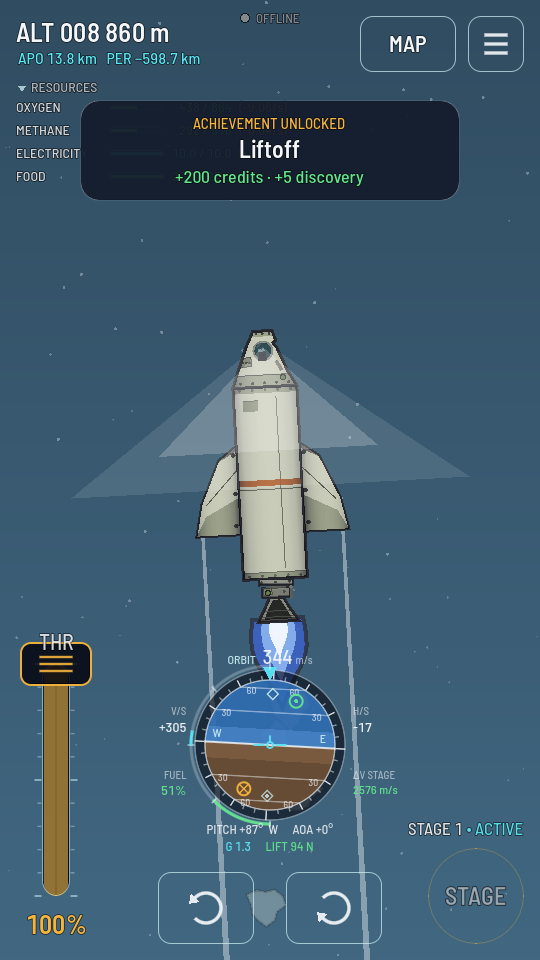
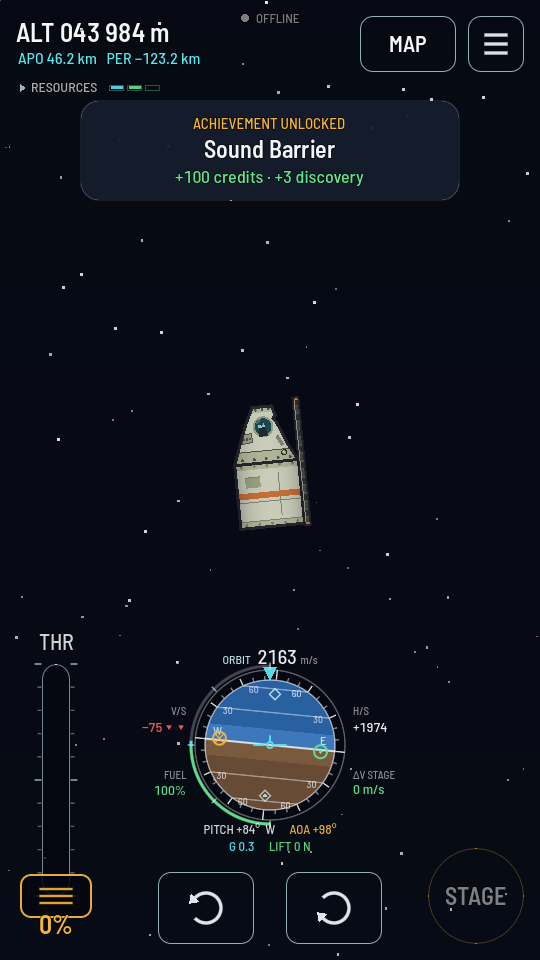
Crossing the speed of sound costs more than the speeds on either side of it. The air ahead can no longer get out of the way in advance. It piles up instead into a cone that trails the ship, a faint shockwave visible in the sky, while the climb briefly fights hardest against the throttle before it breaks through.
Skin heating
Air moving fast enough against a part heats its skin, and every part has its own limit past which it comes apart. The info card's MAX TEMP row is that limit: a Wing tolerates 610 K, and because its whole leading edge takes the air it reaches that at only about 230 m/s near the ground, a little faster higher up, while a plain fuel tank tolerates 1300 K nose-first. A wing is for flying in the air, never for the climb to space or the fall back from it. As a part nears its limit it glows first, then trails plasma and sparks the hotter it runs, so the ship is warning you before anything actually fails. A bare tank flown fast and low, with nothing ahead of it to shadow its nose from the airflow, can overheat and come apart long before it reaches orbit.
The warning before a part breaks
A part breaks in flight two ways: its skin heats past its MAX TEMP, or the ship is pulled harder than its MAX G, in a turn, a pull-up or a fast spin. The flight screen watches every part for both. Once one is 60 % of the way to its limit, a chip comes on in the left column. It names the part and says HEAT or LOAD, with how far along it is: 0 % is the outside air's temperature, or no load at all, and 100 % is where the part breaks. It is amber at first. From 85 % it turns red and pulses, an alarm sounds, time warp drops to real time, and a message names the part as overheating or overloaded. Ease off, by slowing down, climbing into thinner air or pulling less hard, and the chip goes away again, 3 s after the part was last over 60 %. The red likewise stays 3 s after the last reading over 85 %, so a peak that lasts a moment is still there to read, along with the part it hit. A landing's jolt is not counted: touching down is judged on each part's impact speed instead.
A jet meets the same rule from the other side. The SW-1 Supersonic Wing's sharp leading edge takes only a fifth of the heat a round one does, on a skin rated to 900 K, so it holds up past twice the speed of sound high up. What gives out first at Mach 2 is the fuselage: flown at the small angle a wing needs, its long side meets the air beyond the nose's shadow and heats up, and held there it burns. See Aeroplanes: jets.

The heat shield
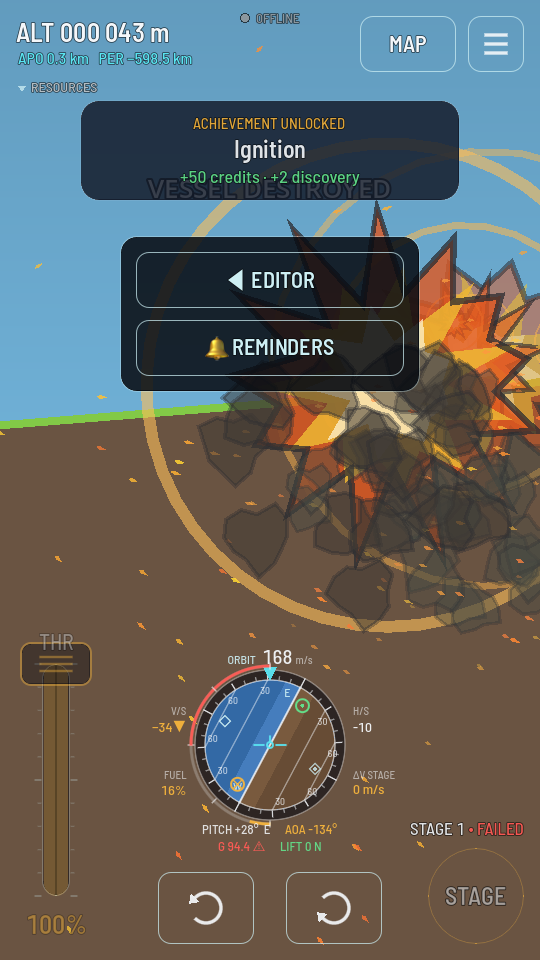
The Heat Shield survives what nothing else can, and it does not resist heat so much as spend itself against it. Flown facing down into the airflow, its dish shadows whatever rides behind it and boils away its own Ablation to carry the heat off, which is what buys it a limit of 3600 K that would destroy almost any other part. How fast it goes is how much heat the dish is taking: every unit carries off 80 MJ, and the heat grows with the thickness of the air and with the cube of your speed, so twice as fast wears the shield eight times as quickly. A steep, fast plunge eats it in a minute or two, a shallow entry that bleeds its speed off high up spends a fraction of it, and the moment the heating stops, so does the burning. Turned edge-on or away from the airflow the dish carries nothing off, and protects nothing either. Once the Ablation is gone the dish is a bare plate, worse than flat, and it heats like anything else on the ship from then on. It buys you one hard re-entry, not an unlimited number of them.
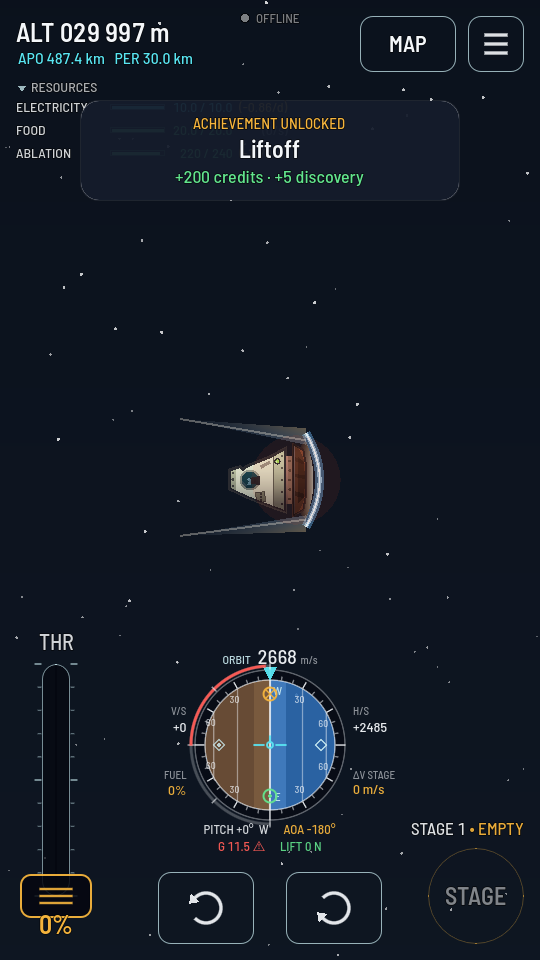
A capsule falling base-first can be steered a little. Tip its top a few degrees off the airflow and the air pushing on the base nudges the whole ship sideways, toward the side the top leans. The Command Pod, the Crew Capsule and the Heat Shield all do this, and with a shield fitted the shield is the part doing it. The push is small, around a seventh of the drag at 10° and a quarter of it at 20°. That is enough to shift a landing, but nowhere near enough to glide. The shield tries to swing itself back into the wind, so the capsule’s own torque has to hold the tilt, and it swings back as soon as you let go.
Heat tiles, and coming back with the tank
The shield protects one capsule, once. Heat Tiles are the other bargain: a thin strip of ceramic bolted down a ship’s flank that spends nothing at all. The tiled face takes about a tenth of the heating a bare hull would, and — this is the whole of it — anything the strip lies over is in its shadow and feels no heating at all. Tile the side of a fuel tank, fall with that side into the wind, and the tank comes down cold enough to land and be recovered with the rest of the ship. Nothing is used up, so the same strip flies again.
The price is attitude. A rocket left to itself turns to fly end-first, which puts the tiles edge-on and the bare hull into the wind, so the strip carries its own answer: Hold into wind on its part sheet turns the tiled side to the airstream and holds it there, and the longer the strip the harder it holds. It is off until you ask for it — on during a climb it would fight you — and it can be put in a stage, so the attitude for an entry is something you set up before you launch.
Tiles are for the heat an entry from orbit makes. They are rated to 1900 K where the shield’s dish is rated to 3600 K, so the disc is still what a capsule wears home from somewhere faster and further — and a strip only shields what it actually lies over, so a pod above the tank is still on its own.
What a fairing or payload bay shelters
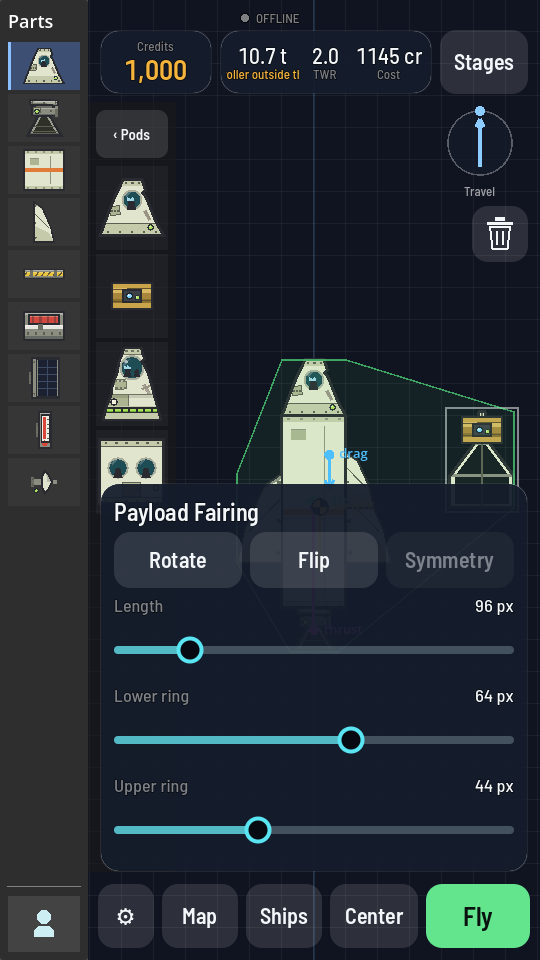
A Payload Fairing is a shell you shape from rings in the hangar, and only a payload standing entirely inside its narrowest ring counts as sheltered from the airflow. One that clears the base but pokes out through the nose is a breach: the hangar names the offending part on the mass line the moment it happens, and a breached shell breaks apart at launch instead of protecting a hole in itself. A Payload Bay is more forgiving: its doors simply stay open around whatever rides inside it, so nothing there can breach it.
Every part's own drag, heating and thrust figures are in Engines and Aero parts.