Every part in the Aero category: what it does to the airflow around your ship, and its figures from the info card.
Aero parts shape how your rocket meets the air: a fin steers you in it, a wing lifts on it, a cone or a shield turns it aside. Read Air, heat and speed for why drag, heat and lift behave the way they do, and Building a rocket for how any part joins the stack.
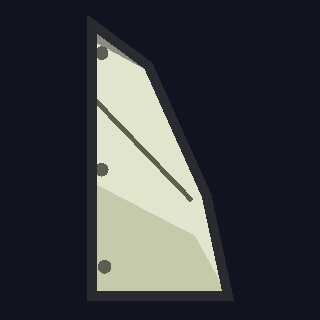
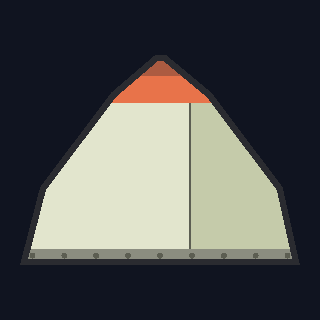
Fin
Part · Aero · sold by Rocketry
A control surface: it deflects with your turn input and steers you in the air, with more authority than a reaction wheel once you are moving fast. Bolt two or more around a stack, near its base, for a stable ride.
Figure
Value
MASS
80 kg
COST
15 cr
DRAG NOSE-ON
0.55×
HEAT EXPOSURE
0.55×
MAX TEMP
2000 K
MAX G
20 g
IMPACT
12 m/s
STRIKE
5 m/s
BLAST
8 kN
NODES
1
CONTROL AREA
1.2 m²
DEFLECTION
±18°
SURFACE CL
1.6
It bolts to the flank of a tank or booster with one radial point. Mirror a pair, or four around the stack, so the steering it gives is even on every side.
Its Size slider, in the hangar only, scales the whole fin from half size up to two and a half times. Control area and mass both follow the square of it, so a fin at double size commands four times the air and weighs four times as much; the CONTROL AREA row on its card is the figure for the size you have set, not the one above.
Where you bolt it matters twice. A fin turns the ship by its distance from the centre of mass, so the same fin at the tail of a long stack turns it far harder than one beside the pod. It also has to be in clean air: a fin tucked in right behind something wider than itself is in that part's wake and steers with only the share of it that stands clear. Put a few metres between them and the air has closed up again, which is why fins belong at the bottom of the rocket.
It has no in-flight actions of its own.
Pairs with any pod for steering low in the air. Instead of a fin, put a Wing where you want lift as well as control.
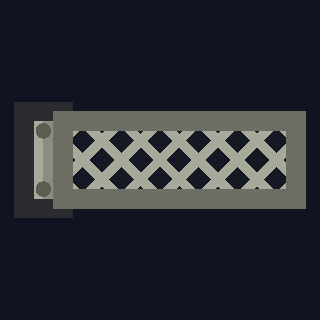
GF-1 Grid Fin
Part · Aero · sold by Booster Recovery
A lattice fin for bringing a booster back. It rides up folded flat against the hull and swings out on the way down, where it holds the booster engines-first and steers it with your turn input.
Figure
Value
MASS
180 kg
COST
45 cr
DRAG NOSE-ON
1.0× (blunt)
FOLDED
no drag, no heat
HEAT EXPOSURE OPEN
0.6×
MAX TEMP
2000 K
MAX G
20 g
IMPACT STOWED
12 m/s
IMPACT OPEN
8 m/s
STRIKE
5 m/s
BLAST
6 kN
GRID FIN DEPLOY
1.5 s
NODES
1
CONTROL AREA
1.5 m²
DEFLECTION
±20°
SURFACE CL
1.2
It bolts to the flank of a tank with one radial point. Put a mirrored pair near the TOP of the booster: a booster falls engines-first, so the top is its tail on the way down, and that is where a fin keeps it pointed and turns it. The card shows the maximum temperature and g load twice, folded and open; for this fin the two are the same.
Folded, it is not in the air at all. It adds no drag, takes no heat and steers nothing, so a set rides to space and back for the cost of its mass. It comes out of the hangar folded unless you switch Deployed on in its sheet.
Open, it meets the air like any part. It has drag and heating of its own, and both follow the angle the air meets it at: its whole span faces air coming along the booster, only its thin edge air coming from the side. Its lattice is mostly holes, so it never shelters the parts behind it; they meet the air as if it were not there.
Its Size slider, in the hangar only, scales it from half size up to two and a half times, so the same fin suits a small booster and a wide one. Control area and mass both follow the square of it.
In flight, tap it and choose Deploy or Stow, or give it a stage of its own. It swings out in a second and a half, so open it before the air gets thick.
Pairs with the landing struts that set the booster down. Instead of a Fin, when the part that needs steering comes back engines-first.
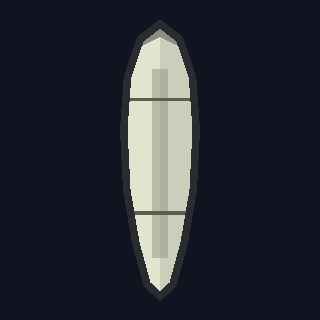
Wing
Part · Aero · sold by Wings
An airfoil seen edge-on: it lies flat over a tank, span toward you, and lifts on that curve. Trim the nose a few degrees up and it carries the ship's weight, which is what turns a rocket flown on its side into an aeroplane.
Figure
Value
MASS
360 kg
COST
150 cr
DRAG NOSE-ON
0.3×
MAX TEMP
610 K
MAX G
20 g
IMPACT
12 m/s
BLAST
8 kN
NODES
1
STAGEABLE
YES
WING AREA
4.8 m²
MAX LIFT CL
1.2
STALL
22°
FLAPS
1.5× lift, 3× drag
ELEVON
±30°, trim held
BEST L/D
5.27
Its root is a stud, not a rail: drop it anywhere on a tank's face and it joins right where you let go, lying over the tank rather than beside it.
Note
A wing takes the air on its whole leading edge, so it heats far faster than a nose cone or a tank. Past about 230 m/s near the ground it reaches its 610 K limit and is lost; higher up it lasts a little faster, but a climb to space or a fall back from one burns it off within seconds. Wings are for flying in the air; a rocket bound for space leaves them at home.
Tap the wing, or its part sheet in flight, for Extend flaps or Retract flaps. Flaps raise its lift and its drag together for a slower approach. Pull pitch in the air to wind the elevon trim, or use Centre elevon to zero it: the ship holds whatever angle you last set, hands-off. The properties sheet carries a Size slider (hangar only), a Flaps toggle and an Elevon trim slider, both usable in flight too, and flaps can also be staged as Flaps out / Flaps in.
Lift is never free. The harder a wing is pulled, the more it drags: twice the angle costs nearly three times the drag, and pulled to the stall it drags more than half as much as it lifts. BEST L/D is the most lift it can give for each unit of its own drag, reached flying only a couple of degrees nose-up. Turned broadside to the airflow it lifts nothing, and its whole surface meets the air like a barn door, so a wing flown sideways or tumbling is a brake, not a free ride.
A pair at Size 1 cannot hold a fully fuelled starter rocket level at low speed: it stalls at about 106 m/s, so a full rocket stays up on them only fast, nose-high and under power. With its fuel gone the same rocket glides on them down to about 68 m/s. A heavier ship needs bigger or more wings.
Pairs with its own elevon and flaps for a glide you can land on a runway. Instead of a fin when you want lift, not just steering. For an aeroplane built from the ground up, the PW-1 Aircraft Wing in the Planes tab is sized by span and chord and flies with a tail.
Aerocone
Part · Aero · sold by Aerodynamics
A shaped nose cone: it caps a stack for less drag going up and less heat coming down, and shields whatever rides directly behind it from the airflow.
Figure
Value
MASS
120 kg
COST
25 cr
DRAG NOSE-ON
0.12×
HEAT EXPOSURE
0.12×
BODY LIFT CL
0.3
MAX TEMP
2600 K
MAX G
35 g
IMPACT
18 m/s
BLAST
10 kN
NODES
1
Its one attachment point is on its base, so it caps whatever sits at the top of a stack: a tank, a pod, or a payload bay.
Its Size slider, in the hangar only, scales it from half size up to one and a half times, to match the stack it caps. It has no in-flight actions.
Pairs with the tank or pod it caps. Instead of the Slim Aerocone when the stack underneath is wider.
Slim Aerocone
Part · Aero · sold by Solid Boosters
A narrower nose cone for a narrower stack: the same job as the Aerocone, lighter and cheaper, sized for a booster rather than a full tank.
Figure
Value
MASS
70 kg
COST
20 cr
DRAG NOSE-ON
0.08×
HEAT EXPOSURE
0.08×
BODY LIFT CL
0.3
MAX TEMP
2600 K
MAX G
35 g
IMPACT
18 m/s
BLAST
8 kN
NODES
1
Its one attachment point is on its base, capping whatever sits at the top of the stack it tops, usually a Solid Booster.
Its Size slider, in the hangar only, scales it from half size up to one and a half times. It has no in-flight actions.
Pairs with a Solid Booster it tops. Instead of the Aerocone on a wider stack.
Heat Tiles
Part · Aero · sold by Reusable Heat Tiles
A thin strip of silica tiles bolted down a ship’s flank. It spends nothing and carries nothing off: flown broad side into the airstream it simply stands between the air and whatever it lies over, and it is still there when you land. It is how a fuel tank comes home.
Figure
Value
DRY MASS
96 kg
COST
190 cr
LENGTH
32–256 px (2–16 m)
MAX TEMP
1900 K
MAX G
20 g
IMPACT
14 m/s
BLAST
4 kN
NODES
1
SHIELD
Tiles take a tenth of the heating a bare hull would, and shadow whatever they lie over
FACING
Broad side into the wind only: edge-on the strip is a bare plate like any other
HOLDING
Hold into wind turns the tiles to the airstream — switch it on before the air, never on the way up
REUSE
Nothing is spent: a strip that came home flies again
The mass and the price above are for the shortest strip and grow with the Length slider, so tiling a whole tank costs about four times a short patch. Its one attachment point is on its inner edge, and it slides anywhere down a flank like a fin or a landing leg; mirror it and the twin on the far side faces outward too.
In flight its sheet has one action, Hold into wind, which turns the tiled side of the ship into the airstream and keeps it there; tapping it again releases it. Both halves can be put in a stage, so an entry attitude is something you set up on the pad rather than remember at 60 km.
Careful
A strip only shields what it lies over, and only while the tiles face the wind. Left edge-on it is dead weight, and a stack with nothing holding it turns to fly end-first within seconds — which is why the hold exists, and why leaving it on during a climb would fight you.
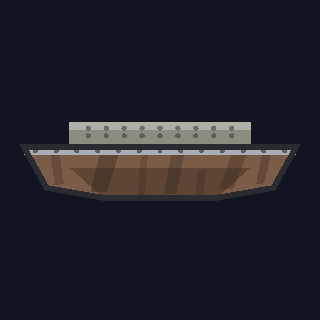
Heat Shield
Part · Aero · sold by Thermal Protection
An ablative disc for the base of a capsule: it burns away to carry re-entry heat off, riding out heat that cooks any other part. Fly the vessel base-first, dish into the wind, and it holds itself there while ablator remains.
Figure
Value
DRY MASS
140 kg
FULL MASS
380 kg
COST
220 cr
STORES ABLATION
240 u · 240 kg
DRAG NOSE-ON
1.0× (blunt)
HEAT EXPOSURE
1.35×
BODY LIFT CL
0.1
BASE-FIRST LIFT CL
0.16
MAX TEMP
3600 K
MAX G
20 g
IMPACT
28 m/s
BLAST
20 kN
ABLATION HEAT
80 MJ/u
ABLATOR HEAT CD
0.22
NODES
2
SHIELD
Ablator boils away in step with the heat it carries off; spent, the disc cooks
MOUNTING
Bolts under the capsule, stacked above the service section
FACING
Works base-first only: the dish must meet the air
TRIM
The dish turns itself into the wind and holds the vessel there
Each unit of Ablation carries off 80 MJ of heat, so the shield wears in step with how hard the air is heating it: a fast, low, steep entry spends it quickly, a slower or higher one far more slowly (Air, heat and speed).
It stacks between a capsule and whatever sits below it: a top node takes the capsule, a bottom node takes the service section it rides on.
Careful
Once the ablator burns out, the same disc is a blunt plate again, worse than flat, and heats like any other part. Watch Check ablator on the way down.
Tap it in flight for Check ablator, which reports the percentage of char left. It has no properties to set.
Pairs with a Parachute for the descent after re-entry. Instead of flying home with no protection, which cooks the capsule.
Heat Shield L
Part · Aero · sold by Wide Capsules
The Heat Shield for the 8 m stack: the same ablative dish twice as wide, with four times the ablator, for a wide capsule coming home. Fly it base-first like the small one.
Figure
Value
DRY MASS
560 kg
FULL MASS
1520 kg
COST
800 cr
STORES ABLATION
960 u · 960 kg
DRAG NOSE-ON
1.0× (blunt)
HEAT EXPOSURE
1.35×
BODY LIFT CL
0.1
BASE-FIRST LIFT CL
0.16
MAX TEMP
3600 K
MAX G
20 g
IMPACT
28 m/s
BLAST
60 kN
ABLATION HEAT
80 MJ/u
ABLATOR HEAT CD
0.22
NODES
2
SHIELD
Ablator boils away in step with the heat it carries off; spent, the disc cooks
MOUNTING
Bolts under a wide capsule, stacked above the service section
FACING
Works base-first only: the dish must meet the air
TRIM
The dish turns itself into the wind and holds the vessel there
Its ablator per square metre is the small shield's, so it wears at the same rate for the same entry; a wide ship simply has four times the dish to spend (Air, heat and speed). The dish also pulls harder into the wind, enough to hold a heavy wide ship base-first.
It stacks between a wide capsule and whatever sits below it, exactly as the small one does. Tap it in flight for Check ablator. It has no properties to set.
Pairs with the Crew Capsule L, which it is sized for. Instead of it, the Heat Shield is the one for a 4 m capsule.