Every part in the Planes tab: the six pieces of an aeroplane, the four that make it a jet, what each one does, and its figures from the info card.
The Planes tab holds an aeroplane in six parts: a propeller for the nose, a cockpit, a fuselage that carries the fuel, a wing, a tail and the wheels. All six are sold by one tech node, Aviation. Four more make it a jet: an air intake for the nose, a jet engine, a tail with a jet built into it and a thin wing for flying fast, all sold by Jet Flight. You build an aeroplane nose-up like any other ship, and any ship standing on landing gear takes off from the runway beside the Launch Pad. Read Aeroplanes for why a propeller, a wing and a tail behave as they do, and Flying an aeroplane to build one and fly it.
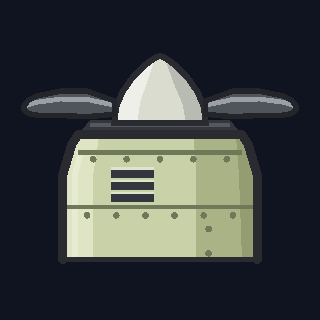
PR-9 Propeller Nose
Part · Planes · sold by Aviation
An aeroplane's engine: a piston engine turning a propeller, capping the front of the fuselage. It burns methane and takes its oxygen from the air it swallows, so it runs only in Earth's air. A spinning propeller that touches the ground destroys it on the spot; a stopped one does not.
Figure
Value
MASS
700 kg
COST
300 cr
CONSUMES METHANE
0.02 u/s
PRODUCES ELECTRICITY
0.02 u/s
THRUST
39.7 kN
DRAG NOSE-ON
0.1×
MAX TEMP
900 K
MAX G
20 g
IMPACT
10 m/s
BLAST
20 kN
NODES
1
STAGEABLE
YES
POWER
1200 kW
PROPELLER
5.6 m
AIR
needs oxygen: Earth only
The figures above are for the nose as it comes out of the drawer. THRUST is the pull standing still at sea level with the engine at full power. It is the most the propeller ever gives: the faster the aeroplane flies, the less it pulls, which is what gives an aeroplane a top speed. POWER is what the engine turns the propeller with. It fades as you climb into thinner air, and it is nothing at all in space, on Mars, or on any world whose air holds no oxygen. The methane it burns follows the power it makes, so a throttled-back cruise or a high, thin-air climb burns less. While it runs it also charges the ship's batteries.
Two sliders on its sheet, in the hangar only, size the engine and the propeller, and the card's rows follow them. Engine power runs from 600 kW to 2400 kW in steps of 50 kW and is the POWER row. A bigger engine weighs more and costs more, burns methane at full power in step with its power, and has a longer cowling: 2.6 m at the bottom of the slider, 3.75 m at the top. Propeller sets the propeller's width from 3 m to 7 m and is the PROPELLER row. A wider propeller pulls harder standing still and weighs a little more, but it burns no more methane, since the engine behind it is the same.
Engine power · Propeller
MASS
COST
THRUST
600 kW · 5.6 m
455 kg
195 cr
25.0 kN
1200 kW · 5.6 m
700 kg
300 cr
39.7 kN
2400 kW · 5.6 m
1190 kg
510 cr
63.1 kN
1200 kW · 3 m
625 kg
268 cr
26.2 kN
1200 kW · 7 m
759 kg
325 cr
46.1 kN
Doubling the power does not double the pull standing still: 2400 kW pulls three fifths harder than 1200 kW. Its gain shows at speed, where a bigger engine holds a higher top speed. What the two sliders trade for an aeroplane is on Aeroplanes.
Its one attachment point is on its base, so it caps the top of the stack: the cockpit, or a fuselage. It lights like any engine, in a stage or with Ignite on its sheet, and Shut down stops it. It winds up over two seconds to the power the throttle asks for, rather than answering at once as a rocket does. Its sheet also carries a Max power slider, which caps the engine at a share of its power and works in flight too. It has no gimbal, no flame and no exhaust, and a stage's Δv leaves it out, since it throws no propellant of its own: an aeroplane's ΔV STAGE reads 0 m/s in flight.
Pairs with an FS-1 Fuselage for its methane. Instead of a rocket engine for flying in Earth's air, never for reaching space.
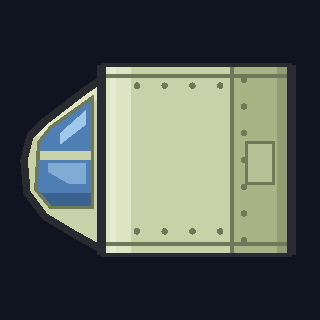
CK-1 Cockpit
Part · Planes · sold by Aviation
The aeroplane's command part: one seat behind a canopy. It flies only with an astronaut in it, exactly as a Command Pod does, so seat one on its sheet before you fly.
Figure
Value
DRY MASS
600 kg
FULL MASS
620 kg
COST
300 cr
STORES ELECTRICITY
20 u
STORES FOOD
20 u · 20 kg
STORES WASTE
20 u · launches empty
CONSUMES ELECTRICITY
0.86 u/day
CONSUMES FOOD
1 u/day
TORQUE
1 kN·m
DRAG NOSE-ON
0.6×
HEAT EXPOSURE
0.6×
MAX TEMP
900 K
MAX G
15 g
IMPACT
12 m/s
BLAST
20 kN · 1.6 m
ASTRONAUTS
1
NODES
5
WHEEL POWER
172.8 u/day
It joins the stack at its top and bottom, takes landing gear on either flank, and has a face a wing can lie on, like a fuselage. Fuel passes through it, so a propeller above it drinks from the fuselage below. Its canopy marks the top of the aeroplane: build with the canopy on the side away from the wheels.
Its own TORQUE is small, a twentieth of a Command Pod's. An aeroplane is turned by its tail's elevator, not by the cockpit. Its sheet carries the same rows as a pod's: the ship's name, Control from here, the crew seat and the rest.
Pairs with the PR-9 Propeller Nose above it and an FS-1 Fuselage behind it. Instead of a Command Pod when the ship flies on wings.
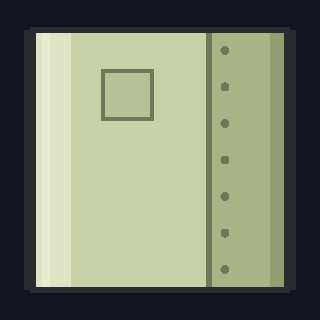
FS-1 Fuselage
Part · Planes · sold by Aviation
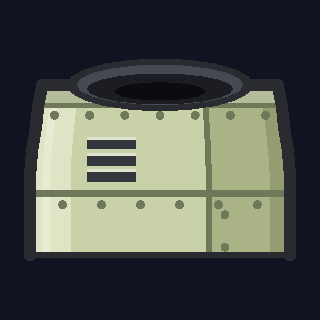
The body of the aeroplane and its fuel tank: a stretchable section that holds methane only, which is all a propeller burns. Wings and landing gear attach to it.
Figure
Value
DRY MASS
220 kg
FULL MASS
470 kg
COST
50 cr
STORES METHANE
50 u · 250 kg
DRAG NOSE-ON
0.8×
HEAT EXPOSURE
1.2×
MAX TEMP
900 K
MAX G
15 g
IMPACT
14 m/s
BLAST
60 kN · 2.7 m
BLAST FULL
122.5 kN · 6.2 m
NODES
5
The figures above are for the section as it comes out of the drawer, 4 m long. Its Length runs from 2 m to 20 m, set on its sheet or by dragging its end as you would a tank (Resize a tank), and its mass, price and methane all grow with it: every 4 m holds another 50 u of methane.
It joins the stack at its top and bottom, takes landing gear on either flank, and a wing's root lies anywhere on its face. It has no in-flight actions.
Pairs with the TL-1 Tail that closes its end. Instead of a rocket's Fuel Tank, which carries oxygen a propeller has no use for.
PW-1 Aircraft Wing
Part · Planes · sold by Aviation
An aeroplane's wing, sized the way a real one is, by its span and its chord. One part is the whole wing from tip to tip. Lay it over the fuselage just behind the centre of mass and it carries the aeroplane.
Figure
Value
MASS
640 kg
COST
200 cr
DRAG NOSE-ON
0.12×
MAX TEMP
610 K
MAX G
8 g
IMPACT
10 m/s
STRIKE
5 m/s
BLAST
8 kN
NODES
1
STAGEABLE
YES
WINGSPAN
20 m
CHORD
4 m
WING AREA
80 m²
ASPECT RATIO
5
MAX LIFT CL
1.5
STALL
20.6°
FLAPS
1.4× lift, 5× drag
BEST L/D
21
The figures above are for the wing as it comes out of the drawer. Two sliders, in the hangar only, size it. Chord sets how deep the section is from front to back, which is what the screen shows; Wingspan sets its length from tip to tip, from 6 m to 40 m, which points out of the screen and is never drawn. WING AREA is the span times the chord, and ASPECT RATIO is the span over the chord. A longer, thinner wing pays less drag for its lift, so its BEST L/D rises, and it stalls at a slightly smaller angle. Mass and price grow with the area, and a little more for a long, thin wing. The card's rows follow the sliders.
The section is cambered, so it lifts with the fuselage flying level. Its root is a stud: drop it anywhere on a fuselage's or a cockpit's face and it joins where you let go.
Tap it in flight for Extend flaps or Retract flaps, or put Flaps out / Flaps in in a stage. The Flaps switch on its sheet works in flight too. Flaps give more lift at the cost of much more drag, for a slower take-off and landing. It has no elevon: the tail's elevator does that job.
Careful
It is as fragile as the rocket Wing. Its 610 K limit is reached at 230 m/s near the ground, so a dive can burn it off, and pulled harder than its 8 g it breaks.
Pairs with the TL-1 Tail, which keeps it flying at the angle you trim. Instead of the Aero tab's Wing, which is sized for a rocket flown on its side.
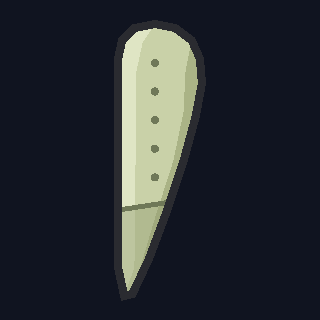
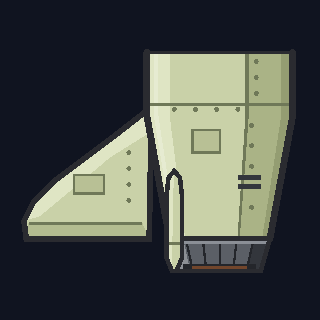
TL-1 Tail
Part · Planes · sold by Aviation
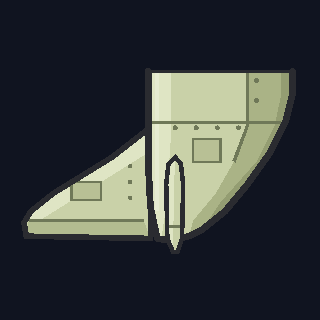
The end of the aeroplane: a cone that closes the fuselage, with a fin standing on it and a horizontal stabiliser across it. The stabiliser keeps the aeroplane pointing where it flies, and its elevator is how you pitch it.
Figure
Value
MASS
300 kg
COST
120 cr
DRAG NOSE-ON
0.3×
MAX TEMP
610 K
MAX G
10 g
IMPACT
10 m/s
BLAST
8 kN
NODES
1
STABILISER SPAN
8 m
STABILISER CHORD
2.4 m
STABILISER AREA
19.2 m²
TAIL EFFICIENCY
0.6
MAX LIFT CL
1.2
ELEVATOR
±25°, springs back to trim
Its one attachment point is at its top, so it is always the last part of the stack, under the fuselage. Its Length slider stretches the cone and the stabiliser's chord together, and Stabiliser span sets the stabiliser's width from 3 m to 16 m; both are hangar only. TAIL EFFICIENCY is the share of the airflow's angle the stabiliser feels, flying in the wake of the wing and the fuselage.
The elevator is a stick on top of a trim. While you hold a pitch button it swings the elevator at 40° a second, as far as the full 25°, and it does so only while there is air to fly on. Let go and it springs back to the trim within half a second. The trim is where the elevator rests hands-off, and the pitch buttons never move it: the Elevator trim slider on its sheet sets it, in the hangar or in flight, and the sheet's Centre elevator puts it back to zero. It cannot be staged.
The fin is drawn but does not fly: a side view has no yaw and no roll to steer, so only the stabiliser meets the air.
Pairs with the FS-1 Fuselage it closes. Instead of a rocket Wing's elevon, which the pitch buttons wind and which stays where they leave it.
LG-1 Landing Gear
Part · Planes · sold by Aviation
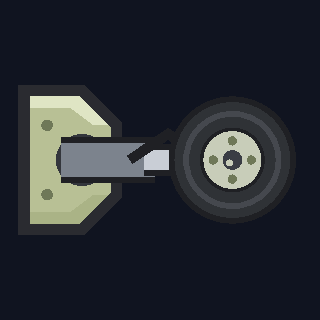
A wheel on a sprung, damped strut. It rolls along the ground where a landing strut's foot would stand still, and its brakes stop it. Any ship standing on landing gear takes off from the runway.
Figure
Value
MASS
120 kg
COST
40 cr
DRAG NOSE-ON
0.3×
HEAT EXPOSURE
0.3×
MAX TEMP
900 K
MAX G
25 g
IMPACT
25 m/s
BLAST
4 kN
NODES
1
STAGEABLE
YES
WHEEL
1.25 m
SUSPENSION
0.5 m · 7.5 rad/s · damping 0.7
ROLLING
0.02 of the load
BRAKES
0.5 of the load
TYRE LIMIT
85 m/s
It mounts on a flank, a fuselage's or a cockpit's, with the wheel swung out away from the hull. The side it hangs from becomes the underside on the runway, so put every wheel on the same side, opposite the canopy. Its Size slider, hangar only, scales the strut, the wheel and the mass together, so a big main gear behind the centre of mass and a small nose wheel up front are the same part. It comes out of the drawer down, with its wheel out.
ROLLING is how much of the weight on the wheel the ground takes off it as it rolls free; BRAKES is how much it can take braked. The Autobrake switch, on by default and usable in flight, holds the brakes whenever the throttle is at zero and lets go the moment it opens: an aeroplane parked with the power off stays where it stopped, and a landing roll ends when you cut the power.
Tap it in flight for Gear up or Gear down, or put either in a stage. The wheel folds into its housing, and folded it meets no air and no ground, so raising it after take-off takes its drag away. See Raise and lower the landing gear.
Careful
A tyre rolled along the ground faster than its 85 m/s TYRE LIMIT bursts, and that wheel is lost. Land with the gear down: folded, the wheels never touch, and the fuselage meets the runway instead.
Pairs with the FS-1 Fuselage it hangs from. Instead of an LT-1 Landing Strut when the ship lands rolling rather than straight down.
AI-1 Air Intake
Part · Planes · sold by Jet Flight
The open nose a jet breathes through. A jet engine carries no oxygen: it burns its methane in the air it swallows, and it swallows only what the intakes aboard catch. A jet with no intake makes no thrust at all.
Figure
Value
MASS
220 kg
COST
160 cr
DRAG NOSE-ON
0.1×
HEAT EXPOSURE
0.35×
MAX TEMP
1400 K
MAX G
20 g
IMPACT
10 m/s
BLAST
8 kN
NODES
1
INTAKE AREA
1 m²
AIR AT REST
183.8 kg/s
FEEDS
jet engines aboard
The figures above are for the intake as it comes out of the drawer. Its Intake slider, hangar only, sets the mouth's area from 0.4 m² to 2.5 m², and the mouth drawn at the nose opens wider with it. A bigger mouth weighs and costs more: 141 kg and 102 cr at the bottom of the slider, 418 kg and 304 cr at the top.
AIR AT REST is what it catches with the aeroplane standing still at sea level, when the engines have to suck the air in themselves. Flying, the oncoming air is rammed into it, so it catches more the faster you go. Every jet aboard shares every intake's air. The take-off run is where a small intake starves an engine, and so is thin air high up with the engines turned all the way up. A jet's own AIR row says how much it asks for at full thrust standing still, so one intake as it comes out of the drawer feeds one jet as it comes out of the drawer, with room to spare.
Its one attachment point is on its base, so it caps the top of the stack like the PR-9 Propeller Nose. It has no actions: it works whenever a jet aboard is running.
Pairs with the JE-1 Jet Engine or the JT-1 Jet Tail. Instead of the PR-9 Propeller Nose at the front of an aeroplane.
JE-1 Jet Engine
Part · Planes · sold by Jet Flight
A turbojet. It is far stronger than the propeller and keeps its thrust as the aeroplane speeds up, which is what takes an aeroplane through the sound barrier. It burns methane in oxygen from the air, so it runs only in Earth's air and only with an air intake aboard, and it is thirsty.
Figure
Value
MASS
1600 kg
COST
1000 cr
CONSUMES METHANE
0.31 u/s
PRODUCES ELECTRICITY
0.03 u/s
THRUST
120 kN
DRAG NOSE-ON
0.3×
MAX TEMP
1400 K
MAX G
20 g
IMPACT
10 m/s
BLAST
30 kN
NODES
2
STAGEABLE
YES
AIR
160 kg/s, through an air intake
OXYGEN
from the air: Earth only
TOP MACH
thrust fades past 2.4
The figures above are for the engine as it comes out of the drawer. THRUST is what it pushes with standing still at sea level, at full power. In flight it changes. It fades as you climb into thinner air. It grows with speed, as the air rammed into the intake is squeezed before the engine sees it, to about twice as much at Mach 2. Past Mach 1 the shock wave in the intake's mouth takes a little of that back. Past TOP MACH the air arrives too hot for the turbine, and by Mach 3.2 the thrust is gone.
The methane it burns follows the thrust it makes, and climbs a little with speed. At full power standing still it burns 0.31 u/s, ten times the propeller's 0.02 u/s.
Its Thrust slider, hangar only, sizes it from 60 kN to 200 kN in steps of 5 kN. Its mass, price, methane and the casing's length follow it.
Thrust
MASS
COST
METHANE
60 kN
1000 kg
625 cr
0.16 u/s
120 kN
1600 kg
1000 cr
0.31 u/s
200 kN
2400 kg
1500 cr
0.52 u/s
A stronger engine also asks for more air, so the bigger settings want a bigger intake, or two. Its sheet carries Max power as well, which caps it at a share of its thrust and works in flight. It lights like any engine, in a stage or with Ignite, and Shut down stops it. It winds up over about five seconds, so the take-off roll starts gently. It has no gimbal, and a stage's Δv leaves it out, since it throws no propellant of its own.
It mounts two ways. Its top joins the end of a fuselage, making it the last part of the stack. Or its stud lies anywhere on a fuselage's face as a pod beside it, the way a wing does. A pod needs a fuel line from the fuselage, since fuel does not cross a face (Draw a fuel line).
Pairs with the AI-1 Air Intake and an FS-1 Fuselage for its methane. Instead of the PR-9 Propeller Nose when the aeroplane has to go fast. The JT-1 Jet Tail is the same engine built into a tail.
JT-1 Jet Tail
Part · Planes · sold by Jet Flight
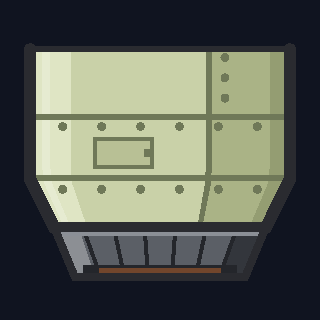
A TL-1 Tail with a jet engine built into it: the cone, the fin and the stabiliser, and the JE-1's nozzle where the cone ends. It goes where the TL-1 goes, at the end of the fuselage. It flies and steers exactly as the TL-1 does and pushes exactly as the JE-1 does.
Figure
Value
MASS
1900 kg
COST
1200 cr
CONSUMES METHANE
0.31 u/s
PRODUCES ELECTRICITY
0.03 u/s
THRUST
120 kN
DRAG NOSE-ON
0.3×
MAX TEMP
1400 K
MAX G
10 g
IMPACT
10 m/s
BLAST
30 kN
NODES
1
STAGEABLE
YES
AIR
160 kg/s, through an air intake
OXYGEN
from the air: Earth only
TOP MACH
thrust fades past 2.4
STABILISER SPAN
8 m
STABILISER CHORD
2.4 m
STABILISER AREA
19.2 m²
TAIL EFFICIENCY
0.6
MAX LIFT CL
1.2
ELEVATOR
±25°, springs back to trim
Its sheet carries both parts' sliders. Length stretches the cone, and Stabiliser span sets the stabiliser from 3 m to 16 m, as on the TL-1. Thrust sizes the engine from 60 kN to 200 kN, as on the JE-1: 1330 kg and 840 cr at the bottom of the slider, 2660 kg and 1680 cr at the top. The engine sits inside the cone, so its Thrust does not lengthen the tail. Elevator trim and Max power work in flight too.
The elevator is the TL-1's, a stick on top of a trim: hold a pitch button and it swings, let go and it springs back to the trim. The sheet offers Ignite or Shut down for the engine and Centre elevator for the trim. Like the JE-1 it needs an air intake aboard and runs only in Earth's air.
Pairs with the AI-1 Air Intake at the nose and an FS-1 Fuselage. Instead of a TL-1 Tail and a separate engine: one part, and the stack ends in the nozzle.
SW-1 Supersonic Wing
Part · Planes · sold by Jet Flight
A thin, short, sharp-edged wing: the opposite trade to the PW-1. It drags much less and lifts much less, so an aeroplane on it has to fly fast to stay up. It keeps lifting through the sound barrier, where a fat wing chokes on its own shock waves.
Figure
Value
MASS
700 kg
COST
450 cr
DRAG NOSE-ON
0.06×
HEAT EXPOSURE
0.45×
MAX TEMP
900 K
MAX G
9 g
IMPACT
10 m/s
STRIKE
5 m/s
BLAST
8 kN
NODES
1
STAGEABLE
YES
WINGSPAN
10 m
CHORD
4 m
WING AREA
40 m²
ASPECT RATIO
2.5
MAX LIFT CL
0.7
STALL
13.4°
FLAPS
1.25× lift, 4× drag
BEST L/D
19.7
LIFT AT MACH 2
68% of its slow lift
THICKNESS
4% of the chord
The figures above are for the wing as it comes out of the drawer. Its Chord and Wingspan sliders work as the PW-1's do, the span from 4 m to 18 m. Its section is only THICKNESS deep and barely cambered, so its MAX LIFT CL is under half the PW-1's, and its short span lifts less for every degree the nose is raised. An aeroplane on it stalls at two to three times the speed of one on the PW-1.
What it gives for that is speed. Its own drag rises only a little through Mach 1, and it keeps lifting past it: LIFT AT MACH 2 is how much of its lift for each degree it still has there. Its sharp leading edge takes a fifth of the heat the PW-1's round one does (HEAT EXPOSURE counts twice: the heat goes with its square), on a skin rated to 900 K.
Its root is a stud like the PW-1's: drop it anywhere on a fuselage's or a cockpit's face. Like the PW-1 it has no elevon: the tail's elevator pitches the aeroplane, so fly it with a JT-1 Jet Tail or a TL-1 Tail. Tap it in flight for Extend flaps or Retract flaps; its flaps add less than the PW-1's.
Careful
It is no good slow. Land fast with the flaps out, and keep the landing roll under the tyres' 85 m/s limit.
Pairs with a jet: the JE-1 Jet Engine or the JT-1 Jet Tail. Instead of the PW-1 Aircraft Wing when the aeroplane flies fast.