Flying an aeroplane
Build a small aeroplane from the Planes tab, roll it down the runway, lift it off, and set it back down on its wheels. At the end of it you hold Wheels Up and Greaser.
What you need first
This guide assumes you have flown Your first flight, so you know the hangar, the throttle and the STAGE button. The aeroplane needs one tech node in tier 2, so the Research Centre has to reach level 2 first.
| Buy | Price | Needs first |
|---|---|---|
| Wings | 24 discovery | — |
| Research Centre level 2 | 200 discovery + 2,500 credits | — |
| Aviation | 45 discovery | Wings |
You also need an Astronaut on your roster to sit in the cockpit: Recruit a Meek. The Launch Pad at level 1 is enough. Its runway is 300 m long, and this aeroplane needs less than half of it. Every flight costs the aeroplane's price, 1,100 cr, and recovering it brings back what returned. How each part behaves is explained on Aeroplanes.
Build it
An aeroplane is built nose-up like any ship. Keep one rule in mind the whole way: the canopy goes on one side and every wheel on the other, because the side the wheels hang from is the side the runway turns down.
- Open the Planes tab in the palette. Its drawer starts with the six parts this aeroplane is built from, top to bottom: propeller, cockpit, fuselage, wing, tail and wheel. The four under them make an aeroplane a jet (Build a jet).
- Stack the nose. Drag the PR-9 Propeller Nose onto the canvas, then the CK-1 Cockpit under it. The cockpit's canopy shows on its left side.
- Add the body. Drag an FS-1 Fuselage under the cockpit and stretch it to 8 m, twice the length it comes out at, by dragging its end or with the Length slider on its sheet (Resize a tank). It holds the methane the propeller burns.
- Close it with the tail. Drag the TL-1 Tail under the fuselage. It snaps on at its top and ends the stack.
- Lay the wing over the fuselage. Drop the PW-1 Aircraft Wing on the fuselage's face, just below the checkered centre-of-mass marker. It lands where you let go. Leave its Wingspan at 20 m.
- Hang the wheels on the right. Drag an LG-1 Landing Gear onto the fuselage's right flank, a little behind the wing: that is the main gear. Drag a second onto the cockpit's right flank: that is the nose wheel. Leave both at Size 1 so the aeroplane sits level.
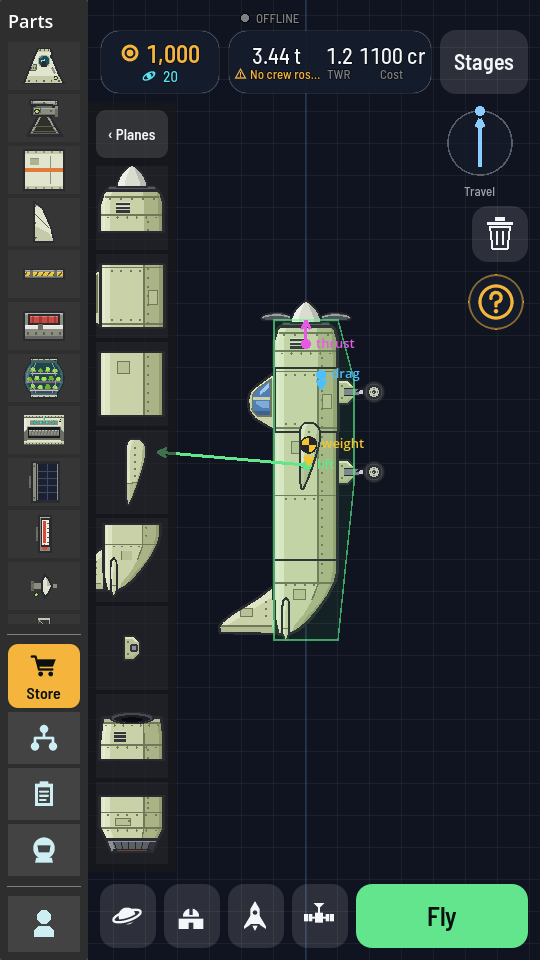
The canopy faces left, both wheels hang right. The readout reads 3.44 t and 1100 cr. - Seat your astronaut. Tap the cockpit twice to open its sheet and fill its seat (Seat crew on a pod). The cockpit flies only with an astronaut in it.
- Check the readout. The line under the ship's mass reads Takes off from the runway. If it reads Too big for the runway instead, the ship is over the Launch Pad's mass cap, or longer than its tower is tall.
Take off
- Tap Fly. The flight opens on the runway beside the pad, the aeroplane lying level on its wheels with its nose pointing east, to the right of the screen. The brakes are on.
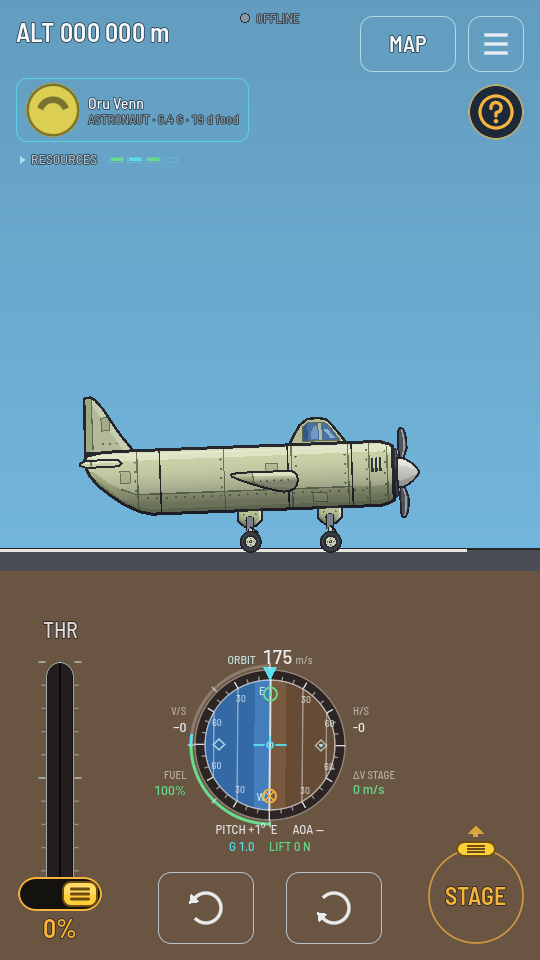
Ready to roll. The navball reads ORBIT, which counts Earth's own spin even standing still. - Tap the navball until it reads SURFACE. Now the speed above it is your speed over the ground, which is the one that matters for flying.
- Tap STAGE. The propeller lights, the throttle jumps to full and the brakes let go. The aeroplane starts to roll, gaining speed as the propeller winds up.
- At 30 m/s, rotate. Hold the turn button that lifts the nose, the left one while the nose points right. The tail's elevator swings nose-up for as long as you hold it. Watch PITCH under the navball and let go at 7°. The elevator springs back as soon as you let go, so from here keep the nose where you want it with short presses of either button.
- Let it fly off. The aeroplane leaves the ground at 39.9 m/s, 129 m down the runway. Wheels Up pays the moment the wheels leave the runway.
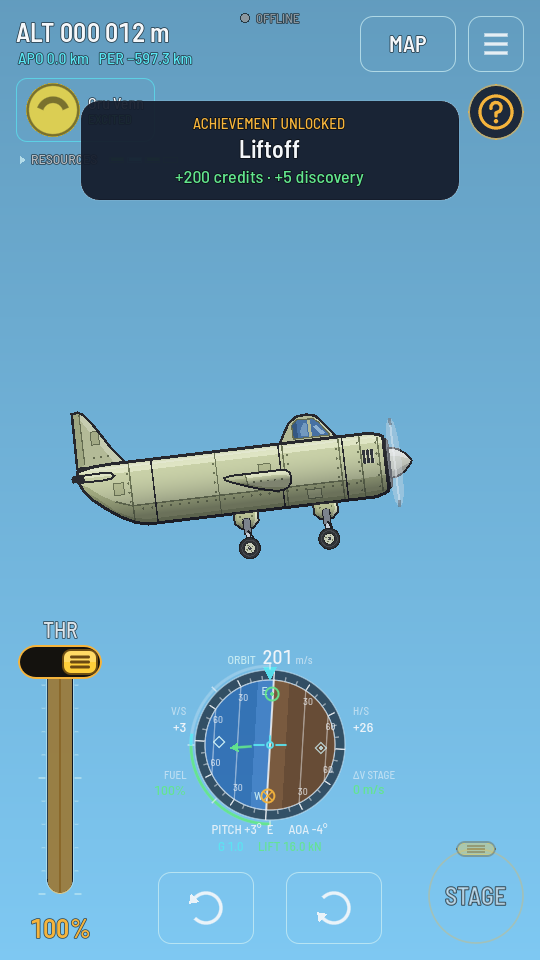
Just off the ground. The wheels are still down; raise them next. - Raise the gear. Tap each wheel and choose Gear up on its sheet. Each wheel is its own part, so do both. They fold away, and the aeroplane speeds up with their drag gone.
- Climb, then level off. Hold PITCH at 8° with short presses and the aeroplane climbs steadily. When you are high enough, press the other button until the nose sits near the horizon.
- Trim it to fly hands-off. Tap the tail and drag its Elevator trim slider a little at a time until the aeroplane holds its attitude with your hands off the buttons. If the nose drops instead of rising, drag the other way: Trim the elevator.
Land
A side view has no way to turn round. A half loop would leave the aeroplane flying the other way upside down, with its wheels on top. So you land ahead of where you took off. The ground stays flat for 2.8 km east of the pad, which is room for a short first flight; further east, Earth's hills begin.
- Lower the gear. Tap each wheel and choose Gear down. The wheels take two and a half seconds to swing out.
- Cut the throttle. Slide it to 0 %. The aeroplane starts down, and the autobrake is now armed for the moment the wheels touch.
- Hold the nose a few degrees up. Keep PITCH at 5° all the way down with short presses, or trim it there. The aeroplane sinks gently instead of diving. For a slower approach, tap the wing and choose Extend flaps.
- Touch down on the wheels. The springs take the weight and the brakes take hold. This aeroplane touches down at 36.6 m/s and rolls to a stop 200 m on. Greaser pays as the wheels come down.
- Recover it. Standing still on the ground, it can be brought home from the flight menu's RECOVER: see Recover a landed ship.
What to try next
- Cross-Country: fly 100 km from the pad under power without climbing above 6 km. Throttle back once you are cruising: this aeroplane's methane lasts far longer at part power. With a longer flight comes the hills: land on the flattest ground you can find.
- A longer, thinner wing glides further on the same fuel; a bigger one lands slower. The wing explains the trade.
- Go faster: raise the nose's Engine power and shorten the wing. A faster aeroplane shows what that buys and what it costs.
- Upgrade the Launch Pad and the runway doubles in length at every level, room for a heavier aeroplane: Upgrade a building.