Aeroplanes
An aeroplane is a ship that never leaves the air: a propeller or a jet pushes it, a wing holds it up, a tail keeps it pointed and wheels carry it along the runway. This page explains why each of those behaves as it does, and why an aeroplane flies only on Earth.
A ship on wheels
Everything in the Planes tab is sold by one tech node, Aviation. An aeroplane is built from those six parts the way a rocket is built from its own: a stack from the nose down, with the wing lying over the fuselage and the wheels on its flank. The game draws no line between the two. A ship becomes an aeroplane the moment it stands on landing gear, and that is also what sends it to the runway instead of the pad.
Built nose-up, flown on its side
The hangar builds every ship pointing up the screen, and an aeroplane is no exception: the propeller at the top, the tail at the bottom. The runway then lays it on its side. The flank the landing gear hangs from is turned down onto the runway, and the opposite flank becomes the top. Build with the cockpit's canopy on one side and every wheel on the other, and the aeroplane rolls out upright.
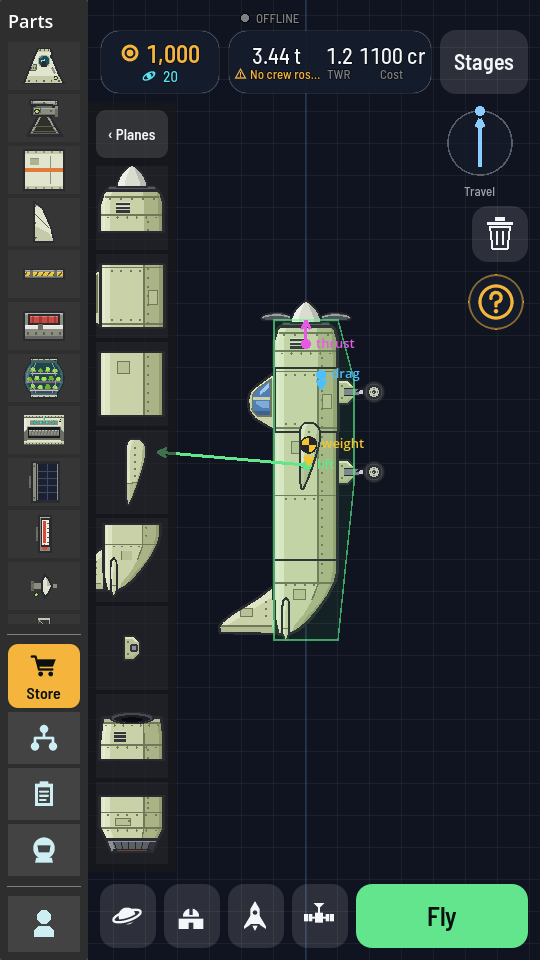
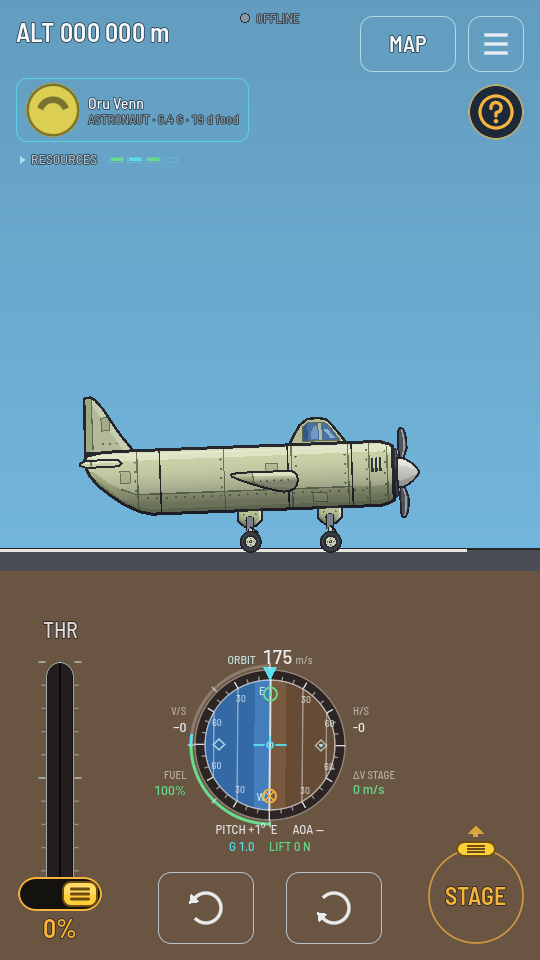
An aeroplane flies along the ground's surface rather than away from it, so most of the time its nose points across the screen, not up it. The navball, the pitch buttons and the attitude readout all work exactly as they do for a rocket. A rocket's "up" is simply an aeroplane's "forward".
The runway
The runway is part of the Launch Pad: a strip of flat ground east of the tower. The hangar's Fly sends any ship standing on landing gear there instead of to the pad, and the readout under the ship's mass says so: Takes off from the runway. The ship starts at the end of the strip, lying on its wheels with its nose pointing down the runway and the brakes on.
The runway's length is the Launch Pad's level: 300 m at level 1, doubling at every level after it. A ship on the runway is held to the pad's caps at that level: its mass, and its height cap read as a length, since a ship built nose-up is as long lying down as it was tall standing. The Launch Pad's sheet in the Space Center shows a runway ship's mass and length as YOUR SHIP with the word runway beside them. Every level's figures are in Buildings.
The runway is the only one. Like the pad it stands on Earth alone. An aeroplane that comes down somewhere else is a landed ship like any other: it can take off again from wherever it stands, ground allowing, or be recovered where it stopped (Recover a landed ship).
A propeller is not a rocket
A rocket engine carries everything it burns and throws it out of the back. The PR-9 Propeller Nose does neither. It burns methane with oxygen it takes from the air, and it pushes by swinging a propeller through that same air. Three things follow from that.
It is rated by power, not thrust. Its card quotes its power, what the engine turns the propeller with: 1200 kW as it comes out of the drawer. How hard that pulls depends on how fast the aeroplane is already moving: the most it ever pulls is standing still, and the faster you fly, the less it pulls. That is why an aeroplane has a top speed, and why it reaches it gently rather than running out of fuel at it.
It needs oxygen in the air. In space it makes nothing, and on Mars it makes nothing either: Mars has air, but no oxygen in it. Of the worlds you can fly to, Earth's air is the only one a propeller runs in, and its card says so on the AIR row. That is why aeroplanes fly only on Earth.
It weakens as you climb. Thinner air holds less oxygen, so the engine makes less power the higher you go, until it cannot hold the aeroplane up any longer. An aeroplane has a ceiling just as it has a top speed.
It also burns its methane in step with the power it makes, so throttling back to cruise stretches the fuel a long way. And because it throws no propellant of its own, the rocket sums behind ΔV STAGE say nothing about it: an aeroplane's reads 0 m/s. Its range is a matter of fuel, speed and throttle instead.
A bigger engine, a bigger propeller
The nose is sized in the hangar like a tank, with two sliders on its sheet. Engine power is the size of the engine, from 600 kW to 2400 kW. Propeller is how wide the propeller is, from 3 m to 7 m. They do different jobs.
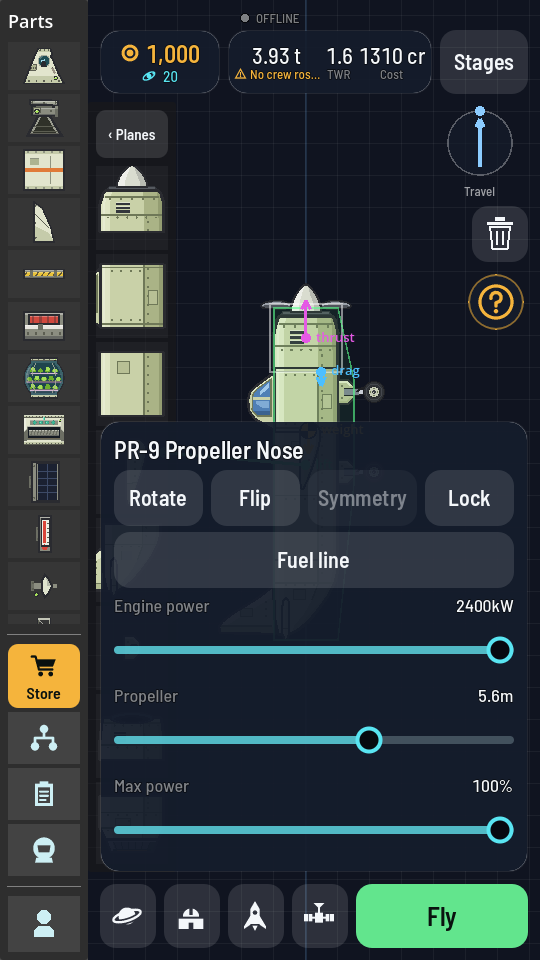
More power is more speed. A propeller's pull fades as the aeroplane speeds up, and only more power holds it up at speed, so a bigger engine raises the top speed. It costs three ways. The engine is heavier and dearer: twice the power weighs and costs 1.7 times as much. Its cowling grows longer. And at full power it burns methane in step with its power, so twice the engine empties the same fuselage twice as fast.
A wider propeller is more pull at low speed. A bigger disc grips more air, so it pulls harder standing still and on the take-off roll, where an aeroplane needs it most. It adds a little weight and burns nothing extra, because the engine turning it is the same. At speed it adds little: there the power is what counts.
Max power, the third slider, is not a size. It caps the engine at a share of its power, and it works in flight. The figures each setting gives are on the PR-9's entry.
What holds it up: the wing
A wing makes lift by meeting the air at a small angle. The PW-1 Aircraft Wing is cambered, curved so it lifts even with the fuselage flying level, and lifts harder the more the nose is raised, up to its stall. Past that angle the airflow breaks away, the lift falls and the drag climbs. The card's STALL row is that angle.
A real wing is sized by two figures, and so is this one. The chord is how deep it is from its front edge to its back edge, which is what the side view shows. The wingspan is how far it reaches from tip to tip, which points out of the screen and is never drawn. Their product is the wing area, and the more of it a ship has, the slower it can fly before it stalls.
Their ratio, span over chord, is the aspect ratio, and it decides how much a wing pays for its lift. Every wing drags more as it is pulled harder, and a long, thin wing pays far less of that drag than a short, stubby one of the same area. That is why gliders have long, narrow wings. On the card it shows as a higher BEST L/D: more lift for every unit of drag, a longer glide and more range on the same fuel. The price is a little: a long wing stalls at a slightly smaller angle, and it weighs and costs more for its area.
Flaps give the wing more lift at low speed for a lot more drag, which is what you want slowing down for a landing and nowhere else.
What keeps it pointed: the tail
The TL-1 Tail carries a small wing of its own across its base, the horizontal stabiliser, far behind the centre of mass. Whenever the nose rises or falls away from the direction the aeroplane is flying, the stabiliser meets the air at an angle and pushes the nose back. Without it, an aeroplane tumbles.
The stabiliser's back edge is the elevator, and it answers two hands. The pitch buttons are the stick: hold one and the elevator swings that way, further the longer you hold, up to its full 25°. Let go and it springs back within half a second. A tap is a nudge to the nose, never a setting that keeps it rising. The trim is where the elevator rests when your hands are off, set with the tail's Elevator trim slider, in flight as well as in the hangar. Trim it and the aeroplane settles at whatever attitude that angle holds, hands-off, and the stick works on top of it. Its fin is drawn but does not fly, since a side view has no yaw or roll to steer with. Setting the trim is Trim the elevator.
Wheels and brakes
A landing strut's foot stands still where it lands. The LG-1 Landing Gear's wheel rolls, losing little of its speed to the ground, and its strut is sprung and damped so a firm touchdown is soaked up rather than bounced. Its brakes stop it, and its autobrake, on unless you switch it off, holds the brakes whenever the throttle is at zero and lets go as soon as it opens. That one rule covers the whole flight: brakes on while you sit on the runway, off the moment you open the throttle to roll, on again when you cut the power after landing.
Once you are flying, the wheels are drag and nothing else. Raise them with Gear up and they fold away and stop costing you speed. Lower them again before you land: Raise and lower the landing gear.
Jets
A propeller's pull fades as the aeroplane speeds up, so it can never take an aeroplane near the speed of sound. A jet can. Four parts, sold by the Jet Flight node, make an aeroplane one: the AI-1 Air Intake for the nose, the JE-1 Jet Engine, the JT-1 Jet Tail (a TL-1 Tail with the same engine built into it) and the SW-1 Supersonic Wing. How to put them together is Build a jet.
A jet breathes through an intake. Like the propeller it burns methane in oxygen from the air, so it runs only in Earth's air. But it swallows that air through the intakes aboard, and only what they catch. With no intake it makes no thrust at all. With too small an intake it is starved: on the take-off roll, when the engine must suck its air in itself, and high up in thin air with the engine turned all the way up. Every jet aboard shares every intake.
A jet keeps its thrust at speed. The faster it flies, the harder the oncoming air is rammed into the intake, and the more the engine makes of it: about twice as much at Mach 2 as standing still. That is what lets a jet go through the sound barrier. Past Mach 1 the shock wave in a plain intake's mouth takes a little of it back. And past Mach 2.4 the rammed air arrives too hot for the turbine, and the thrust fades away to nothing by Mach 3.2. Like the propeller it weakens as the air thins with height.
A jet is thirsty. At full power it burns ten times the propeller's methane, so a jet carries a long fuselage and still flies far less long. It goes much faster while it does, so its range is not as short as its hours.
A fast wing lifts little. The SW-1 is thin, short and sharp. It drags far less than the PW-1, and through Mach 1 it barely chokes, where a fat wing's drag climbs steeply and keeps climbing. But it lifts far less: a jet on it stalls at two to three times a propeller aeroplane's speed, and needs a long, fast take-off run and a fast landing.
The sound barrier is a wall. Every part's drag rises steeply as the speed nears Mach 1 and peaks just past it, then eases off. A jet that cannot push through that peak stops just short of Mach 1 however long it waits. Near the ground the air is too thick for it. Very high up the engine is too short of air. In between, around 12 km, the jet in Build a jet goes through and on past Mach 1.6. A stronger engine on a bigger intake goes faster still.
Heat sets the last limit. At Mach 2 the long side of a fuselage, meeting the air at the small angle the wing flies at, heats up. Flown that fast for long, the fuselage burns, so Mach 2 is a dash, flown high, with the nose as close to the direction of flight as the wing allows. See Air, heat and speed.
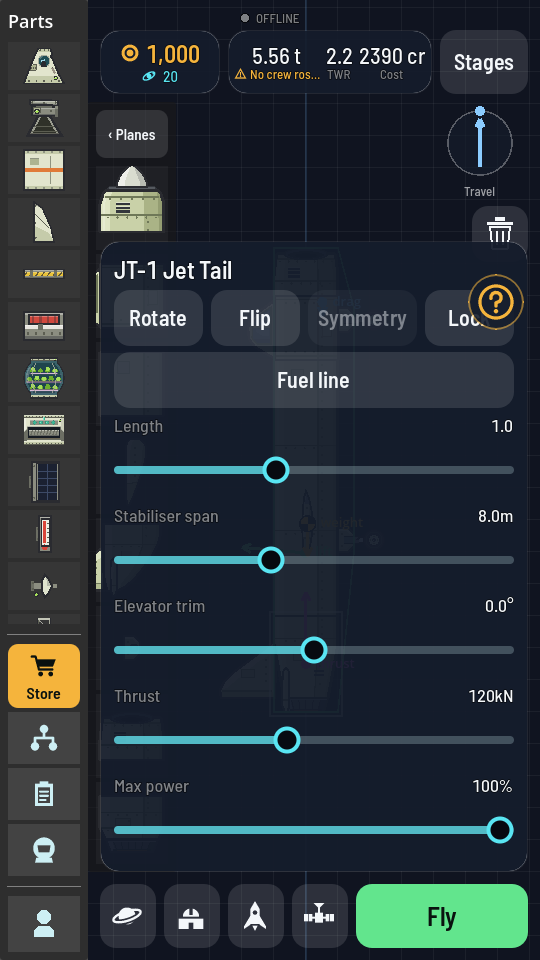
A jet is longer than an aeroplane with a propeller, because it needs a long fuselage for its fuel. The runway holds a ship to the Launch Pad's height cap read as a length, so a jet takes off from a level-2 pad's runway, not the first one (The runway).
What breaks an aeroplane
- Heat. The wing and the tail are rated to 610 K, which near the ground is reached at 230 m/s. An aeroplane's own top speed is far below that, but a long dive is not. See Air, heat and speed.
- Load. The wing breaks if it is pulled harder than its 8 g MAX G: a hard pull out of a dive will do it.
- The tyres. A wheel rolled along the ground faster than its 85 m/s TYRE LIMIT bursts.
- The ground. Touching down on anything but the wheels, or on them too fast, is judged like any landing: on each part's own impact speed. See Landing and recovery.
- The propeller. A spinning propeller that touches the ground destroys the engine at once, however gently it touches. The blades reach past the cowling, so a nose-down touchdown, or the nose tipping onto the runway under hard braking, can find the ground with the engine running. Stopped, the propeller is harmless.
What the aeroplane in the guide does
The aeroplane built in Flying an aeroplane is all six parts as they come out of the drawer, with the wing at 20 m by 4 m and an 8 m fuselage. On Earth, near sea level, it does this.
| Figure | Value |
|---|---|
| Mass | 3.44 t |
| Cost | 1,100 cr |
| Stalls at | 21.4 m/s |
| Stalls at, flaps out | 18.1 m/s |
| Leaves the runway after | 129 m |
| Leaves the runway at | 39.9 m/s |
| Top speed, gear up | 111 m/s |
| Top speed, gear down | 87 m/s |
| Range at 65 % throttle | 918 km |
A bigger wing lowers the stall speed and costs top speed; a longer fuselage carries more methane and more weight. Every part's own figures are on Parts: Planes.
A faster aeroplane from the same parts
Speed comes from three places: more power, less wing and the wheels folded away. Take the guide's aeroplane, set Engine power to 2400 kW and shorten the Wingspan to 10 m, and it does this.
| Figure | Guide aeroplane | Faster build |
|---|---|---|
| Mass | 3.44 t | 3.52 t |
| Cost | 1,100 cr | 1,181 cr |
| Stalls at | 21.4 m/s | 30.5 m/s |
| Top speed, gear up | 111 m/s | 155 m/s |
| Range at 65 % throttle | 918 km | 639 km |
Every gain is paid for. The short wing has less area to hold the aeroplane up, so it stalls faster, needs a longer run down the runway and lands faster. The big engine is heavier and thirstier, so the same fuselage takes it less far. A longer fuselage buys the range back with more methane, at the cost of more weight still. And raising the gear is free speed once you are off the ground: Raise and lower the landing gear.