The Science Lab
A reading pays once and is over. A laboratory keeps paying: it takes the samples your instruments gather, works through them day after day, and turns them into discovery for as long as it is standing somewhere worth standing. It is the reason to leave a station somewhere instead of visiting.
What it is
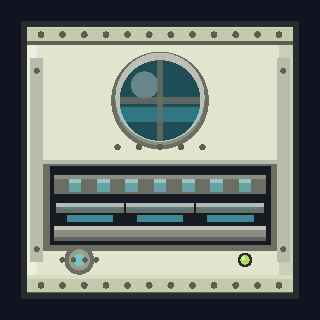
The SL-8 Science Lab is an eight-metre module with three seats and a bench. It is the widest thing on the tech tree's last tier, sold by Orbital Science, and it is not a part you bolt onto a rocket as an afterthought — it weighs 4.4 t empty and costs 15,000 credits to launch. It exists for one job, and it does that job whether you are watching or not.
Three things, or it does nothing
A lab is switched on with Start on its sheet, and then it needs all three of these at once:
| It needs | Or else |
|---|---|
| Somewhere to stand | landed on a world, or coasting above its air. Not on the pad, and not climbing through weather — the sheet says Needs to be landed or in orbit. |
| Scientists at the bench | at least one of its three seats filled, and only a Scientist may sit in them. With none the sheet says No scientist at the bench. |
| Power, and data | 0.9 u/s while it works, and samples to work on — a full bench gets through 40 u of data a day. Out of samples it says Out of data — take readings somewhere new and draws no power until new data arrives. |
Half the power is half the work rather than none, so a lab on a station that dips into shadow slows down and carries on. No power at all stops it dead, and nothing is spoiled: the samples wait.
Data comes from going somewhere new
The bench runs on data, and data comes from your instruments. Every time you take a reading, the reading is offered to the lab aboard the same ship — and the lab files 24 u of data only if it has never analysed that place with that instrument before. Read the same spot again and it files nothing.
Data is the expensive half of this machine. It takes five units of it to work out one point of discovery at Earth's surface, so a new place — 24 u — is a little over half a day of a full bench and nothing more. A laboratory is an errand you keep running, not a tap you leave open.
The places are the survey's own: a world, a band of altitude, and the biome you are standing in. Science readings explains them in full. The lab remembers the last 48 it has worked on, and its sheet counts them for you: Places analysed: 7.
This is what makes a lab a reason to fly rather than a machine that prints discovery. Near home there is soon nothing left to measure and the bench starves. Out at Mars every band is new, every biome is new, and three instruments make three sets of samples out of each of them.
Where it stands is what the work is worth
The same bench, the same crew, the same samples — and the findings differ by a factor of eight depending on where the module is. The multiplier is how hard the place is to reach, exactly as the survey prices a first reading:
| Where the lab is | Worth | A full bench makes |
|---|---|---|
| Earth, surface or orbit | ×1 | 8 discovery a day |
| The Moon | ×2 | 16 discovery a day |
| Mars | ×3.5 | 28 discovery a day |
| A moon of the outer giants, high up | ×8.4 | 67 discovery a day |
Scientists multiply it again. One at the bench is the base rate, two is ×1.6, three is ×2 — and they work through the samples faster in the same proportion, so a full bench wants feeding twice as often as a single scientist does. Being far from home makes a sample worth more; it does not make it last longer.
At Mars with a full bench, a lab earns an average last-tier tech node in about four days of real time. The world clock runs while the game is shut, so those are three days of your life, not three days of playing — as long as you come back and send the findings before the bench fills.
You have to go and send them
What a lab makes does not land in your account, and nothing sends it there for you. It piles up aboard the module, up to 120 u, and it moves only when you take the ship's controls, tap the lab, and press Transmit.
Two things have to be true when you do:
- The space centre has to hear the ship. Same network a probe is flown on, explained in Communications. Out of contact the button reads No link home.
- There has to be a whole point aboard. Fractions stay on the bench; the button reads Nothing to transmit until one adds up.
So a laboratory is not passive income — it is something you tend. A bench nobody visits fills up and stops, and the better the site, the sooner that happens: 120 u is fifteen days of work in Earth orbit, four at Mars, and under two high above an outer moon. The reward for a good site is also the reason you have to come back to it.
What to build around one
A working lab is a small station, not a probe:
- Power. 0.9 u/s is roughly four SP-6 Solar Arrays in daylight, plus a battery for the night side — or an antimatter reactor if you have got that far.
- Crew. Three Scientists, and every one of them eats. A Greenhouse is worth carrying on anything meant to stay.
- Instruments. All three. Each one makes its own samples out of every place, so a lab with one Thermometer starves three times as fast as a lab with the full set.
- An antenna. Whatever it takes to reach home from where you are parking it.
See also
- Run a Science Lab — the steps, from the hangar to the first paid discovery.
- Science readings — what an instrument measures and what a place is.
- Credits and discovery — what discovery buys.
- The SL-8's figures.