Every part in the Life category: what keeps a crew fed and what a ship carries, and their figures from the info card.
Life parts are what a ship needs once it stops being a rocket and starts being somewhere people stay. The greenhouses grow food out of power and time, so a station feeds itself instead of waiting for a supply run; the cargo bays carry whatever else is needed, food and waste included. Read The Meek for what a crew eats, Grow food in orbit for the greenhouse in use, and Load a cargo bay for how a hold is filled.
Cargo Bay
Part · Life · sold by Logistics
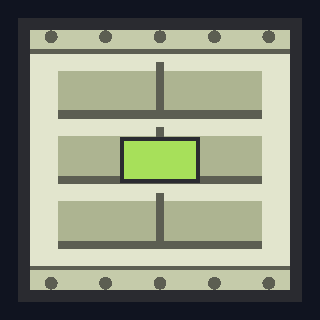
A general-purpose hold. Every other part carries what it was built to carry; this one carries whatever you put in it — food for a long trip, room for the crew's waste, or any other resource — and it stretches like a fuel tank to make room.
Every figure above is quoted at its base length — 4 m, a little taller than the Command Pod. The Length slider stretches it from 2 m to 16 m, and the hold, the shell's mass and the price all scale with it: a bay twice as long holds twice as much, weighs twice as much empty and costs twice as much to launch.
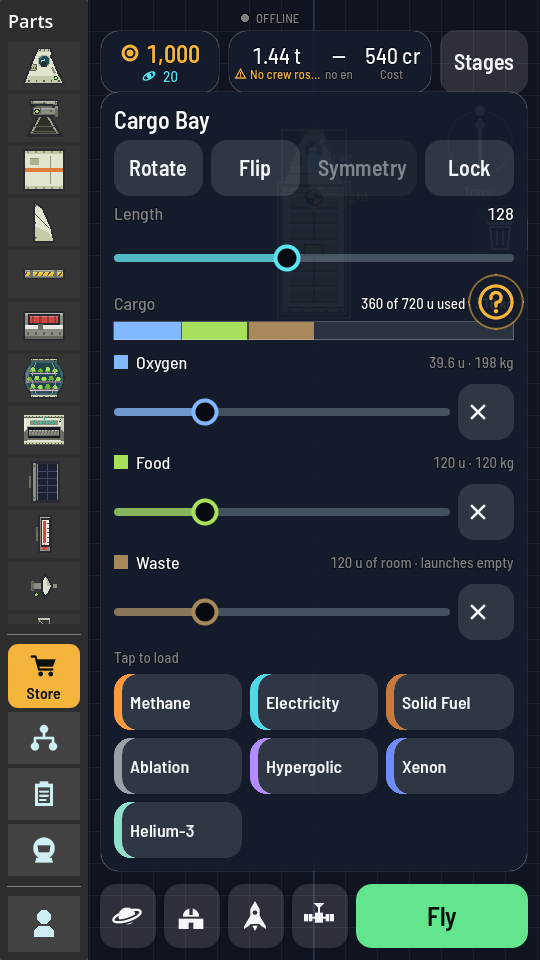
Loading it. The bay's panel in the hangar shows the hold as a coloured bar, one slider per resource in it and a tile for every resource it can still take. See Load a cargo bay.
A bay stretched to 8 m, holding oxygen, food and room for waste, with half its volume still free.
Every resource packs differently. The 360 u of volume holds 360 u of crated stores, but a liquid, a charge or a solid grain needs tanks, cells and racks the hold has to find room for, so fewer units fit. The ×figure on the CARRIES row is how many units of each one a unit of volume takes. At its base length, a bay full of one resource holds:
Resource
A full bay holds
Weighing
Food
360 u
360 kg
Waste
360 u of room
launches empty
Ablation
180 u
180 kg
Oxygen or methane
118.8 u
594 kg
Electricity
72 u
none
Solid fuel
36 u
432 kg
Hypergolic
36 u
288 kg
Xenon
108 u
108 kg
Helium-3
1.2 u of room
launches empty
Two resources share the volume: half a hold of food and half a hold of oxygen is 180 u and 59.4 u. That is on purpose: a bay is a poorer fuel tank than a Fuel Tank, a poorer battery than a battery and a poorer booster case than a booster, so it is the part to reach for when a ship needs a little of something it has no other room for.
Helium-3 is room too, and very little of it. Helium-3 is mined, never loaded, so a hold given to it launches empty like waste. A hold packs it badly: a whole bay keeps 1.2 kg, where the H3-4 Helium-3 Tank built for it keeps 15 kg at its base length and the H3-8 60 kg. Antimatter rides in no hold at all. See Helium-3 and antimatter.
Waste is room, not a load. Loading waste keeps that much of the hold free for what the crew leaves behind; it launches empty and weighs nothing on the pad. See Waste.
How much is a year?
A filled seat eats about 1 u of food a day, so the 360 u a bay holds at its shortest feeds one Meek for roughly a year. Two Meek halve that; stretch the bay instead.
Food, waste, electricity and thruster propellant run along every joint on the ship, so it does not matter where the bay sits — a pod three parts away eats out of it just the same. Fuel does not: the bay's joints carry no fuel, so a bay loaded with oxygen and methane feeds an engine only through a fuel line. See Resources.
The hold is loaded on the ground and nowhere else, so the bay's sliders are hangar-only. Tapping it in flight shows what is left in it, which is the figure that matters once you are under way.
Pairs with a Crew Capsule or a Passenger Cabin on anything going further than the Moon. Instead of bolting on more pods for their larders, which costs you their mass and their seats as well.
Cargo Bay L
Part · Life · sold by Wide Storage
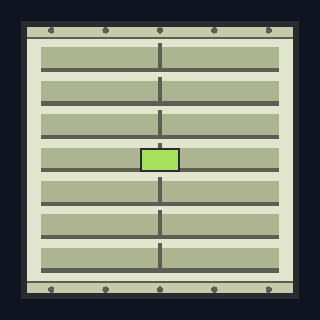
The Cargo Bay at 8 m across: eight times the hold per metre, loaded the same way with whatever the trip needs, and it stretches like the narrow one.
Every figure above is quoted at its base length of 8 m; the Length slider stretches it from 4 m to 24 m, and its hold, mass and price follow. It stacks top and bottom and offers a rail along each side. Loading it works exactly as the Cargo Bay's does: see Load a cargo bay.
Resource
A full bay holds
Weighing
Food
2880 u
2880 kg
Waste
2880 u of room
launches empty
Ablation
1440 u
1440 kg
Oxygen or methane
950.4 u
4752 kg
Electricity
576 u
none
Solid fuel
288 u
3456 kg
Hypergolic
288 u
2304 kg
Xenon
864 u
864 kg
Helium-3
9.8 u of room
launches empty
It has no actions to tap. Its properties, hangar only, are the Length slider and the STORAGE row.
Pairs with a Fuel Tank L in a wide stack, holding a station's stores or a year of food for a crew. Instead of a Fuel Tank L when the cargo is not fuel; full of oxygen and methane it carries 4.8 t where the tank carries 19 t.
Greenhouse
Part · Life · sold by Greenhouses
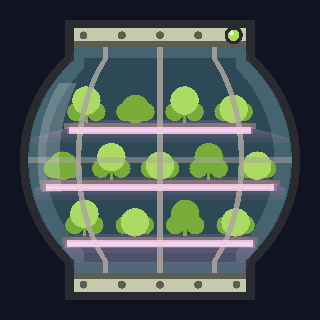
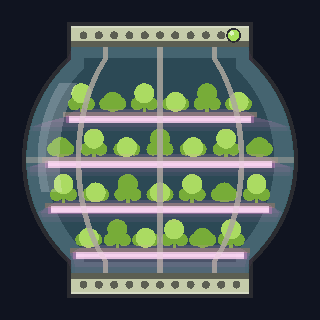
A glass bulb of plants that turns the crew's waste back into food, behind armoured shutters that close over the glass. It grows nothing unless a botanist is aboard the ship — anywhere aboard, not necessarily in the bulb. Open and tended, each crop grows for a day under grow lights and is harvested as 5 u of food from as much waste — 8 u with two botanists aboard, 10 u with three; a crop only ripens if the greenhouse stays open and the lights never lose power while it grows.
Figure
Value
DRY MASS
1600 kg
FULL MASS
1610 kg
COST
1500 cr
STORES ELECTRICITY
30 u
STORES FOOD
10 u · 10 kg
STORES WASTE
10 u · launches empty
CONSUMES ELECTRICITY
0.5 u/s
CONSUMES FOOD
1 u/day
DRAG NOSE-ON
0.8×
BODY LIFT CL
0.2
MAX TEMP STOWED
2000 K
MAX TEMP OPEN
380 K
MAX G STOWED
20 g
MAX G OPEN
2.5 g
IMPACT STOWED
14 m/s
IMPACT OPEN
3 m/s
BLAST
10 kN
EXPLODES
NO
ASTRONAUTS
1
NODES
2
STAGEABLE
YES
DEPLOY
6 s to open
SEATS
1, any trade
HARVEST
5 / 8 / 10 food from as much waste, only while open
BOTANISTS
1 to 3 aboard the ship, in any seat; none grows nothing
CROP TIME
24 h 0 min
GROW LIGHTS
0.5 u/s, unbroken: a power cut restarts the crop
SEAT POWER
1.73 u/day each
It joins the 4 m stack top and bottom, and swells to 6 m across in the middle. The grow lights draw 0.5 u/s for as long as a crop is growing: in a low orbit over Earth that is about three SP-6 Twin Arrays and some 320 u of battery for the night side. The moment the draw comes up short, the crop is lost and the next one starts from the beginning when power returns. A crop that ripens with no waste aboard waits, drawing nothing, until the crew has left enough.
Closed, the shutters cover the glass: it is as tough as a pod (2000 K, 20 g), rides a launch and a re-entry like any other module, and grows nothing. Open, the glass is bare and fragile: it breaks past 2.5 g or 380 K, so open it only once it is in orbit, or standing on a world with mild air, and close it before a burn that pushes hard, an aerobrake or a landing. Closing it loses the crop in progress; opening takes 6 s, and a crop starts only once it is fully open.
The botanists are the ship's. What a greenhouse harvests is decided by how many botanists are aboard the vessel — in a pod, in a Passenger Cabin, in another greenhouse, anywhere — not by who is sitting in this one. With none aboard nothing grows; one works every greenhouse on the ship, and a second and third raise every harvest. Three greenhouses with a botanist apiece all harvest at the three-botanist figure. A botanist is a passenger, so the ship still needs an astronaut in a pod.
Its own seat takes anybody. The bulb seats one Meek of any trade — the Crew row in the hangar, or Transfer crew in flight. Whoever sits there weighs 80 kg, eats 1 u of food a day out of any larder aboard — leaving a unit of waste, which is the compost the next crop grows on — and draws 1.73 u/day for their air. If no food anywhere aboard can reach them, they starve like any other crew.
One crop a day is 5, 8 or 10 u of food a day by the botanists aboard: enough for five, eight or ten Meek, each of whom eats one unit and leaves one unit of waste — the botanists included. Its own larder holds 10 u and it has room for 10 u of waste; a harvest goes into any food store aboard with room.
Tapped in flight, its sheet has an Open or Close button, Transfer crew, and one greyed line — Growing: 4 %, harvest in 23 h 0 min, No power: crop lost, restarts when lit, Ripe: waiting for 5 waste, No botanist aboard: nothing grows, Closed: nothing grows or Opening. It can be staged to open or close, and the hangar's Open switch sets how it starts; a new one starts closed.
Pairs with pods or Passenger Cabins, solar arrays and a big battery as the kitchen of a station; see Grow food in orbit. Instead of a Cargo Bay full of food when the crew stays longer than you can afford to lift their rations.
Greenhouse L
Part · Life · sold by Wide Greenhouses
The Greenhouse for the 8 m stack: the same glass bulb twice the size, holding four times the crops. A crop ripens every six hours — 5 u of food from as much waste, or 8 or 10 u with more botanists aboard — as long as at least one botanist rides the ship and its grow lights never lose power.
Figure
Value
DRY MASS
7200 kg
FULL MASS
7240 kg
COST
6200 cr
STORES ELECTRICITY
120 u
STORES FOOD
40 u · 40 kg
STORES WASTE
40 u · launches empty
CONSUMES ELECTRICITY
2 u/s
CONSUMES FOOD
1 u/day
DRAG NOSE-ON
0.8×
BODY LIFT CL
0.2
MAX TEMP STOWED
2000 K
MAX TEMP OPEN
380 K
MAX G STOWED
20 g
MAX G OPEN
2.5 g
IMPACT STOWED
14 m/s
IMPACT OPEN
3 m/s
BLAST
30 kN
EXPLODES
NO
ASTRONAUTS
1
NODES
2
STAGEABLE
YES
DEPLOY
10 s to open
SEATS
1, any trade
HARVEST
5 / 8 / 10 food from as much waste, only while open
BOTANISTS
1 to 3 aboard the ship, in any seat; none grows nothing
CROP TIME
6 h 0 min
GROW LIGHTS
2 u/s, unbroken: a power cut restarts the crop
SEAT POWER
1.73 u/day each
It joins the 8 m stack top and bottom, and swells to 12 m across in the middle. It opens and closes like the Greenhouse, over 10 s, with the same tolerances either way. The grow lights draw 2 u/s: in a low orbit over Earth, about twelve SP-6 Twin Arrays and some 1,300 u of battery for the night side, such as a B-1600 Battery Bank. Like the small one, a crop is lost the moment the power runs short, and a ripe crop waits for waste.
Four crops a day is 20 u of food a day with one botanist aboard, 32 u with two and 40 u with three: enough for twenty, thirty-two or forty Meek. Its one seat, its sheet and its Open switch are the Greenhouse's.
Pairs with a wide station stack and a B-1600 Battery Bank. Instead of four small Greenhouses when the station is built on the 8 m stack.