Every part in the Mining category: the rigs that dig helium-3, the tanks that carry it, the converters that turn it into antimatter, and the traps that hold that. Each comes in two sizes, a small mine on the 4 m stack and a wide one on the 8 m stack.
Mining parts are the far end of the game: a rig that stands on a deposit and digs, a converter that runs in space turning what it dug into antimatter, and the two stores built for loads no ordinary tank will take. Nothing in the chain is bought: every tank and every trap leaves the pad empty, and every microgram of antimatter a warp drive or a reactor burns was made here. The parts work on their own while nobody is watching, so what matters is the power you leave them and the room you leave them to fill. Read Helium-3 and antimatter for the chain, Mine helium-3 and Make antimatter for each half in use.
The small mine — MR-4, H3-4, AC-4 and AM-4 — is sold on tier 3, a tier before the first warp drive, and makes the probe's antimatter. The wide mine — MR-8, H3-8, AC-8 and AM-8 — is sold on tier 5 and makes enough for the crewed drives.
The small mine
The MR-8's drawing at half the diameter.
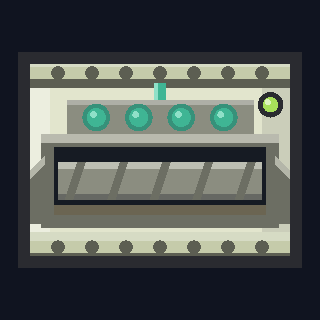
MR-4 Mining Rig
Part · Mining · sold by Helium-3 Prospecting
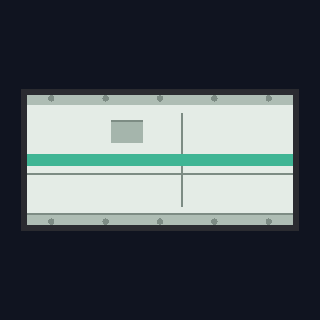
The probe-sized rig: an oven, an auger and a condenser that bake helium-3 out of the ground, small enough to ride on the 4 m stack. Land it on a helium-3 deposit you have found, switch it on, and it fills the helium-3 tanks aboard: 3 kg a day at grade ×1, times the deposit's grade.
Figure
Value
MASS
900 kg
COST
3500 cr
CONSUMES ELECTRICITY
0.24 u/s
DRAG NOSE-ON
0.9×
HEAT EXPOSURE
1.3×
BODY LIFT CL
0.2
MAX TEMP
1400 K
MAX G
12 g
IMPACT
14 m/s
BLAST
8 kN
NODES
4
MAKES
3 Helium-3 a day at grade ×1
WORKS
landed on a deposit you have found
FIND ONE
a survey contract, or a ground imager in orbit
POWER
0.24 u/s, only while working
It joins the 4 m stack top and bottom, and offers a rail along each side for radial parts, so legs and an array can hang on the rig itself. It is 3 m tall. It holds nothing itself: what it makes goes into any helium-3 tank aboard, wherever in the ship it sits, and it stops when they are full. Its 0.24 u/s is one SP-6 Twin Array in full sun, drawn only while it works. On the Moon's richest field, grade ×2.5, it makes 7.5 kg a day, which is the helium-3 for a Coil probe's leg to Mars in five and a half days.
Tapped in flight, its sheet has a Start or Stop button and one greyed line: Serenity Field: grade ×1, 100 % names the deposit and how much of full work it is managing, No deposit here: survey one, or image it from orbit, Nowhere to put it: every store is full or No power. In the hangar the same switch is the Running toggle, off on a new rig. It cannot be staged.
Pairs with an H3-4 Helium-3 Tank, an SP-6 Twin Array, a battery and Landing Struts as a small outpost; see Mine helium-3. Instead of it, the MR-8 once you fly the wide stack, which makes more than two and a half times as much.
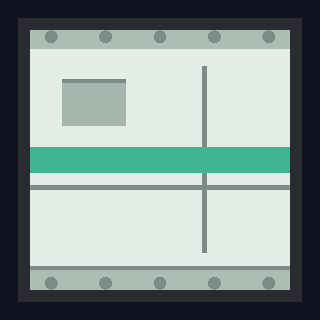
H3-4 Helium-3 Tank
Part · Mining · sold by Helium-3 Prospecting
A stretchable cold tank for helium-3 on the 4 m stack. It is mostly insulation, so it holds kilograms where a fuel tank its size holds tonnes. It launches empty: the only way to fill it is a Mining Rig on the same ship, or a pump from a ship docked to it.
Figure
Value
MASS
150 kg
COST
900 cr
STORES HE3
15 u · launches empty
DRAG NOSE-ON
1.0× (blunt)
HEAT EXPOSURE
1.45×
BODY LIFT CL
0.25
MAX TEMP
1600 K
MAX G
20 g
IMPACT
14 m/s
BLAST
8 kN
NODES
4
Every figure above is quoted at its base length of 4 m. One unit of helium-3 is one kilogram, so a full tank at that length is 15 kg heavier than an empty one, and one MR-4 on a grade ×1 deposit fills it in 5 days. Mass, price and capacity all follow the Length slider: at its longest it keeps 60 kg.
It stacks top and bottom, and offers a rail along each side for radial parts. Helium-3 runs along every joint on the ship, so it does not matter where the tank sits in the stack.
It has no actions of its own to tap; its sheet shows what it holds and offers Transfer resources when another helium-3 store is in reach. Its only property is a Length slider, from 48 to 256, hangar only.
Pairs with an MR-4 Mining Rig on the Moon and an AC-4 Antimatter Converter in orbit. Instead of it, the H3-8 on an 8 m stack, or a Cargo Bay given to helium-3, which keeps only 1.2 kg.
AC-4 Antimatter Converter
Part · Mining · sold by Antimatter Synthesis
A small orbital factory that turns helium-3 into antimatter, and the only way to fill a trap before the wide stack. It works only in space, draws helium-3 from any tank aboard and fills any AM-4 or AM-8 Antimatter Container aboard: 437 g of helium-3 to the microgram, 16 μg a day at full work, so an AM-4 fills in about three days.
Figure
Value
MASS
1400 kg
COST
5000 cr
CONSUMES ELECTRICITY
0.48 u/s
DRAG NOSE-ON
0.9×
HEAT EXPOSURE
1.3×
BODY LIFT CL
0.2
MAX TEMP
1400 K
MAX G
10 g
IMPACT
12 m/s
BLAST
16 kN
NODES
4
MAKES
16 Antimatter a day
FROM
6.99 Helium-3 a day
WORKS
only in space: above the air, off the ground
POWER
0.48 u/s, only while working
It joins the 4 m stack top and bottom, and offers a rail along each side for radial parts, so the arrays and batteries it needs can hang on the converter itself. It is 4 m tall. Antimatter is counted in micrograms and helium-3 in kilograms, so a full day's work is 16 μg out of about 7 kg. Its 0.48 u/s is two SP-6 Twin Arrays in full sun. When less power arrives than it asks for it works that much slower and takes that much less helium-3, so a brown-out wastes nothing. It stops when every container aboard is full.
Tapped in flight, its sheet has a Start or Stop button and one greyed line: Working at 100 %, Works only in space: above the air, off the ground, Nowhere to put it: every store is full, No power or Nothing to convert. In the hangar the same switch is the Running toggle, off on a new converter. It cannot be staged.
Pairs with two AM-4 Antimatter Containers, a helium-3 tank filled on the Moon and two SP-6 Twin Arrays: six days of it fill the traps a Coil probe burns to Mars. See Make antimatter. Instead of it, the AC-8, three times as fast, on the wide stack.
The probe's trap: the same drawing at half the diameter.
AM-4 Antimatter Container
Part · Mining · sold by Antimatter Containment
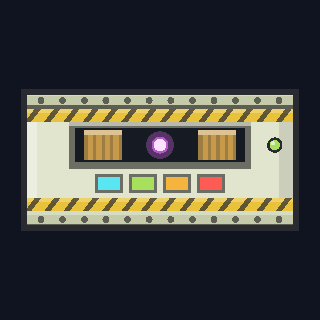
The probe's trap: the AM-8's magnetic trap on the 4 m stack, a quarter of the volume. It launches empty, an AC-4 Antimatter Converter fills it in space, it holds only in space, and it pays for its load by the gravity around it exactly as the big one does.
Figure
Value
MASS
500 kg
COST
1500 cr
STORES ANTIMATTER
50 u · launches empty
DRAG NOSE-ON
0.9×
HEAT EXPOSURE
1.3×
BODY LIFT CL
0.2
MAX TEMP
1400 K
MAX G
10 g
IMPACT
12 m/s
BLAST
4 kN
NODES
4
HOLDS
only in space, and it launches empty
UPKEEP
0.026 u/s × (1 + gravity gauge), only while loaded
GAUGE
3.9 low Earth orbit, 3.0 low Moon orbit, 0 deep space
UNPOWERED
leaks up to 0.01 μg a second, and the fuse burns
LANDED OR IN AIR
the same fuse: 60 s to vent or get back to space
WHEN IT GOES
about 5,900 kN full, over 54 m
Fifty micrograms is forty days of a WC-4 Warp Coil with its AR-4 counted, so a probe to Mars, a seventy-six-day leg of about 94 μg, carries two. Upkeep is 0.026 u/s times one plus the gauge: 0.13 u/s in low Earth orbit, half an SP-6 Twin Array in full sun. Its sheet, its fuse and its Vent antimatter button are the AM-8's. Antimatter moves between two docked ships with Transfer resources, so the traps can be filled on the converter's ship and emptied into the probe's.
Pairs with an AR-4 Antimatter Reactor, a WC-4 Warp Coil and a Sat Controller: the explorer probe. Recovering it on Earth refunds the part and nothing for what is left inside.
The wide mine
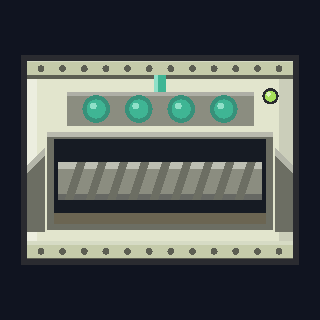
MR-8 Mining Rig
Part · Mining · sold by Helium-3 Mining
An oven, an auger and a condenser that bake helium-3 out of the ground, on the 8 m stack. Land it on a helium-3 deposit you have found, switch it on, and it fills the helium-3 tanks aboard: 8 kg a day at grade ×1, times the deposit's grade.
Figure
Value
MASS
3200 kg
COST
9000 cr
CONSUMES ELECTRICITY
0.48 u/s
DRAG NOSE-ON
0.9×
HEAT EXPOSURE
1.3×
BODY LIFT CL
0.2
MAX TEMP
1400 K
MAX G
12 g
IMPACT
14 m/s
BLAST
20 kN
NODES
4
MAKES
8 Helium-3 a day at grade ×1
WORKS
landed on a deposit you have found
FIND ONE
a survey contract, or a ground imager in orbit
POWER
0.48 u/s, only while working
It joins the 8 m stack top and bottom, and offers a rail along each side for radial parts, so legs and tanks hang on the rig itself. It is 6 m tall. The 4 m version is the MR-4 above. It holds nothing itself: what it makes goes into any helium-3 tank aboard, wherever in the ship it sits, and it stops when they are full. Its 0.48 u/s is two SP-6 Twin Arrays in full sun, drawn only while it works. While it is working the four mint coils on its condenser brighten one after another, so you can see at a glance that it is digging.
Tapped in flight, its sheet is the MR-4's: a Start or Stop button and the same greyed line. In the hangar the same switch is the Running toggle, off on a new rig. It cannot be staged.
Pairs with an H3-8 Helium-3 Tank, solar arrays, a B-1600 Battery Bank and LT-2 Landing Struts as a mining outpost; see Mine helium-3. Instead of it, the MR-4, or two of them, where a probe's warp is all the helium-3 is for.
H3-8 Helium-3 Tank
Part · Mining · sold by Helium-3 Mining
A stretchable cold tank for helium-3, on the 8 m stack, holding a week of an MR-8's work. It launches empty: the only way to fill it is a Mining Rig on the same ship, or a pump from a ship docked to it.
Figure
Value
MASS
600 kg
COST
2600 cr
STORES HE3
60 u · launches empty
DRAG NOSE-ON
1.0× (blunt)
HEAT EXPOSURE
1.45×
BODY LIFT CL
0.25
MAX TEMP
1600 K
MAX G
20 g
IMPACT
14 m/s
BLAST
20 kN
NODES
4
Every figure above is quoted at its base length of 4 m. One unit of helium-3 is one kilogram, so a full tank at that length is 60 kg heavier than an empty one, and one MR-8 on a grade ×1 deposit fills it in 7.5 days. Mass, price and capacity all follow the Length slider. The 4 m version is the H3-4 above.
It stacks top and bottom, and offers a rail along each side for radial parts. Helium-3 runs along every joint on the ship, so it does not matter where the tank sits in the stack.
It has no actions of its own to tap; its sheet shows what it holds and offers Transfer resources when another helium-3 store is in reach. Its only property is a Length slider, from 48 to 256, hangar only.
Pairs with an MR-8 Mining Rig on the Moon and an AC-8 Antimatter Converter in orbit; see Mine helium-3. Instead of it, a Cargo Bay L given to helium-3 keeps 9.8 kg in twice the length.
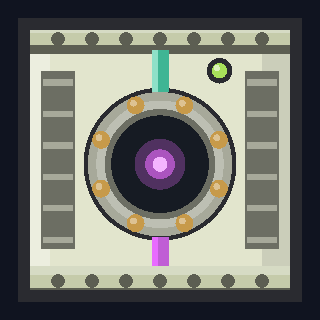
AC-8 Antimatter Converter
Part · Mining · sold by Antimatter Conversion
The wide orbital factory that turns helium-3 into antimatter. It works only in space, draws helium-3 from any tank aboard and fills any AM-8 or AM-4 Antimatter Container aboard: 437 g of helium-3 to the microgram, 48 μg a day at full work, so a big trap fills in three and a half days.
Figure
Value
MASS
5200 kg
COST
16000 cr
CONSUMES ELECTRICITY
1.2 u/s
DRAG NOSE-ON
0.9×
HEAT EXPOSURE
1.3×
BODY LIFT CL
0.2
MAX TEMP
1400 K
MAX G
10 g
IMPACT
12 m/s
BLAST
40 kN
NODES
4
MAKES
48 Antimatter a day
FROM
20.98 Helium-3 a day
WORKS
only in space: above the air, off the ground
POWER
1.2 u/s, only while working
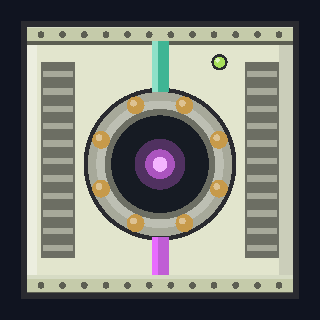
It joins the 8 m stack top and bottom, and offers a rail along each side for radial parts, so the arrays and batteries it needs can hang on the converter itself. It is 8 m tall. The 4 m version is the AC-4 above. A full day's work is 48 μg out of about 21 kg of helium-3, which is nearly three days of one MR-8 on a grade ×1 field, so an AC-8 is kept busy by several rigs or rests between tankers. Its 1.2 u/s is five SP-6 Twin Arrays in full sun. When less power arrives than it asks for it works that much slower and takes that much less helium-3, so a brown-out wastes nothing. It stops when every container aboard is full. While it is working the core in its ring pulses and a spark runs round the eight magnets, which is the plainest sign that it is running.
Tapped in flight, its sheet is the AC-4's: a Start or Stop button and the same greyed line. In the hangar the same switch is the Running toggle, off on a new converter. It cannot be staged.
Pairs with an AM-8 Antimatter Container, a helium-3 tank that was filled on the Moon, and a large power supply; see Make antimatter. Instead of it, the AC-4, a third as fast on two fifths of the power.
AM-8 Antimatter Container
Part · Mining · sold by Antimatter Conversion
A magnetic trap for micrograms of antimatter. It holds only in space, it must never lose power while loaded, and the stronger the gravity around it the more power it takes. It launches empty, and a converter aboard fills it in orbit from helium-3.
Figure
Value
MASS
1800 kg
COST
4000 cr
STORES ANTIMATTER
170 u · launches empty
DRAG NOSE-ON
0.9×
HEAT EXPOSURE
1.3×
BODY LIFT CL
0.2
MAX TEMP
1400 K
MAX G
10 g
IMPACT
12 m/s
BLAST
10 kN · 1.1 m
NODES
4
HOLDS
only in space, and it launches empty
UPKEEP
0.05 u/s × (1 + gravity gauge), only while loaded
GAUGE
3.9 low Earth orbit, 3.0 low Moon orbit, 0 deep space
UNPOWERED
leaks up to 0.02 μg a second, and the fuse burns
LANDED OR IN AIR
the same fuse: 60 s to vent or get back to space
WHEN IT GOES
the biggest blast in the game: 20,070 kN full
It joins the 8 m stack top and bottom, and offers a rail along each side for radial parts. It is 4 m tall and does not stretch. The 4 m version is the AM-4 above. One unit of antimatter is one microgram and weighs nothing, so a full container weighs what an empty one does. The BLAST figure is the empty case: a load adds to it, up to about 20,000 kN reaching 99 m with all 170 μg aboard — the largest blast in the game, four times the biggest fuel tank, and it goes off however the container is destroyed.
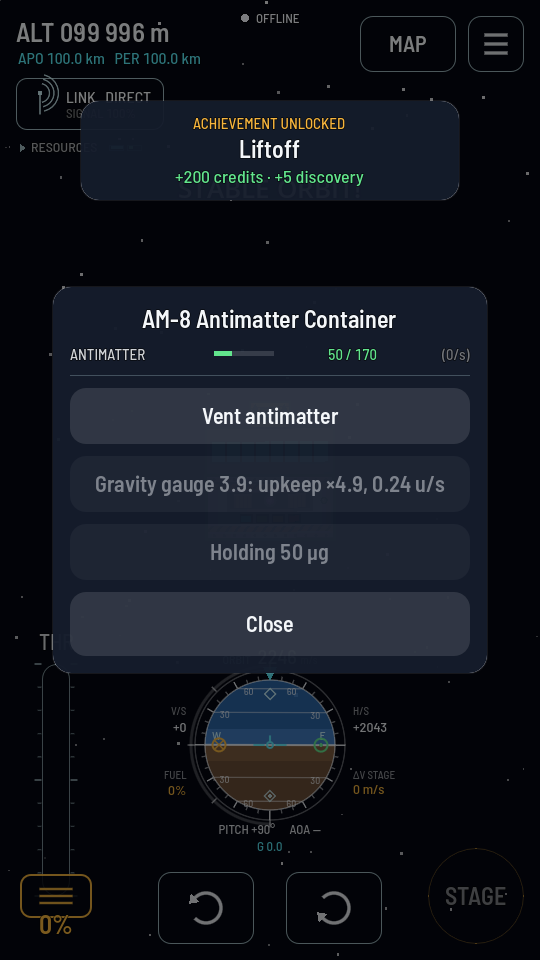
The gravity gauge. Four lamps on the casing light one at a time as gravity around the ship gets stronger, and the sheet gives the reading as a number. Upkeep is 0.05 u/s multiplied by one plus the reading: 0.24 u/s in low Earth orbit, 0.05 u/s in the outer system. An empty container is switched off and draws nothing. While the 60 second fuse is burning the whole row beats red, so a trap in trouble is visible on the ship without opening its sheet. The gravity gauge has the table of readings.
Low Earth orbit is the dearest place to keep it: the gauge reads 3.9 and the upkeep is nearly five times the base draw.
Tapped in flight, its sheet shows the load, a Vent antimatter button and two greyed lines. The first is the gauge: Gravity gauge 3.9: upkeep ×4.9, 0.24 u/s. The second is what the trap is doing: Holding 50 μg, POWER SHORT: leaking, fails in 49 s, CONTAINMENT FAILING: 42 s or Empty: switched off. Venting empties every container aboard at once, safely. It has no properties to set and cannot be staged.
Careful
Landed, or anywhere inside an atmosphere, a loaded container starts a 60 s fuse and then explodes with its load. Vent it before you come down, or get back above the air in time. See Keep antimatter safe.
Pairs with an AC-8 Antimatter Converter, solar arrays and a battery big enough for every shadow the orbit crosses, and with an AR-8 reactor and a Warp Ring on a crewed ship. Antimatter rides in no cargo hold; the only other trap is the AM-4.