Night, lamps and shadows
The sun is the only light in the solar system until you bring your own. On a world's night side, and in a world's shadow in orbit, the ground and your ship are almost black; a lamp lifts the dark off whatever its light falls on.
The dark
Night falls where the sun does on a real planet: on the side of a world turned away from it, with a twilight band and, where there is air, a sunset glow between the two. Deep in the night the ground keeps only a cold blue trace of its colours, and a ship in a world's shadow, on the ground or in orbit, goes nearly as dark. You can still see the shapes against the stars; you cannot see where the ground is rough, where the sea starts, or which way a lander is leaning.
The map is the exception: it is a chart, and it keeps its night side lighter so you can read it at a glance.
Lamps
Two parts give light, both sold by the Lighting node:
- The SL-1 Signal Light shines all round, red or green, steady or blinking. It is for being seen: running lights, a marker on a station, a lander you want to find again.
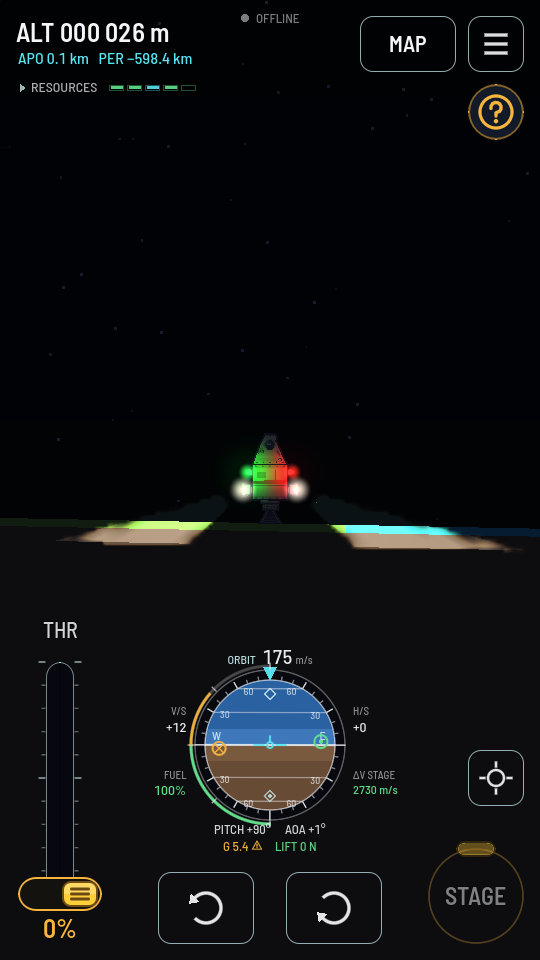
- The FL-30 Floodlight throws a white beam 30 degrees wide and 90 metres long. It is for seeing: the ground under a lander, the ship you are about to dock with.
Where a lamp's light falls, the night is taken off: the ground and every ship in the light show their own colours again, brightest close to the lamp and fading towards the edge of its reach. A coloured lamp shows things in its colour, so a red light makes a hull red and a green one green, and where a red and a green light overlap you see both. Light reaches into the ground only as far as its surface: a beam that meets the ground lights a patch of it and goes no further.
A lamp's light is stopped by other ships. One parked between your floodlight and the ground throws a shadow across the beam. Your own ship never stands in its own shadow: lamps are mounted on the outside of the hull, and they light the ship they are on.
A bright lamp still shows by day. In sunlight its glow and the patch it lights are fainter than at night, as a real one's are, but a floodlight at full brightness is still a mark on sunlit ground. A lamp also shows as a soft glow at its own lens, and a blinking one blinks.
Light costs power
A lamp draws its power for as long as it is on, at its Brightness: nothing while it is off, and the whole of its figure while it blinks, since a blinking lamp is a lamp that is on. A signal light is a trickle; a floodlight is one of the bigger loads a small ship carries, about what two small solar panels make. When the batteries run flat every lamp aboard goes dark, and its sheet says No power.
This goes on while you are away. A floodlight left burning on a lander you have left runs its battery down on the shared clock, exactly as it would if you were flying it. The one exception is the launch pad before the launch: a ship standing there spends nothing, so lamps switched on in the hangar shine on the pad for free. See Electricity.
Ships' shadows
A ship in sunlight throws a shadow away from the sun. It falls along the ground beside a lander, longest when the sun is low, and across any other ship that stands in it, which goes as dark as it would in a world's shadow. A shadow fades out a few dozen ship-lengths behind the ship that throws it, because the sun is a disc and not a point. As with lamps, a ship never stands in its own shadow.
What does not change
Light is for your eyes, not for the ship. A dark ship flies exactly as a lit one does, solar panels charge only by the sun, and an instrument's reading does not care what it can see. Clouds are not lit by lamps: they keep their own night.