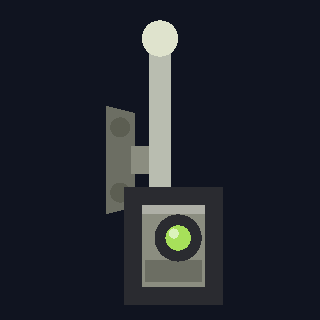
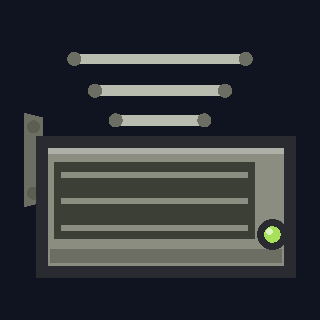
All six antennas: three whips and dishes that only fly their own ship, three relays that also carry other ships' traffic, with their figures from the info card.
They come in pairs. At each of three sizes there is a plain antenna and a relay rated the same, and the relay costs more, weighs more and draws more charge for it. Read Communications for what the two roles mean and why a range is never a single number.
Three rows on these cards are worth knowing before the entries. RANGE is the part's own rating, not how far it reaches. VIA L1 STATION is what it manages talking to a Comm Station nobody has extended, which is the figure you plan a first mission with. ROLE is transmit, or transmit and relay.
A relay's card carries three more, because carrying other ships costs it power. CLIENTS is the most ships it will ever pass on for, PER CLIENT what one of them costs a second, and POWER AT FULL the whole bill with every slot taken — the figure to size panels against. Communications explains what happens when the power runs short.
CW-1 Whip
Part · Comms · sold by Radio Comms
The first antenna: a fixed rod rated at 50 Mm against the Sat Controller's built-in 3,000 km. Put one on anything uncrewed that leaves low orbit.
Figure
Value
MASS
8 kg
COST
90 cr
CONSUMES ELECTRICITY
345.6 u/day
DRAG NOSE-ON
0.5×
HEAT EXPOSURE
0.5×
MAX TEMP
1200 K
MAX G
15 g
IMPACT
10 m/s
STRIKE
3 m/s
BLAST
2 kN
NODES
1
RANGE
50 Mm
ROLE
Transmit
VIA L1 STATION
50 Mm
DATA RATE
500 bps
One radial attachment point: it bolts to a flank and stays there. A whip has no latch, so it is never stowed, never staged, and works from the moment the ship leaves the pad.
It has no actions. Its one setting is an Antenna on toggle, on its sheet in the hangar and in flight. Switched off it draws nothing and hears nothing, which is exactly as good as having no antenna aboard.
Careful
Its 345.6 u/day is the heaviest steady draw a small probe carries. Give anything that fits one a solar panel, or it will be flying on a battery that empties in hours.
Pairs with a Sat Controller and an SP-1 Solar Panel: that is the whole probe kit. Instead of it, the CR-1 Relay Whip when this ship is meant to keep others in contact too.
CR-1 Relay Whip
Part · Comms · sold by Radio Comms
The same reach as the CW-1, but other ships' commands may pass through it. This is the cheapest part that turns a satellite into a piece of a network.
Figure
Value
MASS
18 kg
COST
200 cr
CONSUMES ELECTRICITY
0.01 u/s
DRAG NOSE-ON
0.55×
HEAT EXPOSURE
0.55×
MAX TEMP
1200 K
MAX G
15 g
IMPACT
10 m/s
STRIKE
3 m/s
BLAST
2 kN
NODES
1
RANGE
50 Mm
ROLE
Transmit + relay
VIA L1 STATION
50 Mm
DATA RATE
500 bps
CLIENTS
up to 10
PER CLIENT
0.004 u/s
POWER AT FULL
0.05 u/s
One radial attachment point, fixed like the CW-1. Nothing to deploy and nothing to stage.
It has no actions. Its settings are the Antenna on toggle and Clients carried, both in the hangar and in flight. Switching off the relay a chain runs through strands whatever was behind it.
Ten ships at 0.004 u/s each is 0.05 u/s all in, which is two SP-1 Solar Panels. One panel and a battery carries a handful of ships comfortably and sheds the rest when the sun goes.
Pairs with a high, wide orbit: a relay is worth more the further out it sits, because it sees over the world that would otherwise be in the way. Instead of it, the CW-1 Whip on a probe that is only ever the end of a chain.
CD-2 Dish
Part · Comms · sold by Deep Space Comms
A folding dish two hundred times the whip's rating: the antenna that takes a probe past the Moon and out into the system. It rides the ascent latched in its housing and swings out on a boom when you deploy it.
Figure
Value
MASS
45 kg
COST
420 cr
CONSUMES ELECTRICITY
0.02 u/s
DRAG NOSE-ON
0.8×
HEAT EXPOSURE STOWED
0.36×
HEAT EXPOSURE OPEN
0.8×
MAX TEMP STOWED
2000 K
MAX TEMP OPEN
700 K
MAX G STOWED
20 g
MAX G OPEN
2.5 g
IMPACT STOWED
10 m/s
IMPACT OPEN
0.8 m/s
BLAST
3 kN
COMM DEPLOY
1.6 s
NODES
1
STAGEABLE
YES
RANGE
10.0 Gm
ROLE
Transmit
VIA L1 STATION
707 Mm
DATA RATE
4000 bps
One radial attachment point. It is stowed when it leaves the hangar, and a stowed dish is worth nothing: until the boom is out the ship is flying on whatever else it carries.
Its sheet offers Deploy while stowed and Stow once it is out, and the same action can be put in a stage. It also carries the Antenna on toggle.
Heads up
Open, it takes 2.5 g and 700 K before it breaks. Deploy it after the burn, not before, and stow it again before you go back into air.
Pairs with a Comm Station at level 2, which lifts the pair from 707 Mm to a full 10.0 Gm. Instead of it, the CR-2 Relay Dish where the ship must also carry somebody else's traffic.
CR-2 Relay Dish
Part · Comms · sold by Deep Space Comms
The CD-2's reach with the relay role: the satellite you park in a high orbit round the Moon or Mars so everything you fly there talks through it.
Figure
Value
MASS
85 kg
COST
900 cr
CONSUMES ELECTRICITY
0.04 u/s
DRAG NOSE-ON
0.85×
HEAT EXPOSURE STOWED
0.38×
HEAT EXPOSURE OPEN
0.85×
MAX TEMP STOWED
2000 K
MAX TEMP OPEN
700 K
MAX G STOWED
20 g
MAX G OPEN
2.5 g
IMPACT STOWED
10 m/s
IMPACT OPEN
0.8 m/s
BLAST
3 kN
COMM DEPLOY
1.6 s
NODES
1
STAGEABLE
YES
RANGE
10.0 Gm
ROLE
Transmit + relay
VIA L1 STATION
707 Mm
DATA RATE
4000 bps
CLIENTS
up to 25
PER CLIENT
0.008 u/s
POWER AT FULL
0.24 u/s
One radial attachment point, folding like the CD-2, and deaf while it is stowed.
Its sheet offers Deploy and Stow, tapped or staged, plus the Antenna on toggle and Clients carried. Deploy it as soon as the ship is settled in the orbit you want it to live in, then leave it alone.
Note
Listening costs 0.04 u/s — a B-400 Battery Bank for two hours and forty-six minutes. Carrying its full twenty-five costs 0.24 u/s, which is the same battery in twenty-eight minutes, and exactly one SP-6 Twin Array in the sun. A relay parked round a world needs a panel that covers the dark side, not just a bigger battery, and the Clients carried setting is how you hold the bill down until it has one.
Pairs with an SP-3 Solar Array and a B-90 Battery on a satellite meant to sit still. Instead of it, the CD-2 Dish when the ship is the one being flown rather than the one holding the chain up.
CD-3 Deep Space Dish
Part · Comms · sold by Interplanetary Comms
The biggest transmitter: fifty times the CD-2's rating, for a probe going somewhere no relay of yours has reached yet.
Figure
Value
MASS
150 kg
COST
1600 cr
CONSUMES ELECTRICITY
0.06 u/s
DRAG NOSE-ON
0.9×
HEAT EXPOSURE STOWED
0.41×
HEAT EXPOSURE OPEN
0.9×
MAX TEMP STOWED
2000 K
MAX TEMP OPEN
700 K
MAX G STOWED
18 g
MAX G OPEN
2.5 g
IMPACT STOWED
10 m/s
IMPACT OPEN
0.8 m/s
BLAST
4 kN
COMM DEPLOY
1.6 s
NODES
1
STAGEABLE
YES
RANGE
500.0 Gm
ROLE
Transmit
VIA L1 STATION
5.0 Gm
DATA RATE
24000 bps
One radial attachment point, folding like the other dishes, and deaf while stowed.
Its sheet offers Deploy and Stow, tapped or staged, plus the Antenna on toggle.
Note
Mars is between 7.1 Gm and 34.3 Gm from Earth as the two go round. A CD-3 against a first-level Comm Station reaches 5.0 Gm, so it is the station's third level that actually opens the planets, not the dish alone.
Pairs with a Comm Station at level 3, which lifts the pair to the dish's full 500.0 Gm. Instead of it, the CD-2 Dish anywhere inside the Moon's orbit, which costs 420 cr against this one's 1,600 and does the same job there.
CR-3 Deep Space Relay
Part · Comms · sold by Interplanetary Comms
The last antenna and the most expensive part in the Comms category: a deep-space dish that also carries other ships' traffic, so one satellite can hold up everything you fly at another planet.
Figure
Value
MASS
260 kg
COST
3200 cr
CONSUMES ELECTRICITY
0.1 u/s
DRAG NOSE-ON
0.95×
HEAT EXPOSURE STOWED
0.43×
HEAT EXPOSURE OPEN
0.95×
MAX TEMP STOWED
2000 K
MAX TEMP OPEN
700 K
MAX G STOWED
18 g
MAX G OPEN
2.5 g
IMPACT STOWED
10 m/s
IMPACT OPEN
0.8 m/s
BLAST
5 kN
COMM DEPLOY
1.6 s
NODES
1
STAGEABLE
YES
RANGE
500.0 Gm
ROLE
Transmit + relay
VIA L1 STATION
5.0 Gm
DATA RATE
24000 bps
CLIENTS
up to 60
PER CLIENT
0.012 u/s
POWER AT FULL
0.82 u/s
One radial attachment point, folding like the other dishes, and deaf while stowed.
Its sheet offers Deploy and Stow, tapped or staged, plus the Antenna on toggle and Clients carried.
Careful
At 0.1 u/s just listening, this is the hungriest part in the category — and carrying its full sixty is 0.82 u/s, three and a half SP-6 Twin Arrays' worth. Each of those sixty costs 0.012 u/s, three times what a whip's short hops cost, because every one of them is being pushed across the solar system. Fly it with the arrays and a B-400 Battery Bank, or turn Clients carried down to what your panels really cover; otherwise it runs itself flat in the first long eclipse and drops the ships behind it.
Pairs with a high orbit round the world you mean to work at, so probes down at the surface talk through it instead of to Earth. Instead of it, the CD-3 Deep Space Dish on the probe itself, which is half the price and only has to talk for one ship.