Every part in the Struct category: the couplers that let a stage go, the shells that carry cargo through the air, and the ring and the claw two ships join through.
These are the parts a rocket comes apart on, and the parts that put it back together. Read Staging for how one of them is fired at the right moment, Debris and dropped stages for what happens to whatever comes off, and Rendezvous and docking for the joint two ships make in orbit.
Decoupler
Part · Struct · sold by Radial Staging
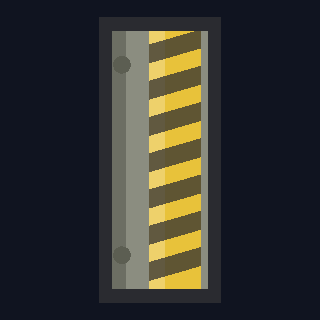
Drops a booster strapped to the flank. Put one between the rocket's side and each strap-on, and the strap-ons fall away when the stage fires.
Figure
Value
MASS
50 kg
COST
40 cr
DRAG NOSE-ON
1.0× (blunt)
MAX TEMP
3000 K
MAX G
22 g
IMPACT
16 m/s
BLAST
15 kN
SEPARATES
INNER
PUSH
2.5 m/s
NODES
2
STAGEABLE
YES
It has two points, back to back on its flanks. The inner one bolts against the rocket's side; the outer one carries the booster. When it fires, it is destroyed: both points let go and it blows itself clear in a small flash, so it leaves with neither the booster nor the rocket. What it was holding is sprung apart as it goes — the booster outward off the flank, the rocket a little the other way, opening at 2.5 m/s between them. That shove is shared by weight, so a light case takes nearly all of it and a heavy rocket barely leans: it is enough to let go of the flank cleanly, not enough to throw a booster clear of a burning stage. For that, see the Separation Motor.
Its part sheet offers Fire, greyed until the rocket has launched, and Fuse lit while the fuse burns: once fired, it cannot be stopped. It has no properties. Put it in a stage to fire it at the right moment instead of tapping it.
Pairs with a Solid Booster or a flank tank. Instead of the Separator, which cuts a stack in line rather than on the side.
Separator
Part · Struct · sold by Staging
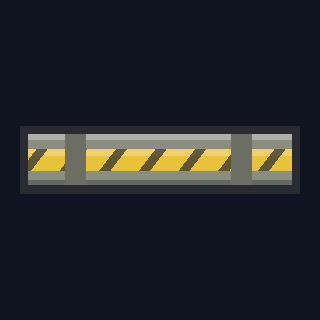
Cuts a stack in two. Put it between a spent stage and the one above it, and one tap of STAGE leaves the old stage behind.
Figure
Value
MASS
50 kg
COST
50 cr
DRAG NOSE-ON
1.0× (blunt)
MAX TEMP
3000 K
MAX G
22 g
IMPACT
16 m/s
BLAST
15 kN
SEPARATES
TOP + BOTTOM
PUSH
2.0 m/s
NODES
2
STAGEABLE
YES
It sits in line, one stack point on top and one underneath, and both of them let go. Nothing is left holding it, so it blows itself clear in a small flash instead of tumbling along behind you. The two stages are sprung apart as it goes, opening at 2.0 m/s between them — shared by weight, so the lighter half is the one that really moves and the spent stage drops away instead of hanging under your engine bell.
Its part sheet offers Fire, greyed until the rocket has launched. It has no properties. In the staging list, put it in the same stage as the engine above it and the new stage lights as the old one falls.
Pairs with the engine of the stage above it. Instead of the Decoupler, which drops a booster off the flank.
FTS Charge
Part · Struct · sold by Flight Termination
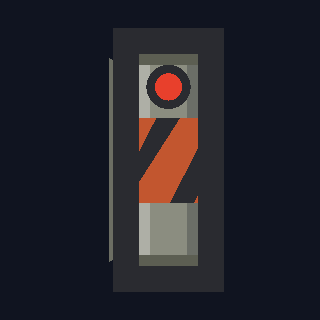
A flight termination charge. Bolt it to the side of a tank or a booster, fire it, and the part it is bolted to is destroyed along with it.
Figure
Value
MASS
6 kg
COST
25 cr
DRAG NOSE-ON
0.8×
MAX TEMP
10000 K
MAX G
10000 g
IMPACT
500 m/s
STRIKE
500 m/s
BLAST
4000 kN
FUSE
1 s
NODES
1
STAGEABLE
YES
ON FIRE
Destroys every part it is attached to when the fuse runs out
It is the slimmest part in the palette, a strip barely proud of the hull, and has the biggest blast in the game. It has one point, on its flank, and mounts on the side of whatever it is dropped against. Firing it lights a one-second fuse, so whatever is flying away from it, a capsule on its escape motor or a stage you have just dropped, gets clear first. When the fuse runs out it blows up and takes every part it is attached to with it, however heavy or strong that part is. A tank it destroys goes up in turn with its own blast, so on a full stage one charge can take a great deal more than the tank it sat on.
Its part sheet offers Fire, greyed until the rocket has launched, and Fuse lit while the fuse burns: once fired, it cannot be stopped. It has no properties. Put it in a stage to fire it at a set moment: it goes off last in its stage, after that stage's engines light and its separators fire, so one stage can drop a booster and destroy it.
It goes off only when you fire it. It is rated far past anything else aboard for load, heat, landing and blows, so a hard ascent, a re-entry, a crash or a tank exploding beside it never sets it off. If the part it is bolted to is destroyed some other way, the charge falls away whole.
Pairs with a spent stage or booster you want gone rather than falling in one piece. Instead of a Separator, which lets a stage go whole.
Payload Bay
Part · Struct · sold by Payload Bay
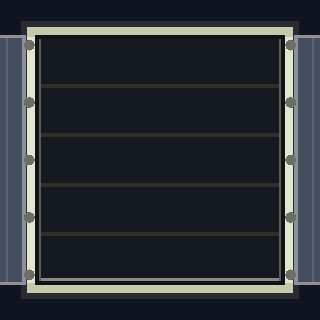
A hollow hull with clamshell doors. Mount instruments on the rails inside and they ride up out of the airflow, then open the doors in orbit to use them.
Figure
Value
MASS
340 kg
COST
140 cr
DRAG NOSE-ON
1.0× (blunt)
HEAT EXPOSURE
1.2×
BODY LIFT CL
0.2
MAX TEMP
2100 K
MAX G
18 g
IMPACT
16 m/s
BLAST
45 kN
NODES
5
STAGEABLE
YES
PAYLOAD
Sheltered from drag and heat
CAVITY
52 × 52 px
DOORS
Tap in flight to open
MASS, COST and CAVITY are quoted at the bay's starting length, 64 px. Its properties sheet carries one slider, Length, from 48 px to 256 px, and all three grow with it. The slider is hangar-only.
It has a stack point at each end and three rails inside: the two inner walls and the floor. There are no rails on the outside, so a part dropped near the bay goes in it rather than on it.
Its part sheet offers Open doors and Close doors, worded by which way they are. Staging it swings them the other way, so one stage can open them and a later one shut them. The doors stay however you left them, so a satellite abandoned with its bay open is found open.
Pairs with a Thermometer, a Barometer, a Mass Spectrometer or any instrument you want kept out of the airflow. Instead of a Payload Fairing, which is thrown away rather than closed again.
Payload Bay L
Part · Struct · sold by Wide Fairings
The Payload Bay for the 8 m stack: the same hollow hull and clamshell doors, as wide as a wide tank, so a whole 4 m part fits inside it out of the airflow.
Figure
Value
MASS
2200 kg
COST
950 cr
DRAG NOSE-ON
1.0× (blunt)
HEAT EXPOSURE
1.2×
BODY LIFT CL
0.2
MAX TEMP
2100 K
MAX G
18 g
IMPACT
16 m/s
BLAST
120 kN
NODES
5
STAGEABLE
YES
PAYLOAD
Sheltered from drag and heat
CAVITY
116 × 116 px
DOORS
Tap in flight to open
MASS, COST and CAVITY are quoted at the bay's starting length, 128 px. Its Length slider runs from 64 px to 384 px, and all three grow with it. The slider is hangar-only.
It mounts and works exactly like the Payload Bay: a stack point at each end, rails on the two inner walls and the floor, and Open doors / Close doors on its part sheet or its stage.
Pairs with a Fuel Tank L or an Adapter above and below it, and with anything up to a 4 m part inside. Instead of a Payload Fairing L, which is thrown away rather than closed again.
Docking Port
Part · Struct · sold by Docking
A latching ring. Bring it face to face with another one in orbit, slowly and squarely, and the two ships become one with their tanks plumbed together.
Figure
Value
MASS
60 kg
COST
200 cr
DRAG NOSE-ON
0.95×
HEAT EXPOSURE
0.95×
MAX TEMP
2000 K
MAX G
20 g
IMPACT
10 m/s
BLAST
4 kN
SEPARATES
PORT
PUSH
0.4 m/s
NODES
2
STAGEABLE
YES
DOCK GAP
1.0 m
DOCK SPEED
0.8 m/s
DOCK CONE
40 °
DOCK SPIN
0.25 rad/s
Its stack point sits underneath; the latching face is on top. That face takes nothing but another Docking Port, so it cannot be built over by accident. Two of them can be joined in the hangar, which is how you build a ship with a joint it can shed later.
The four DOCK rows are the latch's limits: how close the two faces must be, how slowly they may close, how far off square they may point, and how fast the two ships may turn against each other. Where the two ports differ, the tighter figure is the one that counts. Every resource crosses the joint once it is made: fuel, hypergolic propellant, electricity, food, waste, xenon, helium-3, antimatter and data.
Its part sheet offers Undock, greyed while nothing is docked to it. Staging it cuts the joint the same way, and pushes the two halves gently apart.
It also carries a Docking switch, on the sheet in the hangar and in flight, and on unless you turn it off. Clear it and the ring stops latching altogether: you can hold station a metre off another ship, fly a tug past a station, or pass a ring by without the two snapping together. A ring you switch off while it is already docked still undocks normally — the switch decides what the ring catches, never what it lets go of. Each ring has its own, so a station can leave one berth live and the rest shut.
Pairs with an RCS Thruster Block and a tank of hypergolic propellant, which is what the last few metres are flown on. Instead of the Separator, which cuts a joint and can never make one.
Grappling Claw
Part · Struct · sold by Grappling
Jaws on the end of a stack. Fly them slowly and squarely into any part of another ship — one with no docking port, a spent stage, a station whose ports are all taken — and they bite, and the two ships become one.
Figure
Value
MASS
150 kg
COST
600 cr
DRAG NOSE-ON
1.0× (blunt)
MAX TEMP
1800 K
MAX G
18 g
IMPACT
10 m/s
BLAST
4 kN
SEPARATES
GRIP
PUSH
0.3 m/s
NODES
2
STAGEABLE
YES
GRAB GAP
1 m
GRAB SPEED
1 m/s
GRAB CONE
35 °
GRAB SPIN
0.3 rad/s
Its stack point sits underneath; the jaws are on top. Nothing can be bolted to the jaws in the hangar — they are for closing on a ship in flight.
The four GRAB rows are the jaws' limits, read the way a Docking Port's DOCK rows are: how close they must come to the other ship's hull, how slowly they may close, how far off square to that side of the hull they may point, and how fast the two ships may turn against each other. The part they bite has no latches of its own, so the claw's figures are the only ones that count. The held ship is turned square onto the jaws as they close.
What crosses the grip is whatever the part it holds carries. Grab a fuel tank and its oxygen and methane can be pumped across; grab a pod or a probe core and only charge, food, waste and hypergolic propellant can, since fuel never passes through those. The claw's own stack point carries fuel, so mount it straight on a tank if a refuelling is the point.
Its part sheet offers Release, greyed while it holds nothing, and one property, Armed, in the hangar and in flight. A disarmed claw closes on nothing, so you can fly it past a ship you do not mean to catch. Staging it releases what it holds; either way the two ships are pushed gently apart.
Pairs with an RCS Thruster Block and a tank of hypergolic propellant for the last few metres. Instead of the Docking Port, which is lighter and cheaper but needs a port on the other ship too.
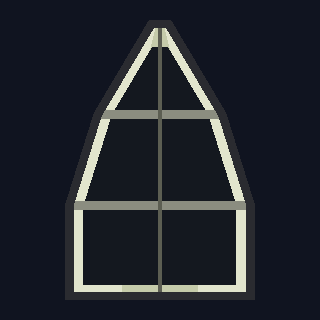
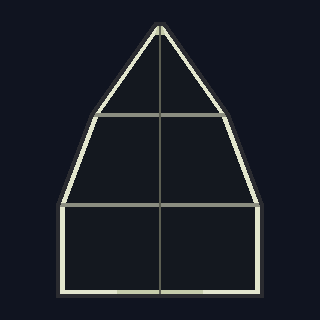
Payload Fairing
Part · Struct · sold by Payload Fairings
A shell over the nose of the rocket. What fits inside it rides up with no drag and no heating of its own, and the shell is split off and thrown away once the air is thin.
Figure
Value
MASS
210 kg
COST
60 cr
DRAG NOSE-ON
0.15×
HEAT EXPOSURE
0.9×
BODY LIFT CL
0.25
MAX TEMP
3300 K
MAX G
16 g
IMPACT
10 m/s
BLAST
25 kN
NODES
2
STAGEABLE
YES
PAYLOAD
62 × 84 px
RINGS
2, base to nose: 72 / 48 px
JETTISON
Splits into two halves
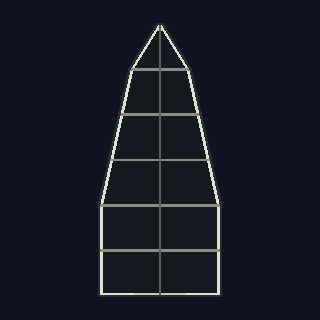
The shell is a stack of rings: a base a little wider than a tank, so a capsule or a cabin of the stack's width fits inside once the rings are opened to match, two rings you can widen or narrow, and a tip. Its properties sheet carries a Length slider from 64 px to 256 px and one slider per ring, Lower ring and Upper ring, from 16 px to 96 px each. The figures above are what the card reads at the settings a fresh one is placed with; MASS, COST, PAYLOAD and RINGS all follow the sliders. Mass and price go with the skin, so a taller or a fatter shell costs more of both. All the sliders are hangar-only.
It has two points, both on the base plate and both riding the Length slider: a stack point underneath, and a mounting point just inside it that the cargo sits on. Power and food reach the cargo through that point, so an instrument under the shell still runs off the ship.
Careful
The fit is judged against the taper, not against the widest ring. A payload that clears the middle but stands out through the nose is not covered, and the hangar says so under the ship's mass, naming the part that sticks out: "Sat Controller outside the fairing". The rocket still flies, and the shell breaks up the moment it launches: its two halves fall away and the payload stays on the stage the shell stood on, exactly as after a jettison.
Its part sheet offers Jettison, greyed until the rocket has launched. It splits into two halves, which are flown, not deleted, and they tumble down behind you. Whatever was on the mounting point stays behind on the part below.
Pairs with a satellite that will not survive the ascent bare. Instead of the Contoured Fairing, which has five rings for a payload this one cannot be drawn around.
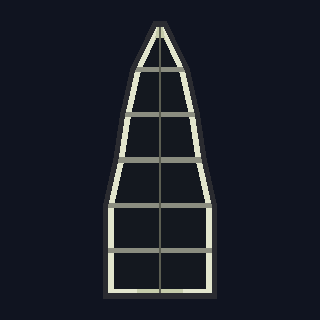
Contoured Fairing
Part · Struct · sold by Contoured Fairings
A taller shell with five rings instead of two: five places to bend the skin, so it goes round a payload the plain fairing will not.
Figure
Value
MASS
380 kg
COST
120 cr
DRAG NOSE-ON
0.15×
HEAT EXPOSURE
0.9×
BODY LIFT CL
0.25
MAX TEMP
3300 K
MAX G
16 g
IMPACT
10 m/s
BLAST
25 kN
NODES
2
STAGEABLE
YES
PAYLOAD
62 × 148 px
RINGS
5, base to nose: 72 / 72 / 60 / 48 / 36 px
JETTISON
Splits into two halves
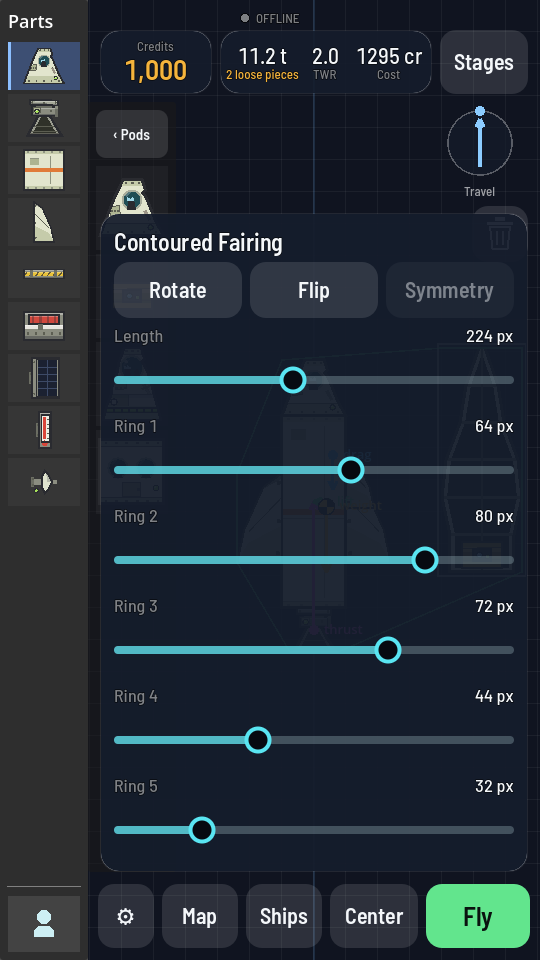
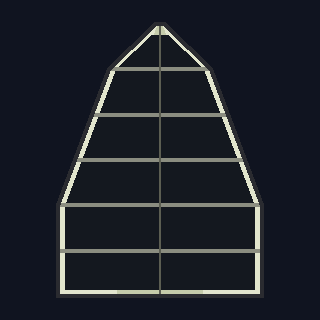
Its properties sheet carries a Length slider from 96 px to 384 px and five ring sliders, Ring 1 at the base to Ring 5 at the nose, from 16 px to 96 px each. As on the Payload Fairing, the figures above are the settings a fresh one is placed with, and mass, price and the room inside all follow the sliders.
Six sliders shape the shell: the length, then each ring in turn from the base up.
It attaches and it is thrown away exactly as the Payload Fairing is: a stack point and a mounting point on the base plate, Jettison on its sheet, and two halves left tumbling. The same warning applies, and so does the same hangar line when the payload stands through the skin.
Pairs with a wide or an awkwardly shaped payload on a tall rocket. Instead of the Payload Fairing, which weighs and costs less on anything it will actually go round.
Payload Fairing L
Part · Struct · sold by Wide Fairings
The Payload Fairing at the wide stack's size: a nine-metre base, so a wide tank, a wide cargo hold or a wide greenhouse rides up inside the skin instead of out in the air.
Figure
Value
MASS
840 kg
COST
240 cr
DRAG NOSE-ON
0.15×
HEAT EXPOSURE
0.9×
BODY LIFT CL
0.25
MAX TEMP
3300 K
MAX G
16 g
IMPACT
10 m/s
BLAST
25 kN
NODES
2
STAGEABLE
YES
PAYLOAD
134 × 180 px
RINGS
2, base to nose: 144 / 96 px
JETTISON
Splits into two halves
It is the same shell in every way but its size, and every rule on this page still holds: two rings and a Length slider, a stack point and a mounting point on the base plate, Jettison on its sheet, two halves left tumbling, and the same warning when the payload stands out through the nose. The Length slider runs from 128 px to 512 px, and the two ring sliders from 32 px to 192 px each.
Those ring sliders are why this part exists rather than a wider setting on the small one. Each shell's rings only ever reach as far as its own base allows, so the Payload Fairing stops at 96 px however you drag it — wide enough for a capsule, never wide enough for an eight-metre tank. Nothing on the narrow stack will cover a wide payload, whatever you do to it.
Mass and price are skin, not volume: twice the width and twice the length is four times the shell, not eight. At 240 cr it is still cheap next to what it is carrying, which is the point — a fairing is thrown away on every flight and never recovered.
Pairs with a wide stage carrying something that will not survive the ascent bare. Instead of the Payload Fairing, which is lighter and cheaper on anything that fits it.
Contoured Fairing L
Part · Struct · sold by Wide Fairings
The tallest shell in the game: five rings up twenty metres of skin, on the same nine-metre base, for a wide payload that the two-ring shell cannot be drawn around without bulging past it.
Figure
Value
MASS
1520 kg
COST
480 cr
DRAG NOSE-ON
0.15×
HEAT EXPOSURE
0.9×
BODY LIFT CL
0.25
MAX TEMP
3300 K
MAX G
16 g
IMPACT
10 m/s
BLAST
25 kN
NODES
2
STAGEABLE
YES
PAYLOAD
134 × 308 px
RINGS
5, base to nose: 144 / 144 / 120 / 96 / 72 px
JETTISON
Splits into two halves
Its Length slider runs from 192 px to 768 px and its five ring sliders from 32 px to 192 px, so at full stretch it is taller than anything the launch pad will accept — check the pad's height cap before you build to the end of the slider.
Pairs with a station module, a lander or a stack of satellites going up inside one wide stage. Instead of the Payload Fairing L, which weighs and costs a good deal less on anything its two rings will go round.
Ultra-Wide Fairing
Part · Struct · sold by Ultra-Wide Fairings
The wide stack's shell with five rings, like the Contoured Fairing L, on the same nine-metre base — but its rings open far past it: up to thirty-six metres across, so a payload four times the stack's width rides up inside the skin.
Figure
Value
MASS
840 kg
COST
240 cr
DRAG NOSE-ON
0.15×
HEAT EXPOSURE
0.9×
BODY LIFT CL
0.25
MAX TEMP
3300 K
MAX G
16 g
IMPACT
10 m/s
BLAST
25 kN
NODES
2
STAGEABLE
YES
PAYLOAD
134 × 180 px
RINGS
5, base to nose: 144 / 144 / 120 / 96 / 72 px
JETTISON
Splits into two halves
Its five ring sliders run from 32 px to 576 px — three times as far as the other wide shells' — and its Length slider from 128 px to 768 px. Open the lowest ring wide and the ones above it to match, taper the last toward the nose, and the shell becomes a hammerhead: a narrow neck on the stack, a wide bay above it, a nose on top. Remember the neck: the base stays nine metres, so whatever you carry has to sit on something above the base plate before it can be wider than that.
The figures above are for the shell at its starting size. Mass and price follow the widest ring and the length, exactly as on every fairing, so opened to 576 px and stretched to 768 px it is sixteen times the skin — and a shell that wide meets a great deal of air on the way up.
Pairs with a wide stage and a payload no stack could carry in the open: a big dish, a station ring, a lander with its legs out. Instead of the Contoured Fairing L, which is the same five rings for anything no wider than its base.
The Separator at 8 m across: a ring between two wide stages, which lets both go when staged and springs them apart.
Figure
Value
MASS
160 kg
COST
140 cr
DRAG NOSE-ON
1.0× (blunt)
MAX TEMP
3000 K
MAX G
22 g
IMPACT
16 m/s
BLAST
40 kN
PUSH
2 m/s
NODES
2
STAGEABLE
YES
It sits in line, one stack point on top and one underneath, and both of them let go. Every wide engine accepts it at its base, alongside the narrow Separator and the Decoupler. The two stages are sprung apart as it goes, opening at 2.0 m/s between them.
Its part sheet offers Fire, greyed until the rocket has launched. It has no properties. In the staging list, put it in the same stage as the engine above it.
Pairs with a Giant Engine, a Quad Cluster or a Nine Cluster above it. Instead of the narrow Separator under a wide bell, which works but leaves the joint 4 m of ring short.