Contracts
A company pays you to test something in flight. An achievement pays once and is gone; the contract board refills. Contracts are the work you can go back to when the first-time money runs out.
The Programme comes first
The top of the board is the Programme: an ordered chain of missions that tells you what to fly next, from your first hop off the pad to a working relay in orbit of four different worlds. Everything under it — the offers, the countdowns, the companies — is side work you take when it suits you. The Programme is the line through the game.
A Programme mission looks different from the rest of the board on purpose. Where an ordinary card names the company that is paying, a Programme card names CHAPTER 3 · EYES AND EARS · STEP 4 OF 8 and draws a row of filled and hollow dots for how far through that chapter you are. It pays in credits and discovery together, so it buys tech as well as rockets.
Four things make it easier than ordinary work, and they are all deliberate:
- No deadline. A Programme mission waits for you. Sign it whenever you like and take as long as you need.
- No advance and no penalty. There is nothing to pay back, so a mission you cannot manage costs you nothing but the time you spent on it.
- It does not fill the Administration. Two Programme missions ride beside a completely full board, so the chain never costs you a paying job.
- You can skip it. The Skip button passes one over for good. It is free, and the missions that were waiting behind it open up exactly as if you had flown it — so nothing in the Programme can ever leave you stuck.
Skipping is permanent, so the button arms before it fires: the first tap turns it red and says Skip for good, and the second sends it — step by step in Skip a Programme mission.
There are 66 missions in 10 chapters, and between them they pay 146,880 credits and 499 discovery. The board only ever shows you the next couple, which is how it is meant to be played; if you would rather see the whole chain laid out, it is on the Programme reference.
Missions you build rather than fly
Most missions are a flight: go there, do this, come home. About a third of the Programme is the other kind — build a number of something and keep it. Three relays in orbit of Earth. Two of your Meek in space at once. A crewed station, held together for a week.
These are counted by the world server, not by your flight, so they tick along whether the game is running or not, and the card shows the count as it stands: Three relays in orbit of Earth — 2 / 3. When the mission asks you to hold something, the card shows that clock too, in days of world time.
A hold is real work, because the world keeps running. A relay whose battery goes flat in eclipse stops counting — it needs a panel and a battery big enough for the night side. A satellite whose orbit dips into the air is destroyed, and takes the hold with it. If the count drops, the clock goes back to zero and the card says so; put the missing piece back and it starts again. Nothing is lost but the wait.
What a contract is
A contract is a paid job with a name on it. It comes from a company, it has a short brief, and it lists one to eight goals: things your ship has to do. Meet every one of them in a single flight, before the deadline, and the company pays the reward.
You are paid twice. Signing pays the advance straight away, and finishing pays the reward on top. The board writes both on every row, so +100 now · +460 done means a hundred credits the moment you accept and four hundred and sixty more when the goals are all met.
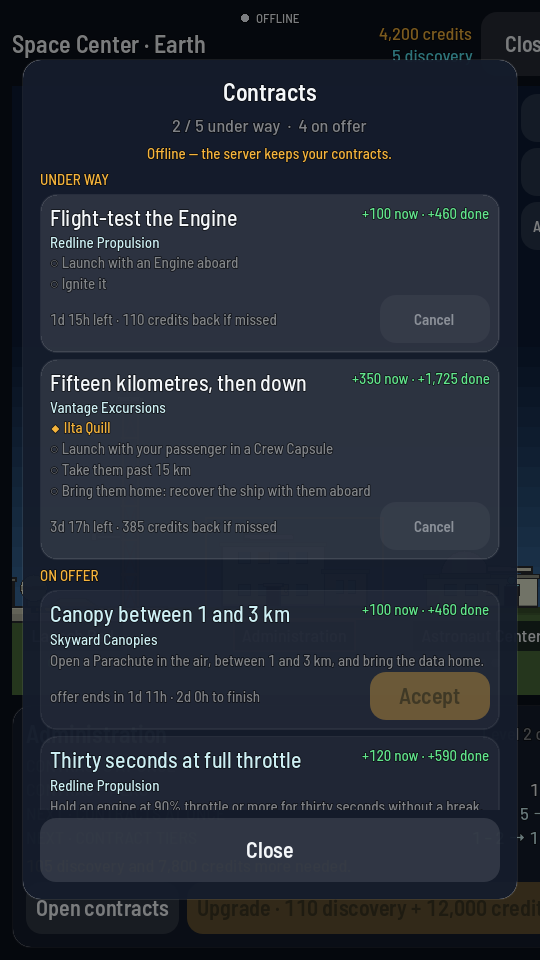
The board is the Administration's
The board lives on the Administration, the building on the Space Center's Earth strip. It is the only place a contract is signed. Its level decides two things: how many contracts you may have under way at once, and how hard the ones you are shown may be. A new Administration handles three at a time and shows only the first tier of work. Extend it and both grow together.
What you see on the board is a fresh draw each time: up to ten offers, picked at random from the tiers your Administration's level allows. Every offer carries its own countdown, and one that runs out is swept off and replaced. Ignoring an offer costs you nothing at all, so there is no hurry to sign something that does not suit the rocket you can build.
Offers do not all run out together, and a job that has just left the board sits out the next few draws while there is other work to deal, so the board turns over a few rows at a time and shows you jobs you have not just seen before it brings an old one back.
The same job can be finished at most 5 times in one day. After the fifth it leaves the board and is not dealt again until a day has passed since the first of them. A day of very many finished, given-up or missed contracts (fifty) pauses new work the same way, until the oldest of them is a day old.
Most jobs leave their numbers open, too. The same company may want six parts at 2 km on one offer and ten parts at 5 km on the next, or a burn of 15 seconds one day and 45 the next. Each offer draws its own figures, writes them into its title and goals, and prices itself on them: the harder the figure, the more it pays, with a little spread on top. What the row quotes is what you are paid. The ranges are in the contracts reference.
You will never be shown a job you have not researched the parts for. A contract that asks for a thruster block, a solid booster or a nose cone is only dealt once the tech node that sells it is yours — so every offer on the board is one you could go and fly today. The Programme is the exception, and deliberately: its missions run ahead of you, because their job is to tell you what to build next.
The contracts reference has the levels, the tiers and what each pays. The Programme sits outside all of it: its missions are chosen by what you have already done, not by your Administration's level, so the chain runs ahead of the board and does not wait for you to extend the building.
Every goal, in one flight
This is true of every contract and of the flying half of the Programme; the building missions above are the exception, and they are the only one. Goals are counted from the moment a rocket leaves the pad, and they reset on every launch. A contract asking you to fly a Parachute and then set the ship down on Earth wants both of those out of the same flight: launching with the chute today and landing something else tomorrow pays nothing. That is the whole shape of a contract, and it is why the interesting ones ask for two or three things that fit on one rocket.
One flight can finish several contracts at the same time, which is the real reason to keep a full slate under way. A rocket that carries a Parachute, an Engine and a Thermometer can be earning three rewards on the way up.
The deadline is real time
Accepting starts a clock, and it is a clock in the world outside the game: real days, running whether the app is open or not. Each row under way shows what is left of it, and turns amber in the last hours.
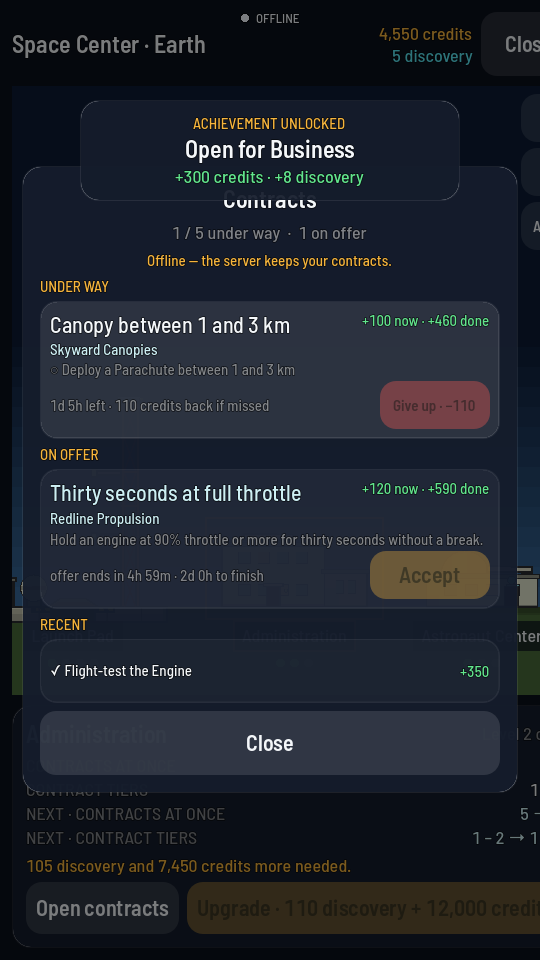
Let the clock run out and the contract fails. The advance goes back, with a tenth of it on top as the penalty, and the row moves down to the recent list with a ✕ beside it. That is the whole risk of taking one on: an advance you cannot earn out is a small loss, never a ruinous one.
Giving one up
A contract you cannot meet can be dropped where it stands. It costs exactly what missing the deadline costs, so giving up buys back nothing but the wait and the slot on the Administration's board. It is worth doing when the slot is what you want, and never worth doing to save money.
Because it costs real credits and cannot be undone, the button on that row asks twice: the first tap turns it red and names the bill, the second sends it. See Give up a contract.
When the credits run out
Every launch costs the rocket's price, and a crash pays nothing back, so a bad run can leave you with less than a rocket costs. When that happens, a card marked RESCUE appears at the top of the board: the Fresh Start Grant. It is there only while your credits are under 1,000, enough for a little more than one starter rocket, and it never takes one of the Administration's slots, so a full board cannot keep it from you.
- Signing it tops you up to 1,000 credits. Its green figure is exactly what you are short: with 120 credits it reads +880 now. That money is yours to keep.
- Nothing is ever taken back. Give it up, or let its clock run out, and it costs nothing at all.
- Flying it pays a little more. Climb past 1 km and recover the ship, in one flight, for +100 on top.
- Once every 48 hours at most. After you sign one, no other is offered for two days, however low your credits fall. It is a way back to the pad, not an income.
The board is readable in flight
The flight is what meets the goals, so you can read the board without leaving the air. The flight menu carries a CONTRACTS chip with the number under way on it, and it opens the same board on the map as in flight. In there it is read-only and shows only what is under way: each goal grows a green tick the moment your ship meets it, so it works as the mission list for the flight you are in.
When the last goal ticks, the contract asks to be paid, and the row says reward pending until the answer comes. Once in a while the answer is no, for example when the flight's launch was itself turned down. Then the ticks are cleared, the row says Not paid and why, and the contract stays under way. It still needs every goal met, by a ship launched after you signed it, before the deadline.
Offers and finished jobs are left out of the flight board on purpose. Nothing you could sign from orbit would be a job you could still fly. See See your contracts in flight.
Some jobs are used up
Most of the flight tests are asked once. When you accept one, the game decides then and there whether that company will ever put it in front of you again, and for a "prove this part works" job the answer is usually no. It is gone for good after that, for you alone.
Alongside them is the steady work, the jobs that always come back however often you fly them: bringing a capsule home, holding a long burn, and every piece of carrying work below. Those are what a veteran's board is made of, and they are the reason contracts count as income rather than a second helping of achievements. An offer you simply let expire is not used up, only redrawn.
Even the steady work comes round less often the more of it you finish. Every contract you complete counts against its own odds on the next draw: a job you have never done keeps its full chance, one done once has half of it, one done four times a fifth. The board leans toward work you have not flown yet without ever ruling anything out. Only a finished contract counts; one that ran out of time or that you gave up changes nothing.
Carrying work pays the bills
Jobs come in two kinds. A test proves a part — fly it, fire it, load it — and once you have taken one on it is usually gone for good. Transport is the other kind: carrying something for money. A passenger, a client's package, a satellite to its orbit. Those never retire, and they are what makes contracts an income rather than a second helping of achievements.
So the board keeps room for them. Two of its ten offers are filled from the carrying work before anything else is drawn — passenger runs first — which means that from the moment you own a Crew Capsule there is nearly always somebody waiting to be flown somewhere. Nearly always, not always — if you have already signed every one your Administration can show, the slots stay empty until one of them ends. The rows say TRANSPORT above the company's name.
Freight is carrying work with nobody aboard, and it is what you fly at the start: no early pod has a seat to spare for a passenger. A freight job wants something aboard, an altitude or a destination, and then the ship recovered — the RECOVER chip in the flight menu, not merely a landing on the ground. That is deliberate. Recovering a rocket refunds every part still on it, so a freight run flown in a ship you bring home whole pays the reward and costs almost nothing. It is the cheapest money in the game, and it is meant to be: it teaches the landing that everything later depends on.
The counts and what each tier pays are in the contracts reference.
Research work pays discovery
A few companies buy measurements rather than flights: a temperature read in a band of air, a series of readings on one climb, the pressure high over Earth, low over the Moon or in the air of Mars. These research contracts pay discovery on top of their credits, and they always come back — so they are the discovery you can keep flying for after the achievements within reach are earned and the places near home have been measured once. Each needs the instrument it names, so a Thermometer opens the first of them and a Barometer the next. What each pays is in the contracts reference, and every other way to earn discovery is gathered in Find more discovery.
Surveys
A survey sends you to one named point of interest, and its title says which: Survey: Table Mountain. It has a single goal — reach the point — and it is dealt only once a ship of yours has landed on that point's world, so a new player sees none and Moon surveys arrive after the first Moon landing. Accepting one draws the point on your map and on the ground. Reaching it pays the point's own reward and completes the survey at the same moment. You can also find a point without its survey, by landing inside it, but then only the point pays; once the point is found its survey never comes back, while one that ran out of time or was given up can be dealt again.
The board keeps one of its ten offers for survey work, the way it keeps two for carrying work, because a survey is what shows you where a point is: without one, the only way to a point is to land on it by chance. So once you have landed on a world, somewhere on it is nearly always waiting to be surveyed. Nearly always, not at once: the slot is filled as the board refills, so if yours is already full of ten offers a survey arrives as they expire over the next day or two, rather than pushing one of them off. That slot costs you nothing in the end — as you find a world's points its surveys stop being dealt, and once you have found them all the slot goes back to ordinary work.
This matters most for the Moon's helium-3 deposits. A deposit is worked only once it is found, and its Prospect survey is what marks where the field is. Landing a rig inside the field finds it too, if you know where to come down. The other way is a Ground Imager in orbit, which needs no contract at all.
Passengers
Some contracts hand you people. A tourist run puts one, two or four passengers on your roster the moment you accept, free, and the board names them on the row. There are twenty-two of them and no two want the same flight: at tier 2 they vary the orbit — a hop, a lob to 300 km, a proper circular orbit, a long ellipse out to 1,500 km, a landing on Table Mountain — or stay in the air altogether and vary how far across the ground the passenger is carried: thirty kilometres from the pad, a hundred point to point, forty without ever climbing past five, or a minute held in the cloud deck. At tier 3 they vary the destination: lunar orbit, the floor of Pad Crater, a flyby that never stops, Mars, one of its two little moons, a station. A run that names a place marks it on your map as a point of interest while it is under way. Landing inside it finds the point at once, as any landing does, and finishing the run finds it if you never touched down there. The passengers are not yours to keep: they do not take up room at the Astronaut Center, they cannot be dismissed, and they leave when the contract ends however it ends.
Lose one on the way and the run fails there and then, without waiting for its deadline: the advance goes back with the tenth on top, exactly as if the clock had run out. The one exception is a passenger killed when another pilot's ship hits yours. That is not your failure, so the run is simply let go: the advance goes back and nothing more.
A passenger still needs a seat next to an astronaut, so these jobs name the Crew Capsule in their first goal, and they finish on a recovery rather than a landing. Getting your passengers off the ship is the point. See The Meek for who is riding.
Contracts belong to the shared world
The board is part of the world everyone flies in. In sandbox it opens and tells you so, and nothing there can be signed, judged or paid. Fly sandbox for the flying; come back to the shared world for the work.