Points of interest
A point of interest is a named place on a world — a summit, a crater, a canyon, the launch pad itself — with a circle of ground around it. The simplest way to find one is to land a ship inside its circle, on any flight, with or without a contract. A survey contract for the point shows you where it is and pays on top of the point. A contract that sends you there, such as a tourist run to Table Mountain, finds it too. Or you can photograph it from orbit with a Ground Imager, with no contract and no landing. Whichever way, the point pays its credits and discovery once.
Found by landing
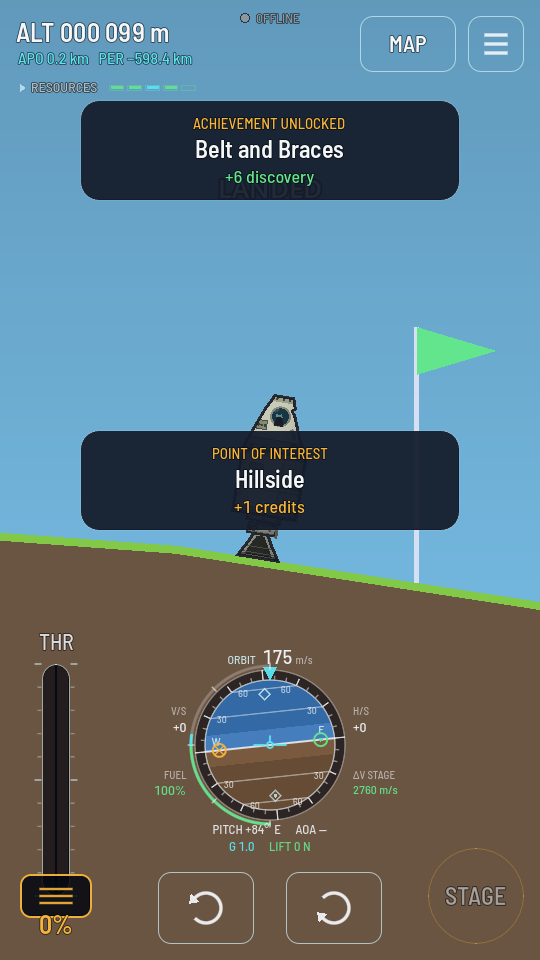
Set a ship down anywhere inside a point's circle and the point is yours: a POINT OF INTEREST banner names it and pays its credits and discovery. No contract is needed, and the point does not have to be on your map. That includes points you cannot see until you find them. Flying low over a point without landing finds nothing unless a contract is sending you there.
Some places have something standing on them. What stands there is solid: you can set a ship down on its top, and its sides stop a ship like a cliff. Landing beside it finds the place like any point, and a few of them greet a landing with a tune of their own.
Found by its survey
A survey is the guided way: it puts the point on your map and on the ground, and it pays on top of the point. It takes three things, in order:
| Step | What happens |
|---|---|
| Land on the world | The first time a ship of yours comes back down on a world after a launch, that world's points open for contracts. On Earth that is the first flight that lands again; on the Moon, your first Moon landing. |
| Take its survey | Every point has a survey contract, and from then on the Administration's board can deal it like any other job. Accepting it is what puts the point on your map and on the ground. |
| Reach it | Fly a rocket launched after you signed the survey into the point's circle: land in it, or for a wide point marked for flying over, pass low enough. The point pays its reward, the survey is completed and pays too, and the point is yours for good. A ship that left the pad before you signed still finds the point by landing in it, but it cannot meet the survey, which ends with its advance handed back and nothing charged. |
A survey is an ordinary contract in every other way: an advance when you sign, a real-time deadline, and the same bill if it runs out or you give it up. A failed or abandoned survey can be dealt to you again; only finding the point takes it off the board for good. Earth's surveys are first-tier work; the Moon's and Mars' need an Administration that shows the third tier.
Found by finishing a contract
Some contracts send you to a particular place without being surveys: a tourist run that wants its passenger set down on Table Mountain, or in Pad Crater on the Moon. Such a contract names the point in its goal, and while it is under way the point is drawn on your map and stands on the ground exactly as a survey's does, so you can see where to go. These contracts are not held back until you have landed on that world: taking one is how you learn where the place is.
The goal counts only inside the point's circle, by the point's own rule. Landing there ticks it off and, like any landing inside a point, finds the point at once. If the goal is met without landing, the point is found when the whole contract is completed — every goal in the one flight, passenger brought home and all — and then it pays its reward alongside the contract's, with a POINT OF INTEREST banner. If the contract runs out of time or you give it up, the point leaves your map again, until another contract or a survey sends you back there. A point you have already found stays found, and a contract sending you to it still wants the ship inside the circle.
Found from orbit
A GI-1 Ground Imager finds points of interest without going near the ground. It works in one band of height: one world radius above the ground, give or take five per cent.
| World | Imaging band |
|---|---|
| Earth | 570–630 km |
| The Moon | 190–210 km |
| Mars | 304–336 km |
The camera is a heavy load on the batteries, and it has no antenna: it sends what it sees home over the ship's radio. So it images only while three things hold together: the ship is in the band, it has charge, and the space centre can hear it — see Communications. A lone satellite over Earth is heard only while it is in sight of the ground station, roughly the side of the world the pad is on; points on the far side, and the far sides of the Moon and Mars, need relays of your own carrying the link.
While all three hold, every pass over a point of interest is a chance to find it: the camera sees 5° either side of straight down, which over Earth is a strip about 52 km wide on each side of the ship's track, plus each point's own radius. It is not certain. The GI-1's accuracy is 5 %, so each pass finds the point one time in twenty. The ground turns under an orbit, so a ship in Earth's band passes over each place about once every hour and a half, and finds a point in sight of home in a day or two on average — some sooner, some much later. A satellite is something you leave running, not a one-lap errand. Imaging needs no survey, no landing on that world and no flight launched for the purpose: a satellite you left in the band, with the power and the link, keeps finding points while you are away.
The game checks the pass for you on the world's own clock; you do not have to be watching. A point found this way pays exactly what it pays when you reach it. With the game open, a POINT OF INTEREST banner names it within a minute or so; your phone is told too, open or shut, if you allowed notifications.
Some points are mines
Four of the Moon's points of interest are helium-3 deposits. A deposit is found exactly as any point is: by landing inside it, by its survey, which is titled Prospect:, or from orbit, and it pays once. A rig that lands inside a deposit you had not found finds it on touchdown and can start work. What it adds comes afterwards: a found deposit stays on the map in mint instead of green, with its grade beside its name, and a Mining Rig landed anywhere inside its radius can work it. See Helium-3 and antimatter and Mine helium-3.
A place with a radius
Every point of interest sits at one spot on its world's surface and reaches a set distance out along the ground from it. That distance is its radius, and it is what makes each one a different kind of flight. The smallest are ten metres across, the size of a building: to find one you have to put a ship down almost exactly on it. The largest reach a hundred kilometres either way, a whole region: you only have to get there.
Every world you can stand on has points of interest: at least five on each planet and three on each moon. The gas giants and the Sun have none, since nothing can land on them. The list of points names each one, where it is and what it pays.
Landed, or flying low
A point of interest counts one of two ways, and the list says which:
| Counts when | What you have to do |
|---|---|
| Landed | Come to rest on the ground inside the radius. Flying over it does nothing, however low. |
| Flying low | Be inside the radius no higher than its height limit above the ground under you. Landing inside it counts too. |
The height limit is measured from the ground, not from sea level, so over a mountain range it is the peaks you have to stay close to. The altimeter's AGL line reads the same figure; see Flying.
What finding one pays
The first time one of your ships reaches a point of interest, a POINT OF INTEREST banner names it and says what it paid, and a CONTRACT COMPLETE banner names the survey it finished. The reward goes to your account at once, and it is paid once, ever: going back pays nothing. The further from home, the more a point pays — a few hundred credits on Earth, a couple of thousand on Mars — and every one pays some discovery too.
A flight that has to go somewhere anyway can usually pick one up on the way. A lander aimed at a named crater instead of empty ground earns the crater as well as the landing.
Where to see them
On the map, a world's points of interest are marked on its edge as small diamonds: amber for one a survey or another contract under way is sending you to, green for one you have found, and mint for a helium-3 deposit you have found, which also prints its grade. (A cyan diamond is not a point of interest: it marks where a player contract you hold asks you to land.) A point no contract under way sends you to, and not yet found, is not drawn at all. When the world is drawn big enough, the stretch of ground each one covers is traced along the edge beside its diamond, and its name is printed next to it.
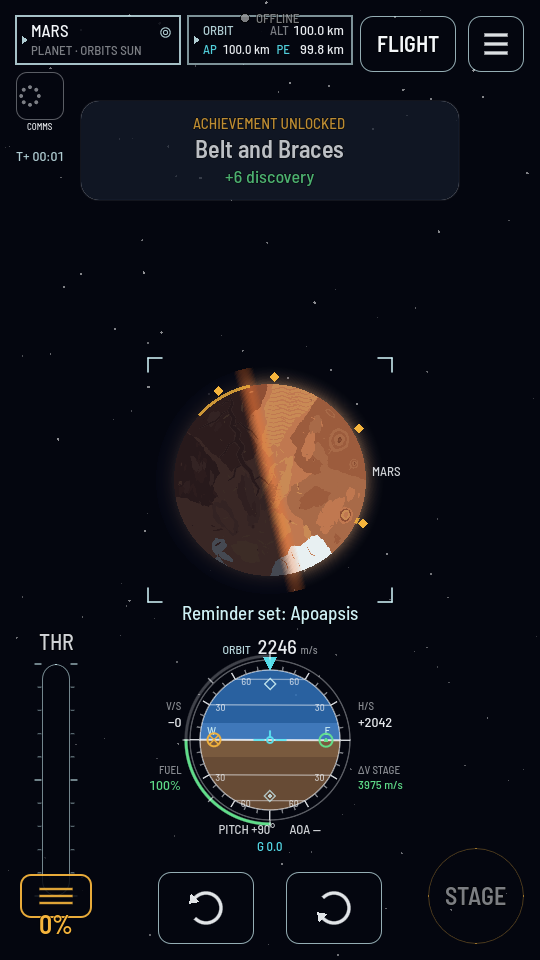
In flight, near the ground, a point of interest stands on the terrain as a mast with a pennant at its centre and a short post at each edge of its radius, so you can see where it starts as you come in. A point the size of a building has only its two posts: the building is the marker.