Moon
Earth's own moon: airless, lightly held, twenty named landforms, and the first place most pilots go.
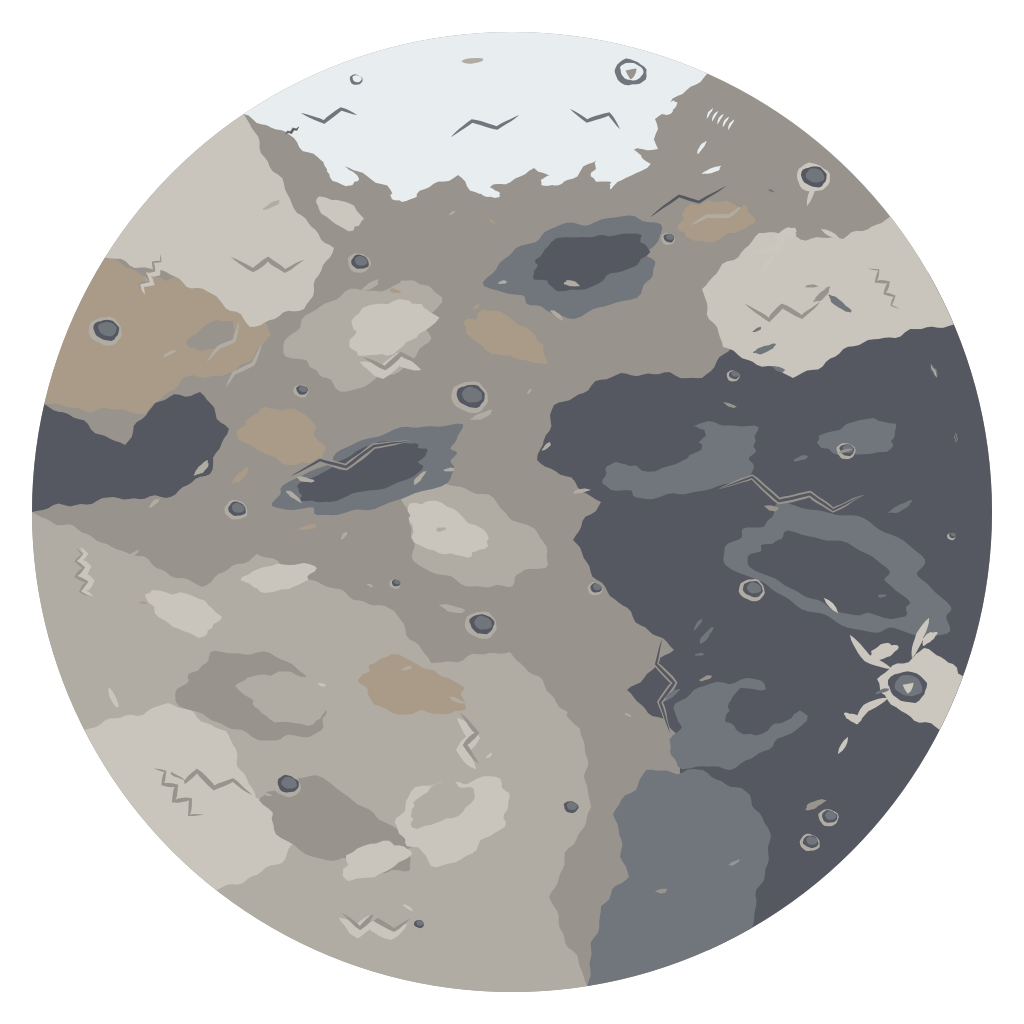
The numbers
These are the figures the map's card shows when you hold your finger on the Moon, plus the two speeds that decide what a flight there costs. Low orbit speed is how fast you must be going, sideways, to stay up just above the surface. Escape speed is how fast you must be going to leave altogether. Sphere of influence is how far the Moon's pull reaches before something bigger takes over.
| Figure | Value |
|---|---|
| TYPE | Moon |
| ORBITS | Earth |
| DISTANCE FROM EARTH | 12.00 Mm |
| ORBIT PERIOD | 1d 14:36:24 |
| ORBIT SHAPE | circular |
| RADIUS | 200.0 km |
| GRAVITY | 1.63 m/s² |
| DAY | 1d 14:36:24 |
| STATIONARY ORBIT | none — it turns once per trip round its planet |
| LOW ORBIT SPEED | 557 m/s |
| ESCAPE SPEED | 807 m/s |
| SPHERE OF INFLUENCE | 2.43 Mm |
| ATMOSPHERE | NONE |
Stationary orbit is the height where one trip round takes exactly one of the world’s days, so a ship there hangs over the same spot on the ground. See Stationary orbits.
Its day and its orbit are the same length, so the Moon keeps one face turned toward Earth for ever. Land on the near side and Earth hangs in the sky and never moves; land on the far side and you never see it at all.
What it is made of
What the world is built from. It is not something a ship measures, but it is why the ground looks and behaves as it does — an ice moon takes an impact differently from an iron one.
| Material | Share |
|---|---|
| Silicate rock | 85 % |
| Iron core | 15 % |
The air
None. the Moon has no atmosphere whatsoever, and that decides most of what a flight here is like. There is nothing for a parachute to catch, so the whole descent is flown on the engine and the last metres are taken on the landing legs. There is nothing to heat a hull on the way in, so a heat shield is dead weight. And there is nothing to slow a ship on the way up, so the climb off the surface is as cheap as the gravity allows.
It also means there are no air bands to survey: leave the ground and you are straight into low space. See Science and readings for what that is worth.
The ground
Eight biomes, taken from the picture of the Moon's face that the map draws: the ground you fly over is the rim of that picture. The mare comes round three times, the bright highlands three times and the ancient highlands twice, and the Polar Ice is one long stretch, the widest of all, from −124° to −66° — the ice that Ice Rift, Shackleton and the Frost Basin are cut into. The world's 0° lies on a mare — the flattest ground the Moon has, and the lowest, which is why the datum is measured from it — and the bright highlands are the roughest, standing 1,200 m above that and wandering 700 m either way.
| Biome | Where | Typical height | Roughness |
|---|---|---|---|
| Mare Plains | −180° to −167°, −23° to 20°, 27° to 60° | 0 m | ± 110 m |
| Basin Floor | 60° to 81° | 200 m | ± 200 m |
| Regolith Flats | −66° to −38° | 350 m | ± 280 m |
| Dust Fields | −167° to −148° | 510 m | ± 340 m |
| Ejecta Rays | 20° to 27° | 650 m | ± 420 m |
| Polar Ice | −124° to −66° | 800 m | ± 300 m |
| Ancient Highlands | 81° to 128°, 153° to 180° | 950 m | ± 620 m |
| Bright Highlands | −148° to −124°, −38° to −23°, 128° to 153° | 1,200 m | ± 700 m |
Where is the band's place round the world, in degrees from the world's own 0°, running out to ±180° on the far side. Typical height is where that biome's ground sits against the datum the map measures altitude from, and roughness is how far it wanders either side of that. Nothing here holds water — the polar ice is ground, not sea — and with no air, none of it is damp.
Named landforms
The Moon's ground is drawn from a table of named features rather than noise alone, as every world you can stand on is. Where you come to rest is recorded by name, which is why some achievements ask for a summit, a crater floor or a plateau rather than just a landing. All 20 of them are below, in order round the world — 0° lies on the Mare Plains, and the list runs from the far side of the world back to it and on round.
| Landform | Kind | Where | Height | Flat ground |
|---|---|---|---|---|
| Mare Ingenii | Plateau | −172° | 30 m | 12,000 m |
| Dust Basin | Crater | −156° | 900 m | 1,200 m |
| Farside Massif | Mountain range | −146.5° | 4,000 m | 45 m |
| Ice Rift | Valley | −120° | −700 m | 1,200 m |
| Shackleton | Crater | −110° | 900 m | 300 m |
| Cold Plateau | Plateau | −95° | 800 m | 6,000 m |
| Frost Basin | Crater | −75° | 1,500 m | 2,000 m |
| Frost Dunes | Dunes | −62° | 100 m | — |
| Copernicus | Crater | −48° | 1,200 m | 1,000 m |
| Alpine Front | Mountain range | −31° | 3,000 m | 45 m |
| Serenity Shore | Escarpment | −18.5° | 300 m | 2,000 m |
| Hadley Rille | Valley | −9.5° | −350 m | 500 m |
| Pad Crater | Crater | 3.2° | 220 m | 300 m |
| Mare Serenity | Plateau | 7.5° | 30 m | 15,000 m |
| Tycho Basin | Crater | 24° | 1,800 m | 1,500 m |
| Twin Craters West | Crater | 44° | 600 m | 500 m |
| Twin Craters East | Crater | 48° | 600 m | 500 m |
| Lunar Alps | Mountain range | 140° | 3,500 m | 40 m |
| Highland Plain | Plateau | 155° | 400 m | 8,000 m |
| Far Highlands Massif | Mountain range | 172° | 4,500 m | 40 m |
Height is how far the feature stands above the ground around it, or below it where the figure is negative. Flat ground is how much level ground it offers at the top or on the floor — which is what decides whether a lander can stand on it. The ground at the world's own 0° is kept dead flat for the first fraction of a degree.
Getting there
No air at all, so nothing slows you on the way down: the whole landing is flown on the engine and taken on the legs. The pull is light, so the lander is smaller than the trip makes it sound. Landing pays One Small Step.
What a ship leaving Earth's pad needs, in total change of speed, to do each of these:
| Trip | Δv from Earth's pad |
|---|---|
| Orbit | 4,272 m/s |
| Land | 4,863 m/s |
| Land and come home | 5,766 m/s |
Helium-3
The Moon is the one world with helium-3 deposits. Its dark plains hold the gas in their dust, and four fields are rich enough to mine: Serenity Field, Twin Craters Field and Basin Floor Field on the near side, and a richer one hidden on the far side. A Mining Rig landed on a field you have found fills the helium-3 tanks aboard. The list of points of interest says where each field is and what its grade is, and Mine helium-3 has the steps.
What it pays
Every place nobody has measured before pays discovery the first time an instrument reads it, and how much depends on how far from home the world is. the Moon counts as 2.00 against Earth's 1.00, so every place on it pays that many times what the same place at home would.
| Figure | Value |
|---|---|
| PLACES TO SURVEY | 20 |
| WORTH IN ALL | 40 discovery |
| CREDITS BESIDE IT | 800 |
A place is a world, a band of altitude and — on the ground — the biome you are standing in, and each instrument surveys each place separately. Science and readings explains the whole of it.
What it pays out for
The Moon is named by 8 achievements: Lunar Weather Station, Lunar Visitor, One Small Step, Lunar Orbit, Assembly, Lunar Orbit, Crater Floor, Abort, Lunar, Moonshine. There are also three hidden achievements here, which you will find by flying.
The full list, with what each one pays, is on the Achievements reference.