Earth
Home: the world every pilot starts on, with the thickest air, the strongest pull and the only ground a parachute alone can bring a ship down onto.
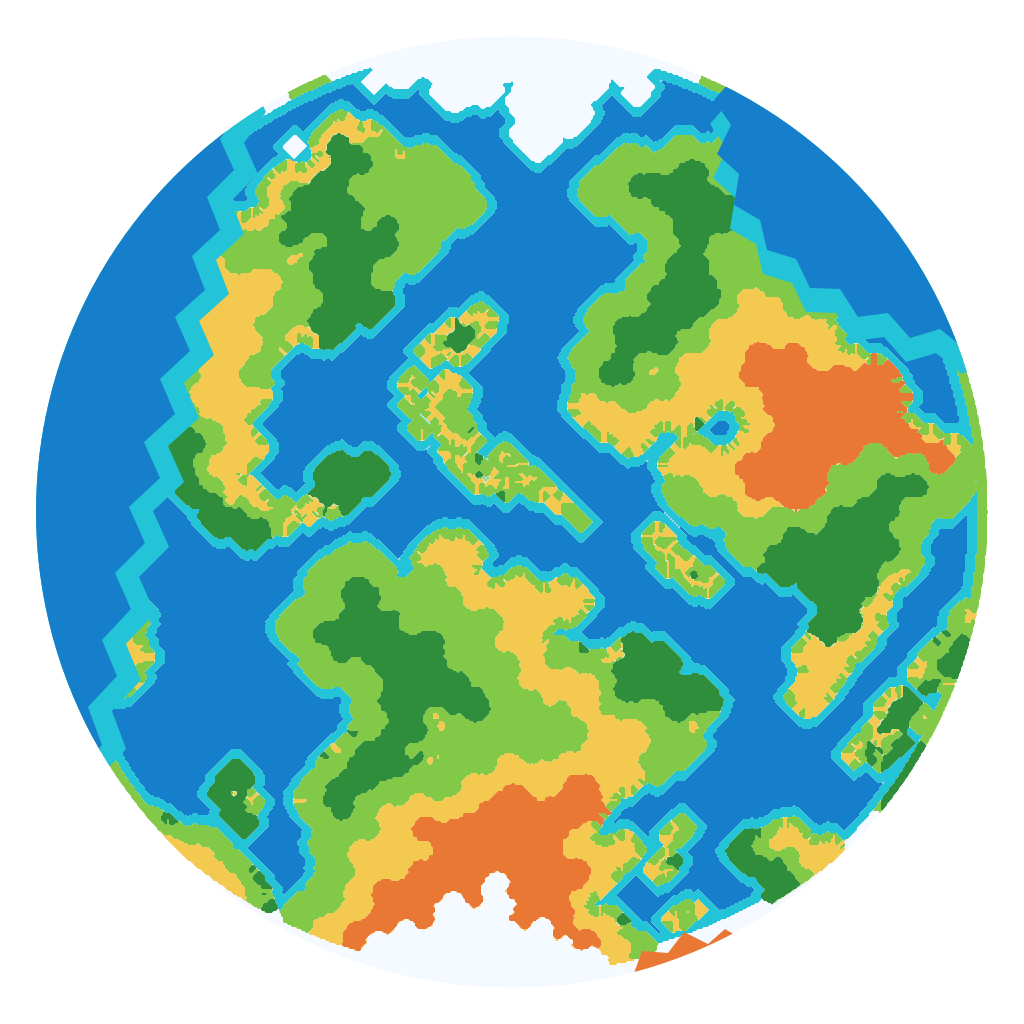
The numbers
These are the figures the map's card shows when you hold your finger on Earth, plus the two speeds that decide what a flight there costs. Low orbit speed is how fast you must be going, sideways, to stay up just above the surface. Escape speed is how fast you must be going to leave altogether. Sphere of influence is how far Earth's pull reaches before something bigger takes over.
| Figure | Value |
|---|---|
| TYPE | Planet |
| ORBITS | Sun |
| DISTANCE FROM SUN | 13.60 Gm |
| ORBIT PERIOD | 106d 14:50:06 |
| ORBIT SHAPE | circular |
| RADIUS | 600.0 km |
| GRAVITY | 9.81 m/s² |
| DAY | 6:00:00 |
| STATIONARY ORBIT | 2.87 Mm up |
| STATIONARY SPEED | 1,009 m/s |
| LOW ORBIT SPEED | 2,279 m/s |
| ESCAPE SPEED | 3,431 m/s |
| SPHERE OF INFLUENCE | 84.22 Mm |
| ATMOSPHERE | 70.0 km tall |
Stationary orbit is the height where one trip round takes exactly one of the world’s days, so a ship there hangs over the same spot on the ground. See Stationary orbits.
What it is made of
What the world is built from. It is not something a ship measures, but it is why the ground looks and behaves as it does — an ice moon takes an impact differently from an iron one.
| Material | Share |
|---|---|
| Silicate rock | 67 % |
| Iron core | 31 % |
| Water ice | 2 % |
The air
Breathable air, and the only atmosphere in the system with free oxygen in it. Water vapour is a surface gas — a hundredth of the air at the pad, gone by 50 km — and ozone is the opposite, absent at the ground and at its thickest around 25 km. Right at the ceiling the mix thins into atomic oxygen, helium and hydrogen. A Thermometer flown up through it reads 288 K at the pad falling to 217 K, and a Barometer reads 101.3 kPa falling to nothing.
| Figure | Value |
|---|---|
| TOP OF THE AIR | 70.0 km |
| PRESSURE AT THE SURFACE | 101.3 kPa |
| DENSITY AT THE SURFACE | 1.23 kg/m³ |
| HALVES EVERY | 3,882 m |
| TEMPERATURE AT THE SURFACE | 288 K (15 °C) |
| COOLS BY | 6.5 K per km |
| COLDEST IT GETS | 217 K (−56 °C) |
Pressure falls off as you climb: every 3,882 m of height, there is half as much air around you. A Barometer reads that fall directly, and a Thermometer reads the cooling beside it — 6.5 K for every kilometre, until the air bottoms out at 217 K (−56 °C) and stops getting colder.
What the air is made of
The mix changes with height. Each column is a measured level; between two of them the game blends one into the other, and above the top one there is nothing left to breathe. A Mass Spectrometer reads this table itself: its figure is the mean molar mass of the mix where the reading is taken, and beside it the line names the biggest gases it found. See the Mass Spectrometer.
| Gas | Surface | 12.0 km | 25.0 km | 50.0 km | 70.0 km |
|---|---|---|---|---|---|
| Nitrogen | 77.1 % | 78.08 % | 78.08 % | 78.1 % | 78 % |
| Oxygen | 20.7 % | 20.95 % | 20.94 % | 20.9 % | 20 % |
| Argon | 0.92 % | 0.93 % | 0.93 % | 0.93 % | 0.9 % |
| Water vapour | 1.2 % | 0.005 % | 0.0005 % | — | — |
| Carbon dioxide | 0.04 % | 0.04 % | 0.04 % | 0.04 % | — |
| Ozone | — | 0.0001 % | 0.001 % | 0.0002 % | — |
| Atomic oxygen | — | — | — | — | 1 % |
| Helium | — | — | — | — | 0.05 % |
| Hydrogen | — | — | — | — | 0.02 % |
Clouds
Cloud decks are drawn where the biome underneath is damp enough, so they stand over ocean and forest and thin out over desert. You climb through them on the way up and see them from above afterwards. A cloud is drawn in front of your ship: inside a thick one you lose sight of it until you fly out, so pick your way round the big ones.
Each deck draws several kinds of cloud, and the damper the air, the higher they heap. Over dry grass the low deck is small fair-weather cumulus, flat-bottomed or torn; over forest it grows taller, and over the sea it builds into towers, with the odd thunderstorm standing on its own: a dark base with rain falling from it and a flat top spreading downwind. The middle deck runs from smooth stacked lenses through rows of small cloudlets to grey sheets and dark rain cloud; the high deck from straight wisps and hooked strands to rippled specks and a thin veil.
| Deck | From | To |
|---|---|---|
| Cumulus | 900 m | 2,200 m |
| Stratus | 4,200 m | 6,500 m |
| Cirrus | 9,000 m | 12,000 m |
The ground
Earth's ground is the only one in the system read off a picture rather than a band table: the biomes below are painted on Earth's surface map, so where the ocean ends and the desert starts is where the map says, not at a round number of degrees. Seven of them cover the world, and an eighth, the Launch Pad, is the flat gravel apron the pad itself stands on.
| Biome | Typical height | Roughness | Damp | Water |
|---|---|---|---|---|
| Deep Ocean | −700 m | ± 250 m | 95 % | sea level |
| Shallows | −35 m | ± 60 m | 85 % | sea level |
| Grasslands | 90 m | ± 260 m | 60 % | — |
| Forest | 180 m | ± 450 m | 70 % | — |
| Desert | 150 m | ± 420 m | 8 % | — |
| Drylands | 250 m | ± 800 m | 15 % | — |
| Ice | 250 m | ± 600 m | 30 % | — |
| Launch Pad | 0 m | ± 0 m | 70 % | — |
Typical height is where that biome's ground sits against the world's datum — sea level on Earth — and roughness is how far the ground wanders either side of it. Damp is what decides whether clouds form overhead. The two ocean biomes carry seawater at sea level, and everything below that line is sea floor. A ship that comes down there floats on it, or sinks to that floor if it is too heavy to float (see Splashing down).
Named landforms
Earth's ground is drawn from a table of named features rather than noise alone, as every world you can stand on is. Where you come to rest is recorded by name, which is why some achievements ask for a summit, a crater floor or a plateau rather than just a landing. All 38 of them are below, in order round the world — the pad sits at 0°, and the list runs from the far side of the world back to it and on round.
| Landform | Kind | Where | Height | Flat ground |
|---|---|---|---|---|
| Storm Island | Volcano | −150° | 2,400 m | 500 m |
| Far Reef | Plateau | −125° | 702 m | 1,500 m |
| Lantern Hill | Mountain range | −99.4° | 800 m | 60 m |
| Blue Plateau | Plateau | −85° | 1,900 m | 15,000 m |
| Southern Wall | Mountain range | −70° | 4,600 m | 40 m |
| Meltwater Canyon | Valley | −58° | −500 m | 1,000 m |
| Halfway Isle | Mountain range | −27° | 1,400 m | 60 m |
| Atoll Shoal | Plateau | −15° | 705 m | 2,000 m |
| Beacon Hill | Plateau | 0.9° | 180 m | 400 m |
| Landing Meadow | Plateau | 2.5° | 60 m | 3,000 m |
| Twin Buttes | Mountain range | 6° | 900 m | 60 m |
| Long Ridge | Mountain range | 11° | 1,400 m | 40 m |
| Kettle Valley | Valley | 15° | −250 m | 1,500 m |
| Table Mountain | Plateau | 19° | 1,600 m | 4,000 m |
| Sunrise Escarpment | Escarpment | 23° | 500 m | 2,000 m |
| Glass Flats | Plateau | 29° | 40 m | 6,000 m |
| Greenwood Rise | Mountain range | 34° | 1,100 m | 50 m |
| The Shoulders | Mountain range | 41° | 2,200 m | 50 m |
| Mirror Lake Basin | Valley | 44° | −180 m | 2,500 m |
| Cedar Highlands | Plateau | 48° | 900 m | 8,000 m |
| Fang Peaks | Mountain range | 52° | 3,300 m | 40 m |
| Frost Wall | Mountain range | 58.2° | 4,200 m | 40 m |
| Ochre Mesa | Plateau | 63° | 700 m | 3,000 m |
| Red Canyon | Valley | 65.4° | −600 m | 800 m |
| Pinewood Steps | Escarpment | 70.4° | 400 m | 3,000 m |
| White Plateau | Plateau | 75.7° | 2,800 m | 12,000 m |
| Eagle Shelf | Plateau | 83.4° | 300 m | 1,200 m |
| The Crown Range | Mountain range | 86.4° | 6,500 m | 45 m |
| Aurora Range | Mountain range | 97° | 3,800 m | 40 m |
| Great Ice Shelf | Plateau | 108° | 1,200 m | 30,000 m |
| Rift Valley | Valley | 118° | −700 m | 3,000 m |
| Crevasse Fields | Dunes | 126° | 120 m | — |
| Mount Ember | Volcano | 130.6° | 3,000 m | 600 m |
| Dune Sea | Dunes | 143.2° | 90 m | — |
| Anvil Mesa | Plateau | 147° | 1,100 m | 2,500 m |
| Furnace Crater | Crater | 150.2° | 350 m | 800 m |
| Harbor Hills | Mountain range | 156° | 1,300 m | 50 m |
| Cape Bluffs | Escarpment | 162.8° | 300 m | 1,500 m |
Height is how far the feature stands above the ground around it, or below it where the figure is negative. Flat ground is how much level ground it offers at the top or on the floor — which is what decides whether a lander can stand on it. The pad's own neighbourhood is kept dead flat for the first fraction of a degree, so nothing you build can be defeated by the ground you launch from.
Its moons
One moon goes round Earth, inside its sphere of influence. It has a sphere of its own, and reaching it is a small transfer inside the big one.
| Moon | Distance out | Radius | Gravity | Air |
|---|---|---|---|---|
| Moon | 12.00 Mm | 200.0 km | 1.63 m/s² | none |
Getting there
Thick air low down and the strongest pull of any world you launch from make this the most expensive climb in the game. It is also the only world where a canopy alone brings a ship home.
What a ship leaving Earth's pad needs, in total change of speed, to do each of these:
| Trip | Δv from Earth's pad |
|---|---|
| Leave the air and fall back under a canopy | 1,087 m/s |
| A stable orbit | 3,104 m/s |
What it pays
Every place nobody has measured before pays discovery the first time an instrument reads it, and how much depends on how far from home the world is. Earth is what that scale is measured against, at a weight of 1.00, so a place here pays the least of anywhere — and it is the cheapest to reach, which is the point.
| Figure | Value |
|---|---|
| PLACES TO SURVEY | 24 |
| WORTH IN ALL | 24 discovery |
| CREDITS BESIDE IT | 480 |
A place is a world, a band of altitude and — on the ground — the biome you are standing in, and each instrument surveys each place separately. Science and readings explains the whole of it.
What it pays out for
Earth is named by 24 achievements: Liftoff, Escape Velocity, Slow Air at One Kilometre, Thin Air, Deep Freeze, Hard Vacuum, Touchdown, Ballistic Arc, Orbital Velocity, High Country, The Long View, Homeward Bound, High Ground, Table Service, Above the Snow Line, Aviator, Seventy Kilos of Engine, A Meek in Orbit, The Long Way Round, Coach to Orbit, Where the Air Turns Strange, Wheels Up, Greaser, Cross-Country. There are also three hidden achievements here, which you will find by flying.
The full list, with what each one pays, is on the Achievements reference.