Orbits
Every ship in space is tracing a curve the game can work out exactly from the clock alone, and the map shows you that whole curve before you fly a metre of it.
What an orbit is
The sky in this game is flat: every world, moon and ship moves in the same plane, so a path never dips above or below another. Cut your engines anywhere above the air and your ship keeps moving under one world's pull alone. It traces a closed loop around that world: an orbit. The game does not need to track every instant of the flight to know where you are. Given the shape of the loop and the time, it can place your ship on it exactly, whether that time is one second from now or a week away. That is why a ship never drifts off its own line and why leaving the game for a while costs you nothing you did not already know was coming.
Apoapsis and periapsis
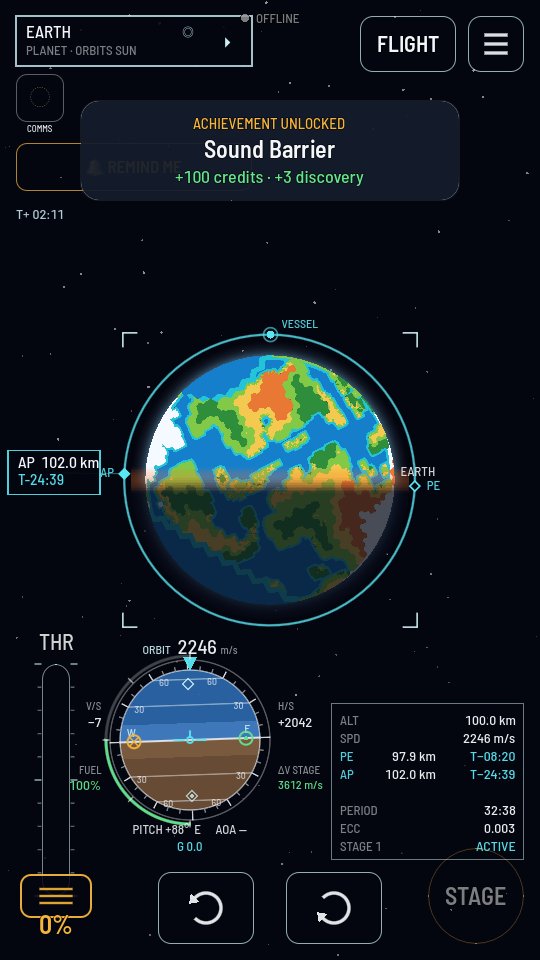
An orbit that is not a perfect circle has a far point and a near point. The far point is the apoapsis and the near one the periapsis. The map marks them as AP and PE, drawn as diamonds on your line. Tap either one and a callout opens with its altitude and how long until you reach it; tap it again to close the callout.
Coasting keeps the curve, a burn bends it
With the engines off, your path is fixed. It does not decay, drift or wander no matter how long you coast it. Only thrust changes an orbit. Push in the direction you are already travelling and you are burning prograde; push the other way and you are burning retrograde. A prograde burn adds energy to the orbit and raises the far side of it; a retrograde burn takes energy away and lowers it. Planning a burn ahead of time, rather than guessing at the stick, is what a maneuver node is for.
Spheres of influence and handing off between worlds
Every world's pull only wins out to a certain distance from it: its sphere of influence, drawn on the map as a dashed ring once you are close enough to see it. Cross that ring outward and the world you were circling lets go of you; cross into a moon's or a planet's own ring and it takes over instead. The hand-off costs you nothing: your speed and position simply carry over into whatever now holds you, and the map redraws your orbit around the new owner from there.
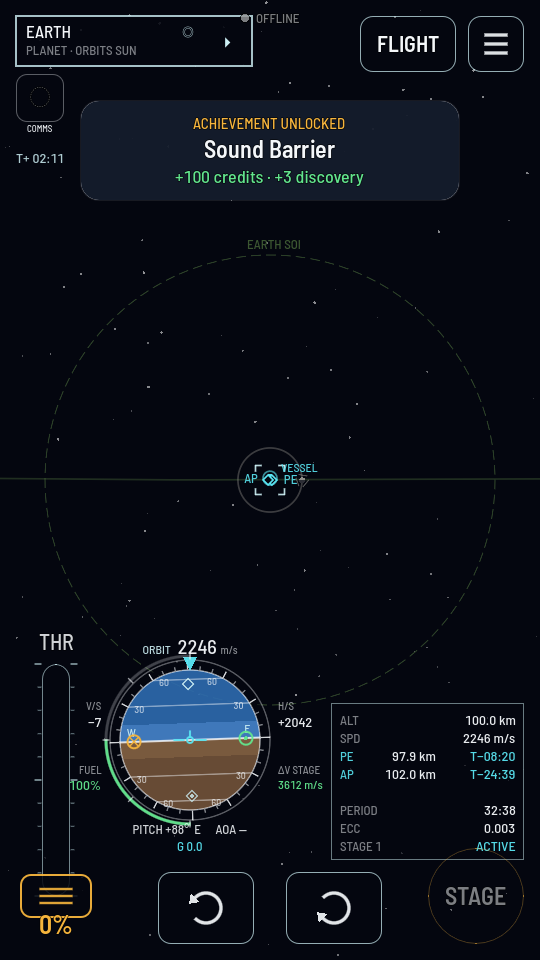
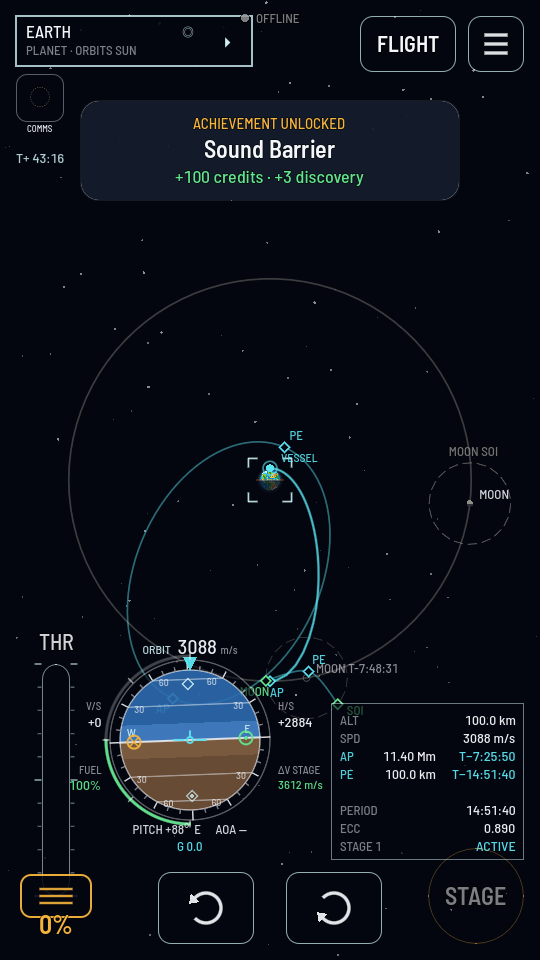
Stretch an orbit far enough and it may never fall back at all: an orbit faster than the world can pull back down is an escape. The info card names it: the APOAPSIS row reads ESCAPE instead of a distance, because there is no far point to reach. On the other side, a PERIAPSIS row can read IMPACT: that near point lies inside the ground, and you will meet it before you ever reach it.
Stationary orbits: hanging over one spot
Every world turns, once per its day, and the higher an orbit the longer a trip round it takes. So for each world there is one height where a circular orbit takes exactly one day: its stationary orbit. Round Earth it is called a geostationary orbit. A ship on that circle, going round the same way the world turns, keeps pace with the ground beneath it and stays over the same spot for as long as it coasts. Earth's is 2.87 Mm up, flown at 1,009 m/s.
Three things have to be right at once. The orbit must be a circle, with AP and PE both at the stationary height: an oval one runs ahead of the ground at PE and falls behind it at AP. It must go round the way the world turns, the way the moons and the planets go round; the same circle flown backwards passes over the ground twice a day. And it must be exactly the right height: a little low and the ship creeps ahead of the ground, a little high and it drifts behind. Because a coasting orbit never changes, a ship set up right stays put indefinitely.
Why fly one: the Comm Station’s dish turns with Earth, so a relay parked in geostationary orbit above it never goes behind the planet as the dish sees it, and every other ship that can hear that relay can always be heard at home. See Communications.
Most worlds have no stationary orbit. Every moon in the system turns exactly once per trip round its planet, keeping one face towards it, and a day that long puts the stationary height outside the moon's own sphere of influence: its planet takes a ship over long before it gets there. Existence and Twostrokes spin so slowly that the same is true of them. The height and speed for every world, and which ones have none, are in the worlds reference.
What the map shows, and what it does not
Above the air, the only markers on your line are AP, PE and, once you are close enough, the sphere-of-influence crossing itself. Diving into a world's atmosphere adds markers of its own: entry, exit, ground impact. Those are covered on the Air, heat and speed and Landing and recovery pages, since those are about what the air and the ground do to a ship, not about the shape of its path.
A ship left in orbit
The shared world's clock never stops, even while the game is closed. Come back a day later and a coasting ship is exactly where its curve says it should be. Nothing was simulated in between, so nothing needed catching up. A ship still under thrust when you left is not so safe: come back within five minutes and it flies on from where you left it, but wait longer than that and it is lost. Coast, and time is free. Burn, and it is the one thing you cannot walk away from.