Sun
The star at the middle of everything: nowhere you can land, and the thing every interplanetary flight actually falls around.
The numbers
The Sun has no orbit of its own: everything else in the system goes round it.
| Figure | Value |
|---|---|
| TYPE | Star |
| RADIUS | 261.60 Mm |
| GRAVITY | 17.10 m/s² |
| DAY | 5d 00:00:00 |
| STATIONARY ORBIT | 1.51 Gm up |
| STATIONARY SPEED | 25,723 m/s |
| ATMOSPHERE | NONE |
Stationary orbit is the height where one trip round takes exactly one of the world’s days, so a ship there hangs over the same spot on its surface. See Stationary orbits.
What it is made of
The star is the system's hydrogen, and almost nothing else.
| Material | Share |
|---|---|
| Hydrogen | 74 % |
| Helium | 24 % |
| Heavier elements | 2 % |
There is no surface, and no air
The Sun is modelled as a body with a radius, a pull and a day, and nothing else. It has no atmosphere, no ground and no biomes, and no ship survives an approach to it. The figures above exist because the map draws it and the sim needs its pull, not because you are ever meant to arrive.
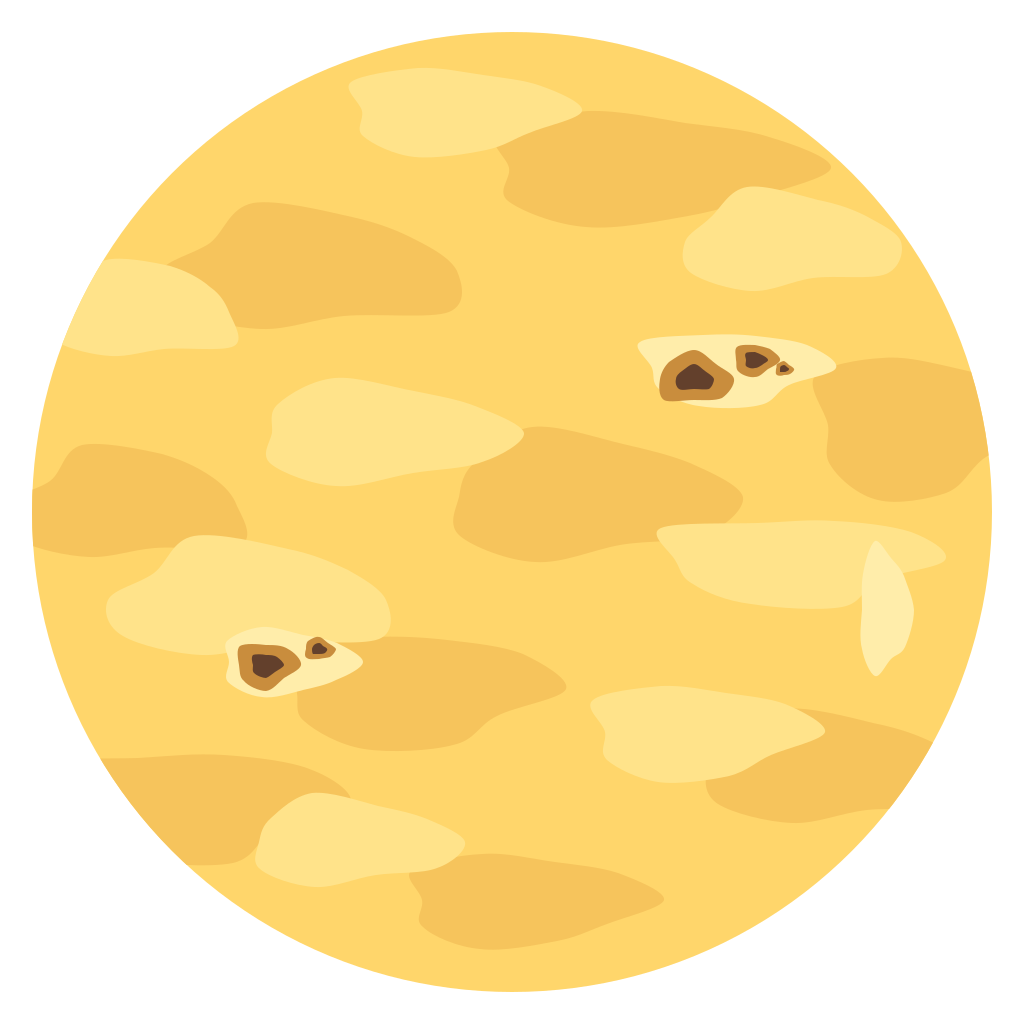
The map paints its face all the same: a golden disc of broad surface cells, a few pale bright regions, and two groups of dark sunspots, one in each half, turning with the star once every five days. None of it is ground; it is what the light looks like.
There is no surface to stand on and no biomes to survey on the ground. Readings taken in its sphere are filed under space, and they still pay: the Sun's sphere is the whole system between the planets, and nobody has measured most of it.
The worlds that go round it
Eleven worlds orbit the Sun, and everything else in the system orbits one of those. They are listed here outward from the star; each has a sphere of influence of its own, and a flight between two of them is a fall around the Sun from one sphere into the other.
| World | Distance out | Radius | Gravity | Air |
|---|---|---|---|---|
| Twostrokes | 5.26 Gm | 229.8 km | 3.70 m/s² | none |
| Existence | 9.84 Gm | 570.0 km | 8.87 m/s² | 9,200 kPa |
| Earth | 13.60 Gm | 600.0 km | 9.81 m/s² | 101.3 kPa |
| Mars | 20.73 Gm | 320.0 km | 3.71 m/s² | 0.61 kPa |
| Schmeckle | 32.12 Gm | 24.7 km | 0.25 m/s² | none |
| Flurbo | 37.62 Gm | 44.5 km | 0.28 m/s² | none |
| Meeseeks Prime | 70.78 Gm | 6.60 Mm | 7.85 m/s² | 2,000 kPa |
| The Box | 130.32 Gm | 5.50 Mm | 6.20 m/s² | 1,200 kPa |
| Cronenberg | 261.37 Gm | 2.40 Mm | 5.50 m/s² | 900 kPa |
| Squanch | 408.95 Gm | 2.32 Mm | 6.20 m/s² | 1,000 kPa |
| Pluto | 536.94 Gm | 111.9 km | 0.62 m/s² | 0.0012 kPa |
Getting there
You never launch from the Sun and you never land on it. What it is for is the space between worlds: a ship that leaves one planet's sphere of influence falls around the Sun until another world's sphere picks it up. Getting a ship into that state at all pays Interplanetary.
What it pays
Every place nobody has measured before pays discovery the first time an instrument reads it, and how much depends on how far from home the world is. the Sun counts as 4.00 against Earth's 1.00, so every place on it pays that many times what the same place at home would.
| Figure | Value |
|---|---|
| PLACES TO SURVEY | 6 |
| WORTH IN ALL | 26 discovery |
| CREDITS BESIDE IT | 520 |
A place is a world, a band of altitude and — on the ground — the biome you are standing in, and each instrument surveys each place separately. Science and readings explains the whole of it.
What it pays out for
One achievement names the Sun: Interplanetary. There are also two hidden achievements here, which you will find by flying.
The full list, with what each one pays, is on the Achievements reference.