The solar system
One star, eleven worlds around it and seventeen moons, all of them real places with ground you can stand a rocket on — and only three of them somewhere you can ever take off from.
What is out there
The system holds 29 bodies. The Sun sits at the middle. Eleven worlds go round it, and seventeen moons go round those. Nothing here is scenery: every one of the 28 worlds and moons has a surface your ship can reach, sit on and leave again. The Sun is the exception, and it is the exception because falling into it is not a landing.
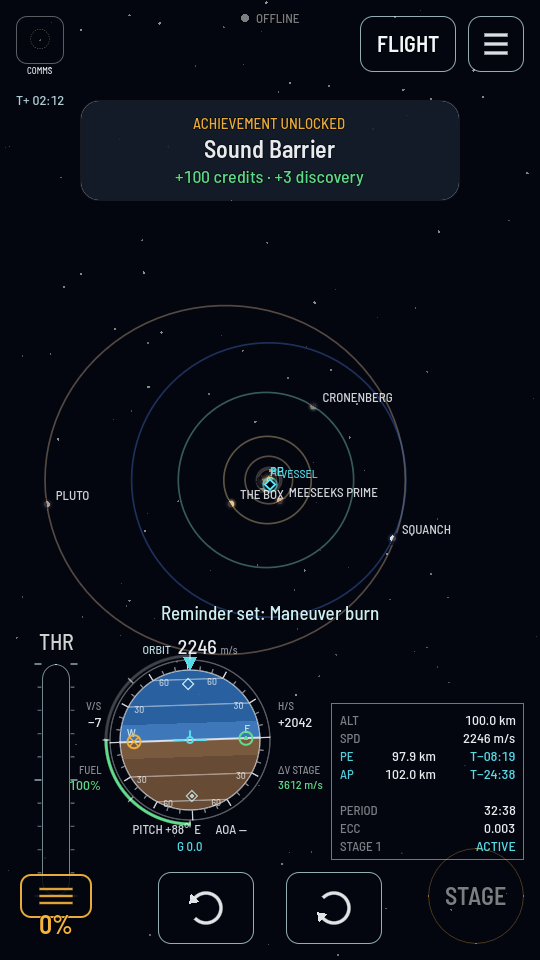
Every world has a page of its own under The worlds: how big it is, how hard it pulls, what it is made of, what its air is made of at every height, every biome on its surface, what a trip there costs and what measuring it pays.
Not everything is on the charts
The 29 bodies above are the ones the charts know. They are not all there is. Some things out there have never been drawn on any map: too small, too dark, or simply too far from where anyone has looked. Others sit on worlds you already know, in places nobody has stood. Not all of it looks as if it got there on its own. Neither the game nor this manual lists them. They are found by going out and looking with the instruments you carry, and some of them only by looking in the right way.
The shape is real, the names are not
The arrangement is the one outside your window. The same planets sit in the same order at the same relative distances, with the same families of moons around them. Earth, the Moon and Mars keep the names you know. Everything else has been renamed, so the second planet is Existence, the largest is Meeseeks Prime with four moons of its own, the ringed one is The Box, and the green one is Cronenberg. Pluto kept its name, because it has one there too.
This matters when you are working out what a trip will be like. If you know what the real Venus is, you already know why nothing you send to Existence comes back. Each world's entry in the reference names the real one it stands for, once, so you can carry that guess across.
Worlds are stacked inside one another
A world's pull only wins out to a certain distance from it: its sphere of influence. Inside that, your ship goes round that world and nothing else. Outside it, whatever holds that world holds you instead. The spheres nest. A moon's sphere sits inside its planet's, and every planet's sits inside the Sun's, which has no outer edge.
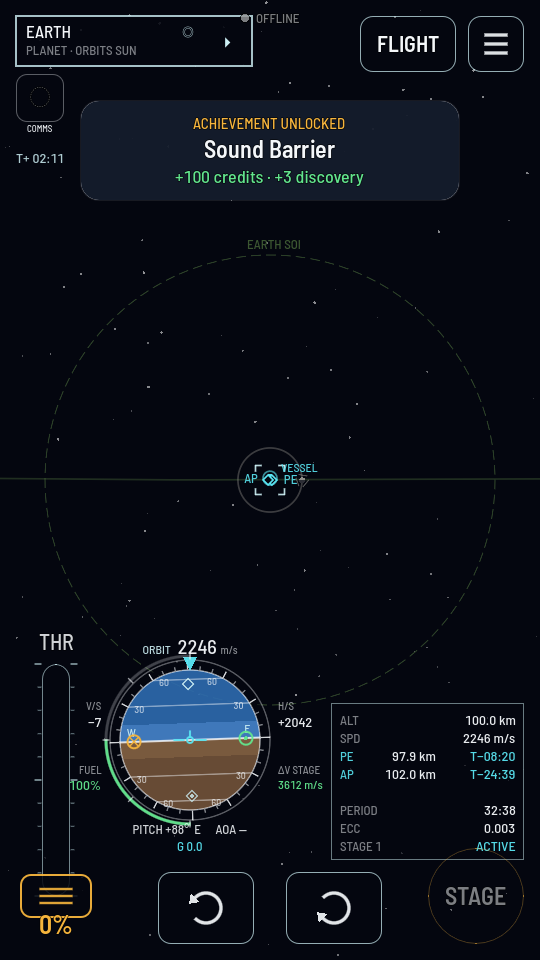
That is why a trip to another planet has three parts and not one. You climb out of the world you are on, you fall around the Sun for a while, and something else catches you at the other end. A trip to a moon is the same idea one storey down. Orbits covers what a crossing does to your path, and The map and maneuver nodes covers how you aim one.
What a world tells you when you select it
On the map, holding your finger on a world until the ring around it closes selects it and opens its card. The card names it, says what kind of body it is and what it orbits, and then lists the figures that decide how a flight there goes: RADIUS, GRAVITY, ATMOSPHERE or NONE, the length of its DAY, the reach of its SOI, the size and PERIOD of its own orbit, and the RANGE from your ship to it right now. Nothing on that card is hidden until you get there. You can read Pluto's gravity on your first flight.
Most of them have no air
Nineteen of the 28 worlds and moons have no atmosphere whatsoever. That changes what a lander is. With no air there is nothing for a canopy to catch, so the whole descent is flown on the engine and the last few metres are taken on the landing legs. There is also nothing to heat a hull on the way in and nothing to slow a ship on the way up, so the climb off an airless world is cheap.
Of the nine with air, two are places a canopy alone can bring a ship down: Earth, and Gazorpazorp, a moon of The Box carrying half again Earth's pressure over a tenth of its pull. Mars' air is less than a hundredth of Earth's and does almost nothing for a lander; Pluto's is thinner still. Existence is buried under ninety-two atmospheres of the stuff. The four giants carry more air than Earth with nothing solid underneath it. Air, heat and speed explains what the air does to a ship; the reference names, world by world, whether there is any.
You launch from one of them
A rocket starts from the Launch Pad, and there is one, on Earth. Every flight begins there, whatever you are aiming for.
Every other world in the system, the Moon and Mars included, can be orbited, landed on, taken readings from and left again, but never started from. A ship standing on another world got there by flying, and leaves under its own engines. See The Space Center for the pad itself.
Distance, not fuel, is what stops you
Getting further out costs less than you would think. The burn that throws a ship out of Earth's orbit does most of the work whichever way it is aimed, so once you can reach the belt, the fuel needed for the outermost planet is barely more than for the nearest one. Pluto's orbit is thirty-nine times as wide as Earth's and a seventh of the way out sits Meeseeks Prime, yet an orbit of one costs 6,716 m/s against the other's 6,458 m/s. The whole table is on the Worlds reference.
What does grow with distance is time and radio. The world's clock runs whether the game is open or not, and a crossing to the outer system takes a long stretch of it. Radio is the harder limit, and it is measured from Earth, because the one Comm Station stands there: the strongest dish and the strongest station each reach 500.00 Gm, past Squanch's orbit but short of Pluto's, so an uncrewed ship at the edge is out of touch unless a relay is parked to carry the link. A crew aboard needs no link at all.
Every world is a real place, not a label
None of these worlds is a coloured circle with a name. Each one is built from something — rock over an iron core, ice over rock, or hydrogen the whole way down — and its surface is cut into biomes: bands running round the world, each with its own colour, its own typical height above the datum and its own roughness. Earth has ocean, shallows, grassland, forest, desert, drylands and ice. The Moon has midlands, craters, canyons, highlands and poles. Gazorpazorp has methane seas with shorelines beside them. Every one of those is listed, with its figures, on that world's page.
The air is as particular. A world with an atmosphere states how tall it is, how fast the pressure falls, how cold it gets and which gases are in it at which heights: Earth's water vapour is gone by 50 km and its ozone peaks around 25 km, Mars is almost pure carbon dioxide, Existence is ninety-six per cent of it at 737 K, Gazorpazorp is nitrogen with methane in it. You never have to know any of that to fly — but a Thermometer, a Barometer and a Mass Spectrometer read the world your ship is actually in, and the readings match what the page says. The gas table is the Mass Spectrometer's: it is the one instrument that measures the mixture itself.
All of it matters to earning, too. Landing in a biome nobody has measured is worth discovery, and so is every band of altitude over it. The biome tables on the world pages are, read the other way round, a list of places nobody has been. Science and readings is how that is paid.
Every world has ground, and the ground is not flat
Each world has a real surface, not a circle. There are hills, slopes, ridges, craters and valleys, and a ship sets down on whatever it happens to be over. Every world with a surface goes further: its ground has named landforms — Earth's Crown Range and Kettle Valley, Olympus on Mars, the Verona Rupes on Blips — and where you come to rest is recorded by name. Each world's page lists every one of its own. That is why some achievements ask for a plateau, a crater floor or a summit rather than just a landing. Landing and recovery covers what the slope under you does to a ship that is trying to stand up.