Meeseeks Prime
The largest thing in the system after the star, the game's Jupiter: no ground at all, the highest escape speed anywhere, and four moons worth the crossing.
The numbers
These are the figures the map's card shows when you hold your finger on Meeseeks Prime, plus the two speeds that decide what a flight there costs. Low orbit speed is how fast you must be going, sideways, to stay up just above the bottom of the air. Escape speed is how fast you must be going to leave altogether. Sphere of influence is how far Meeseeks Prime's pull reaches before something bigger takes over.
| Figure | Value |
|---|---|
| TYPE | Planet |
| ORBITS | Sun |
| DISTANCE FROM SUN | 70.78 Gm |
| ORBIT PERIOD | 1265d 20:44:08 |
| ORBIT SHAPE | slightly oval (eccentricity 0.049) |
| RADIUS | 6.60 Mm |
| GRAVITY | 7.85 m/s² |
| DAY | 9:55:30 |
| STATIONARY ORBIT | 15.68 Mm up |
| STATIONARY SPEED | 3,918 m/s |
| LOW ORBIT SPEED | 6,784 m/s |
| ESCAPE SPEED | 10,179 m/s |
| SPHERE OF INFLUENCE | 2.73 Gm |
| ATMOSPHERE | 820.0 km tall |
Stationary orbit is the height where one trip round takes exactly one of the world’s days, so a ship there hangs over the same spot on the ground. See Stationary orbits.
What it is made of
Meeseeks Prime is gas most of the way down, and the mix below is the whole world rather than a crust.
| Material | Share |
|---|---|
| Hydrogen | 90 % |
| Helium | 10 % |
The air
Hydrogen and helium, with a trace of methane that thins with height. There is no floor under it: the datum the game measures altitude from is a level in the gas, not a surface, and a ship that reaches it has long since broken up.
| Figure | Value |
|---|---|
| TOP OF THE AIR | 820.0 km |
| PRESSURE AT ZERO ALTITUDE | 2,000 kPa |
| DENSITY AT ZERO ALTITUDE | 23.22 kg/m³ |
| HALVES EVERY | 41,589 m |
| TEMPERATURE AT ZERO ALTITUDE | 300 K (27 °C) |
| COOLS BY | 2 K per km |
| COLDEST IT GETS | 110 K (−163 °C) |
Pressure falls off as you climb: every 41,589 m of height, there is half as much air around you. A Barometer reads that fall directly, and a Thermometer reads the cooling beside it — 2 K for every kilometre, until the air bottoms out at 110 K (−163 °C) and stops getting colder. There is no surface here, so both figures are quoted at zero altitude — the level the map measures height from, deep inside the gas.
What the air is made of
The mix changes with height. Each column is a measured level; between two of them the game blends one into the other, and above the top one there is nothing left to breathe. A Mass Spectrometer reads this table itself: its figure is the mean molar mass of the mix where the reading is taken, and beside it the line names the biggest gases it found. See the Mass Spectrometer.
| Gas | Surface | 150.0 km | 400.0 km |
|---|---|---|---|
| Hydrogen | 86 % | 88.8 % | 90 % |
| Helium | 13.5 % | 11 % | 9.9 % |
| Methane | 0.5 % | 0.2 % | 0.1 % |
Clouds
Cloud decks stand at fixed heights and are drawn wherever you fly. You climb through them on the way up and see them from above afterwards. A cloud is drawn in front of your ship: inside a thick one you lose sight of it until you fly out, so pick your way round the big ones. Each deck mixes several kinds of cloud — sheets, lenses, rows of small cloudlets, wisps, hooks and veils — drawn in this world's own colour.
| Deck | From | To |
|---|---|---|
| Stratus | 20,000 m | 70,000 m |
| Cirrus | 110,000 m | 190,000 m |
The cloud bands
There is no surface. What Meeseeks Prime has instead of biomes is bands of cloud, named and drawn round the world, and a ship low enough to be inside one is over that band as far as a reading is concerned. Nothing can land, so no band is ever surveyed from the ground.
| Band | Where | Typical height | Roughness | Damp |
|---|---|---|---|---|
| North Belt | −180° to −120° | — | — | 10 % |
| North Zone | −120° to −60° | — | — | 10 % |
| Equatorial Belt | −60° to 0° | — | — | 10 % |
| The Eye | 0° to 60° | — | — | 10 % |
| South Zone | 60° to 120° | — | — | 10 % |
| South Belt | 120° to 180° | — | — | 10 % |
Where is the band's place round the world, in degrees from the world's own 0°, running out to ±180° on the far side. There is no ground under any of them, so neither height column means anything here.
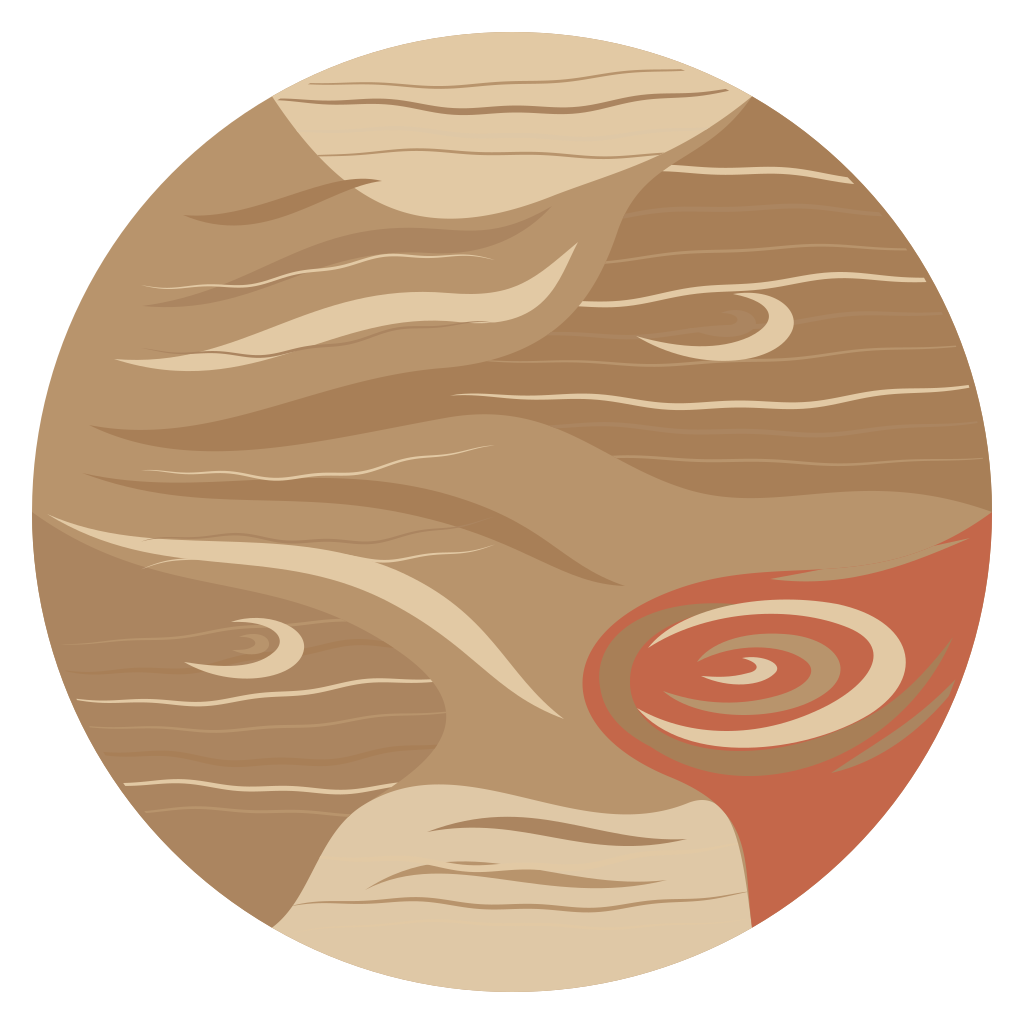
On the map Meeseeks Prime is drawn from a painted picture, and the six bands are its six sectors, 60° each: the dark North Belt, the pale North Zone and the brown Equatorial Belt run round one side, the rust-red swirl of The Eye sits just past 0°, and the pale South Zone and the South Belt run round the other. The colour under you as you skim the clouds is the colour of that sector.
Its moons
Four moons go round Meeseeks Prime, all of them inside its sphere of influence. Each has a sphere of its own, so the trip from one to another is a small transfer inside the big one.
| Moon | Distance out | Radius | Gravity | Air |
|---|---|---|---|---|
| Lookatme | 39.71 Mm | 171.6 km | 1.80 m/s² | none |
| Caandu | 63.20 Mm | 147.0 km | 1.31 m/s² | none |
| Jerry | 100.81 Mm | 248.1 km | 1.43 m/s² | none |
| Glapflap | 177.31 Mm | 227.0 km | 1.24 m/s² | none |
Getting there
There is no ground. It is gas the whole way down, and the air stands so tall that a ship is torn apart long before it reaches anything. Its escape speed is the highest of any world. What you come here for is the moons, and reaching its sphere of influence pays Look at Me, I'm a Planet.
What a ship leaving Earth's pad needs, in total change of speed, to do each of these:
| Trip | Δv from Earth's pad |
|---|---|
| Orbit | 6,458 m/s |
What it pays
Every place nobody has measured before pays discovery the first time an instrument reads it, and how much depends on how far from home the world is. Meeseeks Prime counts as 6.00 against Earth's 1.00, so every place on it pays that many times what the same place at home would.
| Figure | Value |
|---|---|
| PLACES TO SURVEY | 20 |
| WORTH IN ALL | 116 discovery |
| CREDITS BESIDE IT | 2,320 |
A place is a world, a band of altitude and — on the ground — the biome you are standing in, and each instrument surveys each place separately. Science and readings explains the whole of it.
What it pays out for
One achievement names Meeseeks Prime: Look at Me, I'm a Planet.
The full list, with what each one pays, is on the Achievements reference.