Lesson 4: Why rockets throw pieces away
An empty tank is luggage. Every real rocket ever built drops its empties on the way up, and it is the single biggest trick in the whole business.
The idea
Imagine carrying five bottles of water up a hill. You drink the first one. Do you carry the empty bottle the rest of the way? Of course not. You put it down, and the rest of the climb is easier.
A rocket's tank is the bottle, and it is a heavy one. At the moment the fuel runs out, that tank and the engine bolted under it have gone from being the most useful thing on the ship to being the heaviest useless thing on it. Everything above them has to be pushed along by whatever is left.
So you cut them loose. The piece that falls away is a stage, and doing it is staging. The second the empty stage lets go, the rest of the rocket is a much lighter ship with a full tank of its own, and TWR and Δv both jump in your favour.
Take the same parts you already have and stack them as two tanks and two engines with a Separator between: the game's figures for that rocket come to 5,635 m/s of Δv, against the 3,473 m/s of the one-stage starter, using engines that are not one gram better. All of that came from being willing to drop half the ship.
Why it works so well
Δv depends on the ratio between what the ship weighs full and what it weighs empty. A single big rocket can never have a very good ratio, because the tank that holds all that fuel is itself heavy and it stays with you. Splitting the ship lets each stage have a good ratio of its own, and the ratios multiply instead of averaging out.
There is a second reason, and it is thrust. A big engine is right for lifting a full rocket off the pad and wrong for nudging a nearly empty one around in space. Stages let you use one engine for each job and leave the other behind.
What a stage actually is here
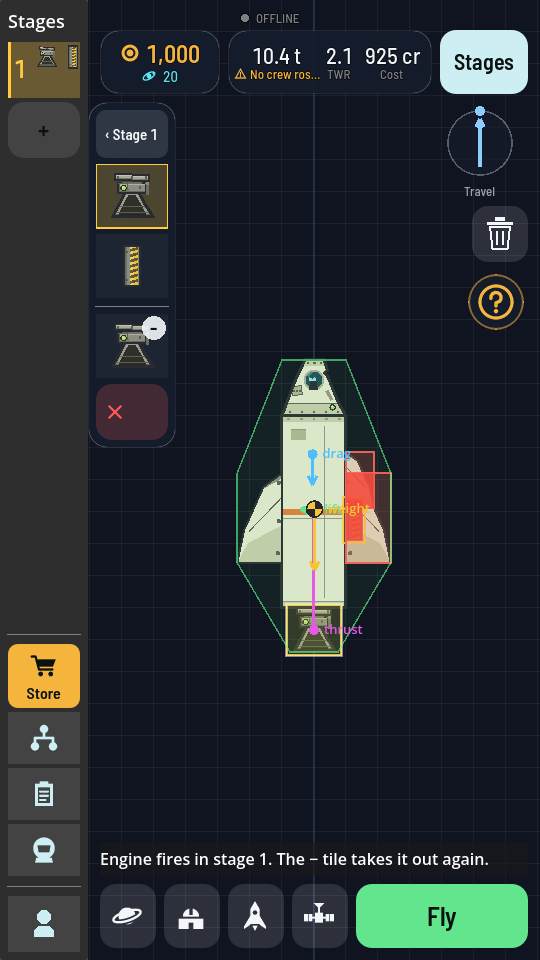
A stage in this game is not a part. It is a line on a list, and the list says what to fire when I press the button. A stage can hold an engine to light, a Separator to cut, a parachute to open, or several of those at once. Pressing STAGE fires everything on the current line and arms the next one.
That is why the usual pattern is to put the Separator and the next engine in the same stage: the old stage lets go and the new engine lights in the same instant, with no dead coast in between.
Where the game says it
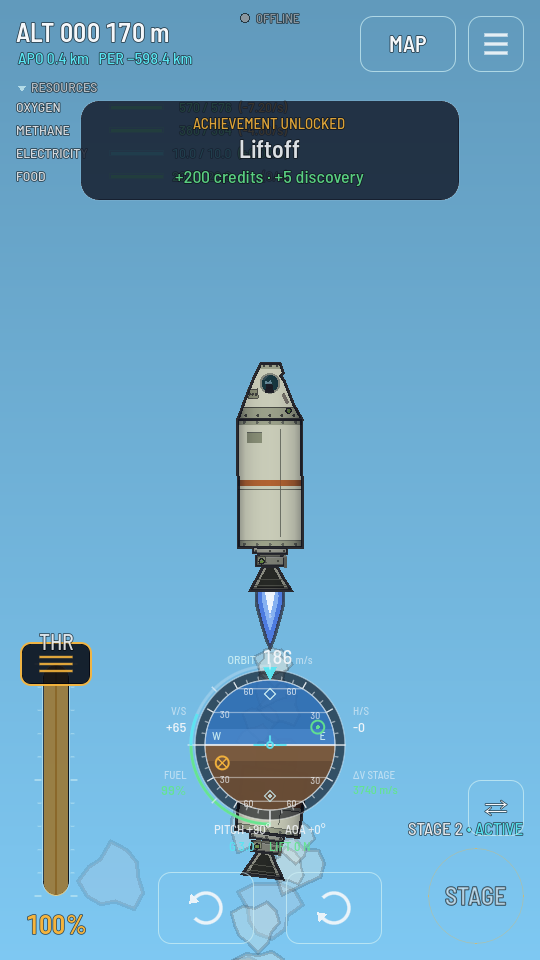
In flight, beside the STAGE button, a small line says which stage is armed. And the number to watch at the moment you press it is ΔV STAGE beside the navball. It shows the stage that is flying now, so when the empty one drops away it does not creep up. It jumps, from nearly nothing to thousands, because the game is now measuring a fresh stage pushing a far lighter ship.
Try it: watch the number jump
You need the Staging node and the second pad level. Build the rocket from Reaching orbit, or any two-stage stack: pod, chute, tank, engine, Separator, tank, engine, two fins.
- Before you launch, write down two numbers from the hangar's readout: the Mass and the TWR it lifts off with (the first stage's engines against the whole rocket).
- Launch and fly until the bottom engine dies. The FUEL gauge reads 0 %, the flame goes out, and ΔV STAGE reads nothing much. Do not press anything yet.
- Look at the ship. It is coasting, carrying a big empty tank and a dead engine. This is the exact moment a single-stage rocket is stuck in forever.
- Press STAGE. The empty stage falls away and the upper engine lights. Watch ΔV STAGE jump, and watch the ship start gaining speed much faster than it did on the pad.
- Look down. The dropped stage is still there, falling, and it is a real object: it can still be hit, and it comes down somewhere. The map's SHIPS chip can show it. See Debris and dropped stages.
What you just proved
- A stage is a line on a list, and STAGE fires that line.
- Dropping dead weight raises your remaining Δv the instant it lets go. Nothing else in the game gives you something for nothing like this.
- Two stages of ordinary parts beat one stage of excellent ones.
- What you drop keeps flying. It is not deleted, and it can come back to hit you if you drop it while the engine above is still lit.
The words
- Stage
- One line of the staging list, and the parts it fires. Usually an engine and the tank feeding it.
- Staging
- Firing that line: lighting engines, cutting a Separator, opening a chute.
- Separator
- The part that cuts a stack in two and pushes both halves gently apart.
- Debris
- Anything flying that nobody is at the controls of, including the stage you just dropped.