Lesson 5: Orbit is sideways, not up
You can reach space and fall straight back out of it. Space is a height you climb to. Orbit is a speed you have to be doing when you get there, and it is a much bigger deal.
The idea
Throw a ball as hard as you can. It curves and lands, a little way off. Throw it harder and it lands further away. The ball is falling the whole time, but it is also travelling sideways, so it comes down further along.
Now imagine standing on a very tall mountain and throwing it unbelievably hard. The ball falls, as always. But the ground beneath it is curving away, because the world is a ball too. Throw hard enough and the ground curves away exactly as fast as the ball falls toward it. The ball never gets any closer. It goes all the way round and hits you in the back of the head.
That is an orbit. Not "high enough that gravity stopped", which never happens, but "sideways fast enough that falling never arrives". An orbiting ship is falling all the time and always missing.
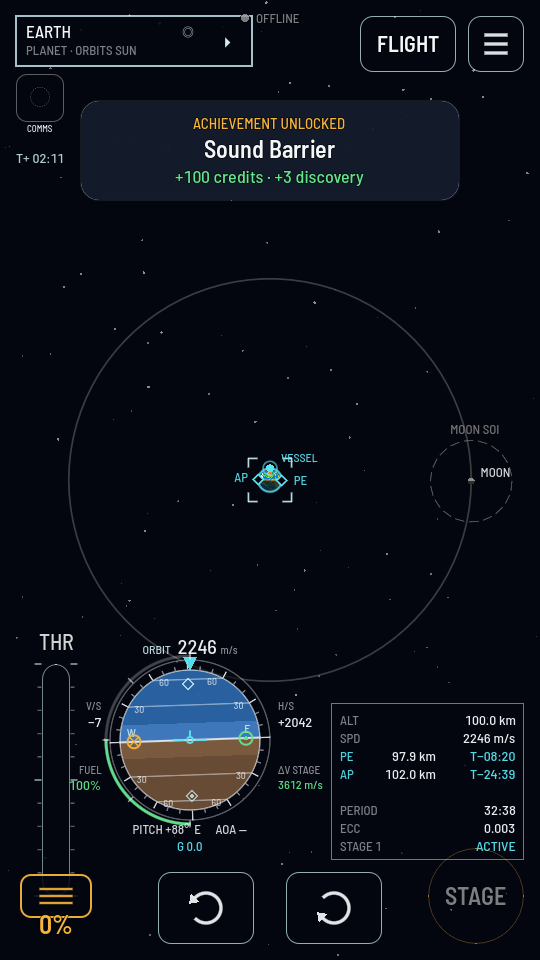
So the question at the heart of every launch is not how do I get up there. It is how do I get going sideways that fast. Around this Earth, just above the ground, that speed is 2,279 m/s. A hundred kilometres up it is a little gentler, 2,246 m/s, because you are further from the pull.
Space and orbit are two different achievements
This game is honest enough to pay you for them separately, which makes the point better than any diagram.
| Feat | What it needs | Pays |
|---|---|---|
| Space! | Get above the air. On Earth the air ends at 70 km. | 400 cr · 10 discovery |
| Stable Orbit | Be going sideways fast enough that your path never comes back into the air. | 1,000 cr · 25 discovery |
You can win the first with the starter rocket pointed straight up and no skill at all. The second one is what the rest of this section is for.
Where the game says it
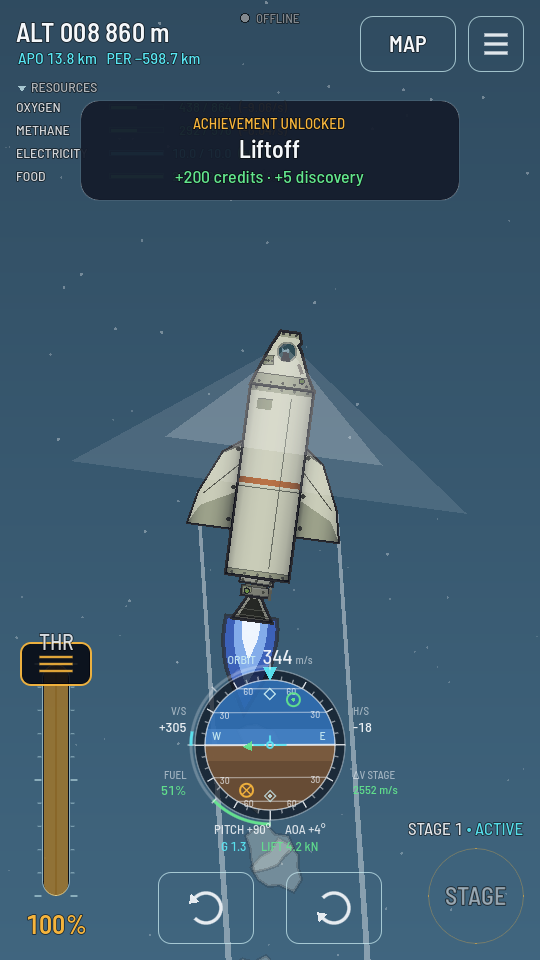
Look either side of the navball in flight. V/S on the left is how fast you are going up or down. H/S on the right is how fast you are going sideways, across the surface. That pair is the whole lesson on one screen.
- A flight straight up has a big V/S and an H/S of almost nothing. It is going to come back down.
- A finished orbit has an H/S in the thousands and a V/S hovering around zero. It is going round.
Getting into orbit is the job of turning the first picture into the second one before the fuel runs out.
Try it: reach space and fall out of it
The starter rocket, straight up, one more time. This time you are going to look at the map.
- Launch and burn everything, pointing straight up. If it goes past 70 km you will see the Space! toast. You are in space. Nothing is holding you there.
- Tap MAP while you are still coasting. The screen swaps for the map with your path drawn on it, a thin line reaching up and curving back to the surface. It is a very tall arc, not a loop.
- Read the ORBIT panel down the left. It arrives folded, showing your altitude with two figures under it: AP, the top of the arc, and PE, the lowest point your path reaches. PE reads IMPACT, because that point is underground. The game is telling you outright that this path ends in the dirt. Tap the panel to open it and the markers your path will meet are listed with a countdown to each.
- Check H/S back in the flight view. It is tiny. All your effort went up, and up is the one direction that cannot keep you anywhere.
- Land under the chute and recover. Then read the next two lessons, which are about turning that arc into a loop.
Why you cannot just point at the sky and go
Two things go wrong when you fly straight up, and they are worth naming because you will feel both.
Gravity eats the budget. Every second you spend pointing straight up, gravity is taking 9.81 m/s out of your Δv and giving you nothing for it. Pointing sideways, that same pull does no harm at all, because it is not fighting your thrust any more.
The air punishes speed low down. You need thousands of metres per second, and the worst place to be going fast is in the thick air near the ground (lesson 9). So the trick is to climb out of the thick stuff first, then lean over and do your fast going sideways up where there is nothing in the way.
That lean is called a gravity turn, and the ship helps you with it: nose it over a little and it keeps drifting toward the way it is already travelling by itself, so you end up flying nearly flat by the time the air runs out.
What you just proved
- Space is a height. Orbit is a sideways speed. They are not the same achievement and the game pays them separately.
- Around this Earth the speed you need is 2,246 m/s sideways at 100 km up.
- A path whose lowest point is underground is not an orbit, and the map says IMPACT when it sees one.
- Flying straight up wastes your Δv twice over: on gravity, and on the air.
The words
- Orbit
- A closed path around a world, fast enough sideways that falling never reaches the ground.
- H/S
- Horizontal speed: how fast you are going across the surface, in metres per second.
- Gravity turn
- Leaning the rocket over gradually during the climb, so that thrust goes sideways instead of straight up.
- IMPACT
- What the map prints in place of a periapsis when the low point of your path is inside the ground.