Reaching orbit
Fly a two-stage rocket past the top of the air and settle it into a circle around Earth that does not come back down on its own. Before you build it, you need a tech node and a bigger pad.
What you need first
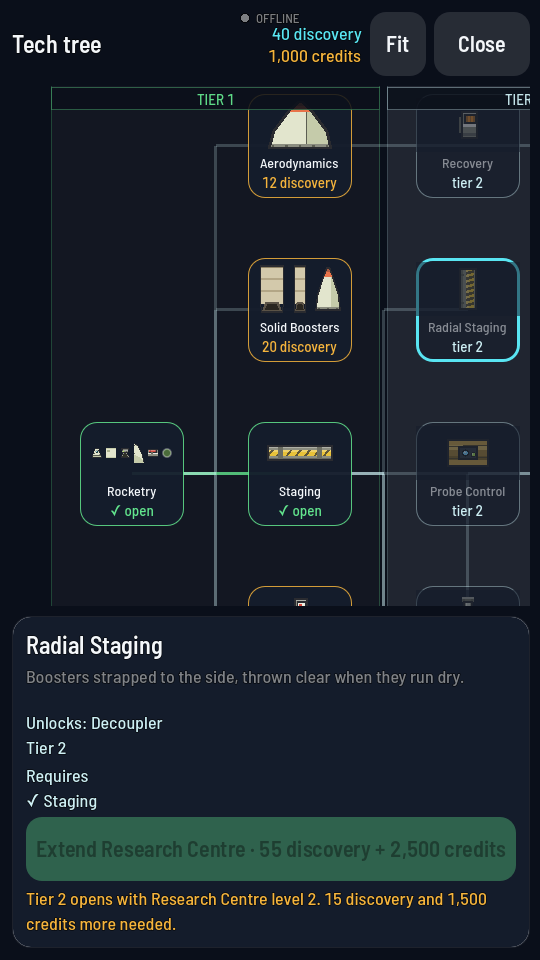
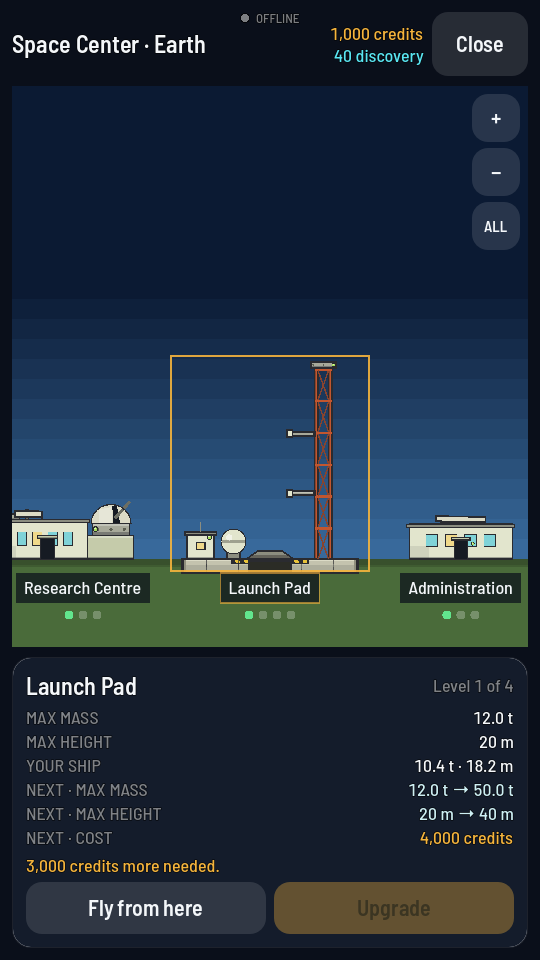
This rocket comes to 19.3 t and 35.6 m tall, and your starting Launch Pad caps a ship at 12.0 t and 20 m. Buy two things before you build it:
- The Staging tech node, 18 discovery. It sells the Separator, and it is what the pad's second level needs.
- The Launch Pad's second level, 4,000 credits, which raises its caps to 50.0 t and 40 m, room to spare for this ship.
From the hangar, tap the Space Center button (the dome), then the Research Centre, then Open tech tree. Tap Staging and its button, reading Unlock · 18 discovery. Close the tree, tap the Launch Pad, check its "NEXT · COST" row (4,000 credits), then tap Upgrade.
Build the two-stage rocket
Tap the trash-can icon in the hangar's top right and confirm Clear to empty the canvas. Stack a Command Pod with a Parachute above it, a Fuel Tank and an Engine below it. That top section is your second stage: tap the tank twice to open its sheet and set its Length slider to 128.
Under it, a Separator, then the first stage: a second Fuel Tank stretched all the way to 256, an Engine at its base, and a Fin on each flank for the climb through the thick lower air. Select one fin and tap Symmetry to give it a matched twin on the other side.
Set up the staging
Open Stages. Put the first-stage engine into stage 1. Put the Separator and the second stage's engine into stage 2 together too: the spent tank falls away and the new engine lights in the same instant, with no dead coast between them. Leave the Parachute out of the list for now. It is for the flight home, in the next guide.
Light it and turn
- Tap Fly. The upgraded pad takes this ship without complaint.
- Tap STAGE. The first-stage engine lights and the rocket leaves the pad, slowly at first.
- Ease it over. Once your speed reads a few hundred m/s, hold one of the two curved-arrow turn buttons for a second, then let go. Do this a few times rather than all at once: the ship keeps turning on its own toward the direction it is already moving, a gravity turn, and ends up flying nearly flat by the time the air runs out.
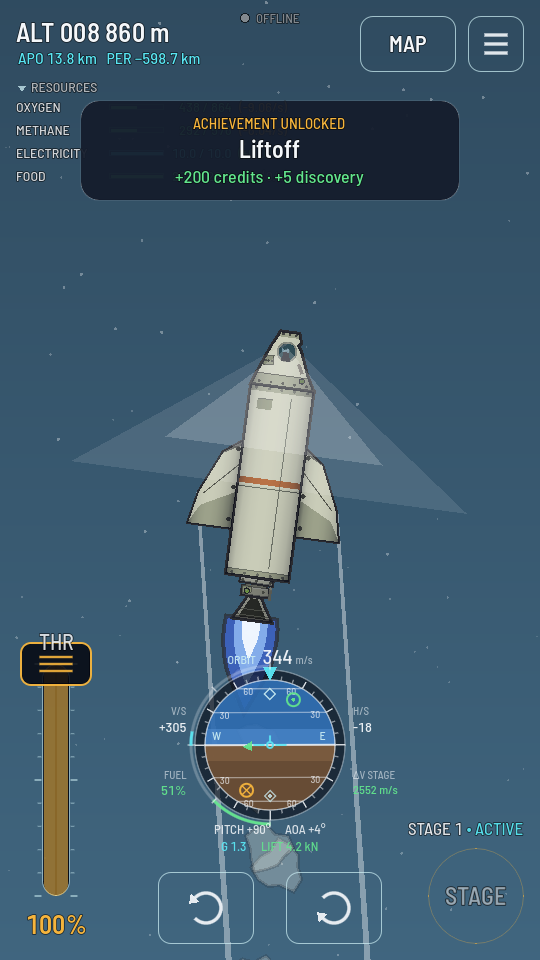
Mid-turn: APO, under the altitude reading at the top left, keeps climbing as long as the engines burn.
Drop the first stage
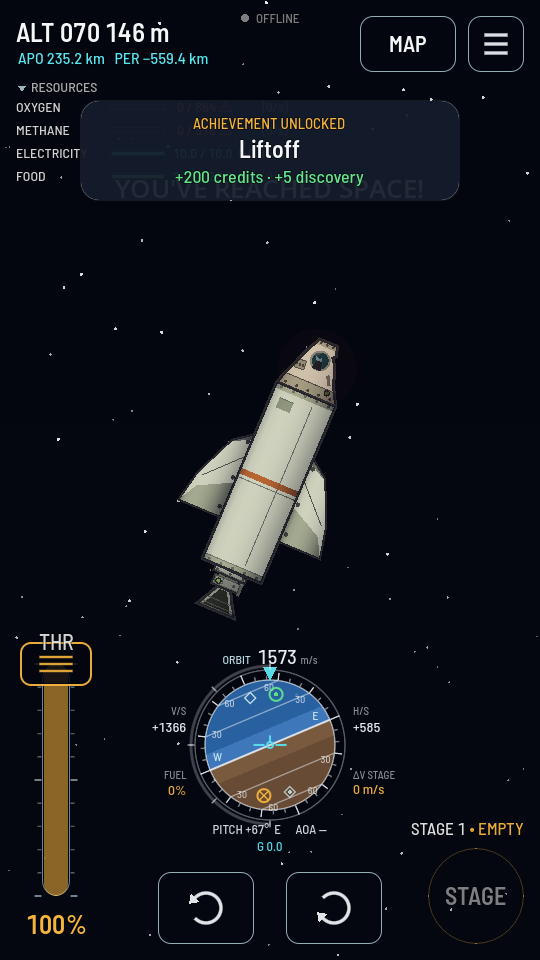
The bottom engine drinks its tank dry long before you are near a full orbit. That is what it is for. Once the FUEL figure beside the navball reads 0 % and the flame goes out, tap STAGE. The spent tank and its engine fall away and the second stage's engine lights in the same moment, right where the first left off.
Climb to a stable orbit
Keep the second stage burning along the way you are already moving until your apoapsis clears 70 km. Earth's atmosphere ends there, and a periapsis under that line is never a stable orbit, however high the apoapsis reads. Once it is comfortably past, cut the throttle and coast.
At apoapsis, tap the navball until it reads ORBIT and steer the green ⊙ mark under the nose: that is your orbital prograde. Hold the throttle again. Burning here, at your highest point, barely moves the apoapsis but lifts the periapsis. This is the circularising burn. Stop once the periapsis reading clears 70 km too.
Read the map
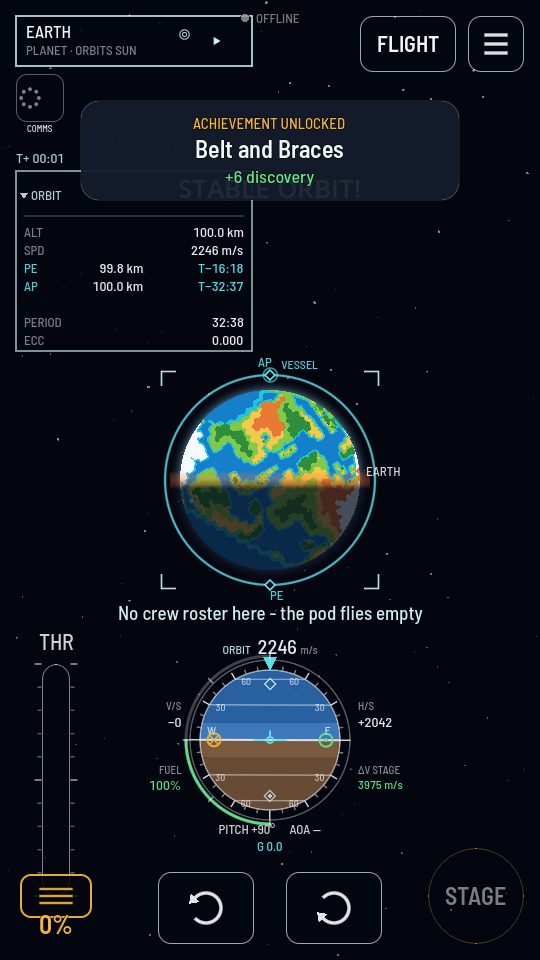
Tap MAP to see the whole path at once. The ORBIT panel down the left arrives folded, stating your altitude with AP and PE under it — the two figures this burn was for. Tap the panel to open the rest: the same two with a countdown to each, the PERIOD of one lap and the ECCENTRICITY, which near zero is close to a circle and is what a well-timed circularising burn leaves you with.
What you earned
This flight lands three achievements, if you have not already earned them:
| Achievement | Reward |
|---|---|
| Staged | 100 credits + 3 discovery |
| Space! | 400 credits + 10 discovery |
| Stable Orbit | 1,000 credits + 25 discovery |
What went wrong?
The Launch Pad still refuses the ship. Its sheet names exactly what is short: the Staging node, or credits, or both. Buy what it names and try again.
The rocket tips over hard during the turn. A turn button was held too long in one go. Ease off sooner and let the gravity turn carry on by itself; a sharp turn low down costs more than it saves.
The second stage runs dry before the periapsis clears the air. The apoapsis was too low when the first stage burned out, so there was not enough height, or Δv, left to lift the periapsis too. Let the apoapsis climb further past 70 km before you cut the engine and coast.
The orbit decays back into the air within a lap or two. The circularising burn stopped short of clearing the periapsis. Burn a little longer at apoapsis next time; the map's PE reading is the one to watch.
Next
You are in orbit with nowhere to go but around, forever, unless you bring the ship home. Coming home from orbit is the next guide: the burn that brings your periapsis back down, and what the heat on the way means for a ship with no Heat Shield.