Coming home from orbit
Bring the ship from your last flight back to the ground in one piece and recover it, with nothing but the parts you already carry to get you through the heat on the way down.
What you need
The two-stage ship from Reaching orbit, already circling Earth with its periapsis clear of the atmosphere. This ship carries no Heat Shield: what protects it on the way down is only what it already has.
Coming down is not a fall you steer around, only one you slow first. Dropping your periapsis back into the air is what starts the drag and the heating that bring an orbiting ship home; nothing about the trip back is optional, only how gently you make it. The steps below follow the same ship the whole way: no new parts, no second flight, just the burn, the fall, and the landing that closes it out.
Bring it down
- Turn retrograde and burn. Tap the navball until it reads ORBIT, then turn the ship until its amber ⊗ retrograde mark sits under the nose: the opposite of the way you are travelling. Hold the throttle here. This is a retrograde burn, and it does the opposite of the circularising burn that put you in orbit: it lowers the point on the far side of your path instead of raising it.
- Watch the periapsis, then cut the engine. The PER reading sits under the altitude counter. Once it drops under 70 km, back below Earth's atmosphere line, cut the throttle. A periapsis just inside that line is enough to bring you down; one deep beneath it only buys you more heat for no extra certainty of landing.
- Swing back around and hold nose-first. Point the nose at your ORBIT prograde mark again, the way you are travelling, and hold it there as the air thickens. Pointed nose-first, the Command Pod meets the airflow and shields the Fuel Tank and Engine riding behind it. The pod's info card lists a MAX TEMP of 2400 K: with no Heat Shield's ablator to spend instead, that figure is the one thing standing between you and a part coming apart in the heat.Heads upDo not let the ship tumble. Whichever part is facing the airflow when you stop steering is the one judged against its own tolerance, and the pod's is the only one built for this.
- Ride out the heat. Below around 70 km the ship starts to glow: a haze builds at the nose and tail as the air fights it, brightening the faster and lower you go. There is no ablator burning away to buy you time here, so the glow is your only warning. Hold the attitude and wait it out; your G load, on the navball's line below the ball, stays modest next to the heat.
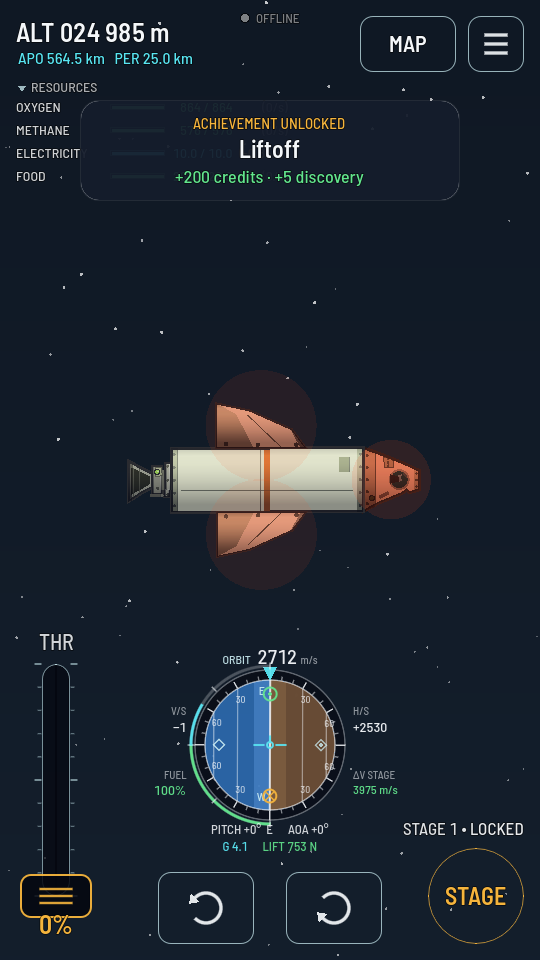
Plasma glow at both ends on the way down. The throttle is at 0% here: there is nothing left to burn, only heat to survive. - Open the parachute once you are slow. The glow fades as you fall into thicker air below, and your speed keeps dropping. Wait until you are well down and slowed before you open the Parachute: its info card's PARACHUTE MAX Q row reads only 12 kPa, and coming in from orbit crosses that figure easily while you are still fast and high. Tap it and choose Deploy.
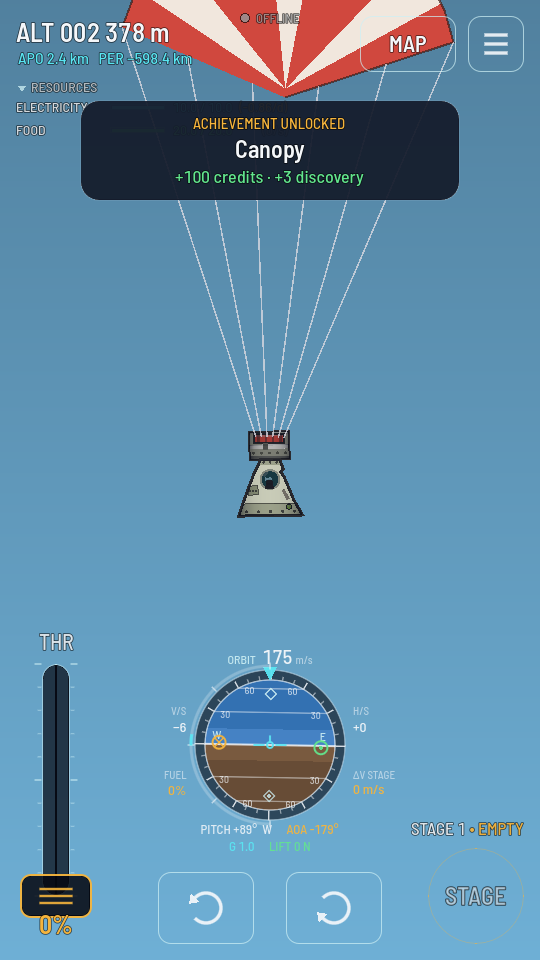
Under the canopy. The same chute, opened the same way, as on your first flight. - Touch down and recover. Let the ship settle on the ground, then open the flight menu and tap RECOVER, the same way you did after your first flight. Every part still aboard, pod, tank, engine and chute, comes home in credits, and the flight ends there.
What you earned
| Achievement | Reward |
|---|---|
| Through the Fire | 350 credits + 7 discovery |
| Touchdown | 300 credits + 8 discovery |
| Home Again | 200 credits + 5 discovery |
Through the Fire is new to this flight: it pays for holding 1,800 m/s below 70 km with nothing shielding you. The other two you most likely already hold from your first flight.
What went wrong?
A part came apart during re-entry. The heat outran the pod's tolerance, or the ship tumbled and put a less tolerant part into the airflow instead. Aim for a periapsis just inside the 70 km line rather than deep beneath it, and hold the nose steady all the way down.
The parachute tore off. It opened too fast, too high, still carrying orbital speed. Wait longer, until the ship has slowed in the thicker air near the ground.
There is no RECOVER in the menu. The ship is still moving, it came down in pieces, or it is not on Earth. Wait for it to stand still; a wreck cannot be recovered.
The ship missed Earth's pad by a long way. That is fine. Recovery only asks that the ship stand still in one piece; it does not care where on the ground that is.
Next
You now have a rocket that can leave Earth and come home again in one piece. The next step is a rocket that does not come home to the same world it left: read Orbits and The map and maneuver nodes for what a transfer between worlds asks of a ship like this one.