Lesson 9: The air: drag, the bang and the heat
Air is a substance, and you have to shove it out of the way. It takes speed off you on the way up, and it gives that speed back as heat on the way down.
The idea
Put your hand out of a car window at walking pace and you barely feel it. Do it at motorway speed and the air nearly takes your arm off. Nothing about the air changed. You did.
That is the one thing to hold on to: the air pushes back harder the faster you go through it, and much harder than you would expect. Going twice as fast is far worse than twice as bad. It also pushes back harder where the air is thick, which is low down, and not at all where there is none.
Two numbers describe Earth's air here. At the ground the pressure is 101.3 kPa, and the air ends at 70 km. Between those, it thins out smoothly. So the bottom few kilometres of every launch are the expensive ones, and by the time you are high up you can go as fast as you like for free.
Three things the air does to you
It drags
Every part of your ship pushes air aside, and a blunt part pays far more for that than a pointed one. A nose cone on top of a stack shelters everything behind it, which is why it earns its place even though it does nothing else. Fins are worth their drag because they keep you pointing the right way. A bare tank at the top of a rocket is the worst of both worlds.
It makes an engine weaker
An engine's bell has to push its exhaust out against the air behind it, so the same engine is stronger the higher it goes. The Engine makes 215 kN at sea level and 250 kN in vacuum. That is why your TWR quietly improves during the climb, and why some engines are built for vacuum only: the Vacuum Engine gets 420 s of Isp out in the open and a miserable 168 s at the pad.
It heats what it touches
Rub your hands together and they warm up. Rub a rocket against a whole atmosphere at two kilometres a second and it glows. Every part has its own temperature limit, and past that limit it comes apart. The limits are honest engineering rather than round numbers:
| Part | Gives up at | What that means |
|---|---|---|
| Wing | 610 K | Its whole leading edge takes the air: past about 230 m/s low down it is gone, and it never survives a trip to space. |
| Fuel Tank | 1,300 K | Survives an ordinary ascent, not a bare-nosed one. |
| Heat Shield | 3,600 K | Made for re-entry, and it spends itself doing the job. |
The ship warns you before anything breaks. A part glows from 600 K, then trails plasma and sparks as it gets hotter. Glow is "ease off or turn away". Plasma is "you have seconds".
The bang
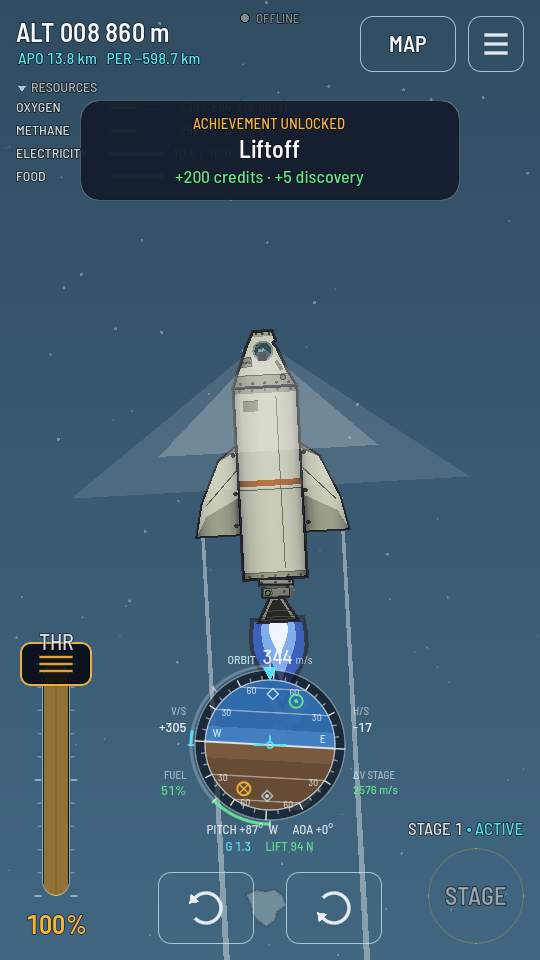
There is one speed that costs extra to pass through: the speed of sound. Below it, the air ahead of your rocket has time to get out of the way. At it, the air cannot move aside fast enough and piles up into a cone that trails behind you, and for a moment the climb fights hardest against the throttle. Then you are through and it eases off.
You can see it happen. A faint pale cone appears behind the rocket, and the game pays you 100 cr and 3 discovery for the Sound Barrier achievement the first time.
Other worlds have other air
Air is a property of the world, not of space, and the differences are enormous. Mars has an atmosphere of 0.61 kPa at its surface, which is under a hundredth of Earth's: enough to heat a ship coming in fast, nowhere near enough for a parachute to do the job alone. The Moon has none at all, so nothing heats and nothing slows you and a parachute is dead weight.
Every world's page in the manual states its air, and reading that before you build the lander is the difference between arriving and arriving in pieces.
Try it: make the air visible
Three flights of the starter rocket, straight up, in sandbox. What you are collecting is the highest altitude each one reaches.
- Wide open. Launch and leave the throttle at 100 %. Note the altitude where the pale cone appears, and the highest altitude you reach.
- Gently. Same rocket, but hold the THR slider at 50 % until you pass 10 km, then open it fully. Note the highest altitude again and compare. You have swapped one bill for another: going slower through thick air pays the air less, and climbing slowly pays gravity more. Which one wins depends on the rocket, and you have just measured it for yours instead of guessing.
- Put a flat face into the wind. In the hangar, stack a second Fuel Tank on top of the pod, with nothing above it, so the tank's flat top leads the way. Seat your astronaut as usual and fly it wide open. Watch the top of that tank as the speed builds: that reddening is the air heating it, and nothing has touched it.
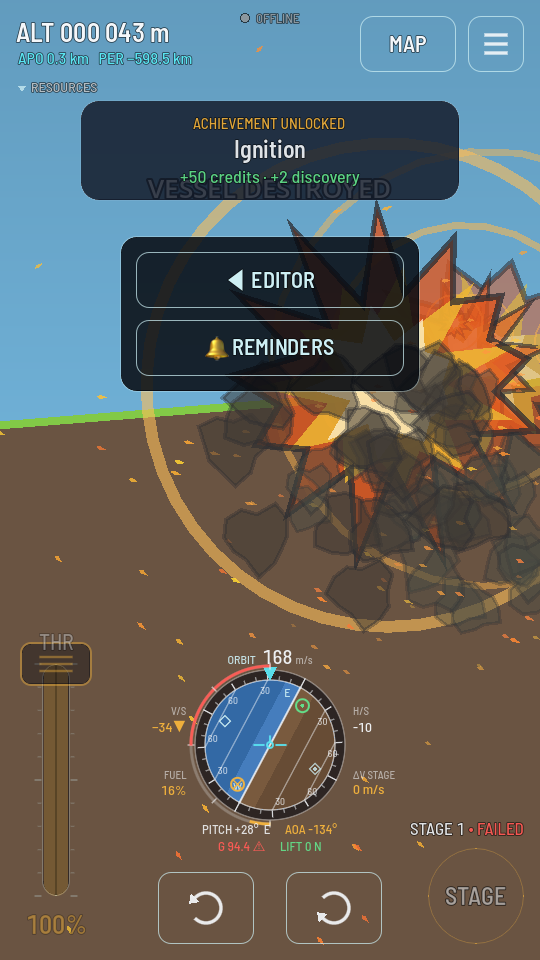
Pushed harder than this, an exposed tank passes its limit and comes apart in the air. - Cap it and fly it once more. With the Aerodynamics node bought, 12 discovery, put an Aerocone on that top tank and fly the same profile. The cone shelters the tank behind it, the reddening goes away, and the rocket reaches higher on exactly the same fuel. That difference is drag, in metres.
To watch heat actually break something, come home from orbit without a Heat Shield. That is lesson 10, and the flight is in Coming home from orbit.
What you just proved
- The air fights back harder the faster you go and the lower you are.
- Shape matters: a pointed nose shelters the whole stack behind it.
- The same engine is stronger in vacuum, and some engines are only good there.
- Heat is a warning you can see coming: glow first, plasma second, wreckage third.
The words
- Drag
- The air's push against a moving ship. Grows fast with speed and with the thickness of the air.
- Supersonic
- Going faster than sound travels through the air around you.
- Max temp
- The temperature a part comes apart at, stated on its info card.
- Ablator
- The layer a Heat Shield boils away to carry heat off. It runs out.