Lesson 10: Coming back down in one piece
Landing is not about steering. It is about getting rid of speed, and about which part of your ship is unlucky enough to touch the ground first.
The idea
Everything you spent getting up there is still in the ship, as speed. To land you have to get rid of all of it, and there are only two ways to do that.
- Burn it off with the engine. Reliable, works everywhere, costs fuel you had to carry.
- Give it to the air. Free, but the air takes its payment in heat, and only worlds with air will take the deal at all.
It is the difference between braking a bike with the brakes and dragging your feet. One costs you brake pads, the other costs you shoes. Coming home to Earth you use the air, because Earth has plenty. Landing on the Moon you use the engine, because there is nothing else.
The part that touches first is the part being judged
This is the rule that surprises people, and it is a fair one. A landing is over in a heartbeat, so the game does not ask what your ship weighs or how brave your pilot is. It asks how fast the part that hit the ground was going, and compares that with what that part can take. Every part's info card states it as IMPACT.
| Part | Survives a touchdown at |
|---|---|
| Engine, on its bell | 14 m/s |
| Fuel Tank | 16 m/s |
| Command Pod | 20 m/s |
| Heat Shield, on its dish | 28 m/s |
| LT-1 Landing Strut | 30 m/s |
| LT-2 Landing Strut | 45 m/s |
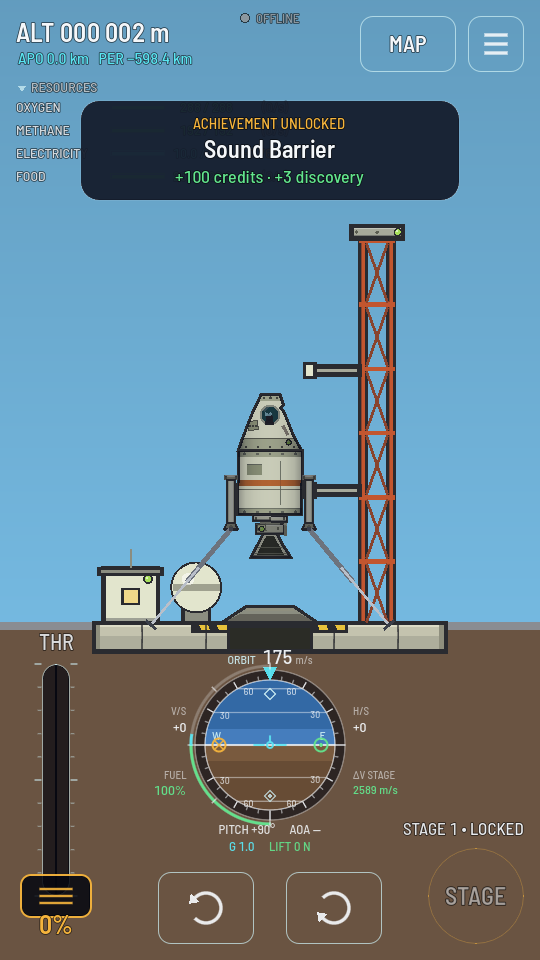
So a rocket set down on its engine bell is the most fragile thing you can build, and the same rocket on legs is more than twice as tough. Legs are not decoration: they have springs in them, and they take the shock over their own travel before anything hard meets anything hard. It is landing on bent knees instead of straight heels.
Parachutes, and why they have rules
On a world with air, a canopy does the work for free. The Parachute opens a canopy of 400 m², which is far bigger than your rocket, and it takes a second and a bit to fill. Three rules come with it:
- Not too fast. Open it into a fast, thick airflow and it tears away. Let the air slow you first, or use a small Drogue Chute to do the early braking and save the big canopy for later.
- Not on the ground. A chute will not open while the ship is standing still, because there is no airflow to fill it. Deploy while you are coming down.
- Once. A used canopy is spent. Only an Engineer aboard can repack one for a second descent.
The number that tells you whether the landing will be fine is V/S, your vertical speed. Under a canopy it settles at a walking pace and stays there, because the air's push has grown to match the ship's weight. That steady speed is all a parachute promises: get it below the weakest IMPACT figure on your ship and you have a landing rather than a crash.
The ground is not flat
Worlds here have hills, slopes, craters and plateaus, and your ship meets whichever bit of ground is under it. A ship on a slope leans to match, and whether it holds that lean or falls over depends on how wide its feet are and how low its weight sits. A bare stack has almost no footprint and goes over easily. When it does go over, the end that swings furthest hits hardest, and that end is judged on its own IMPACT figure like anything else.
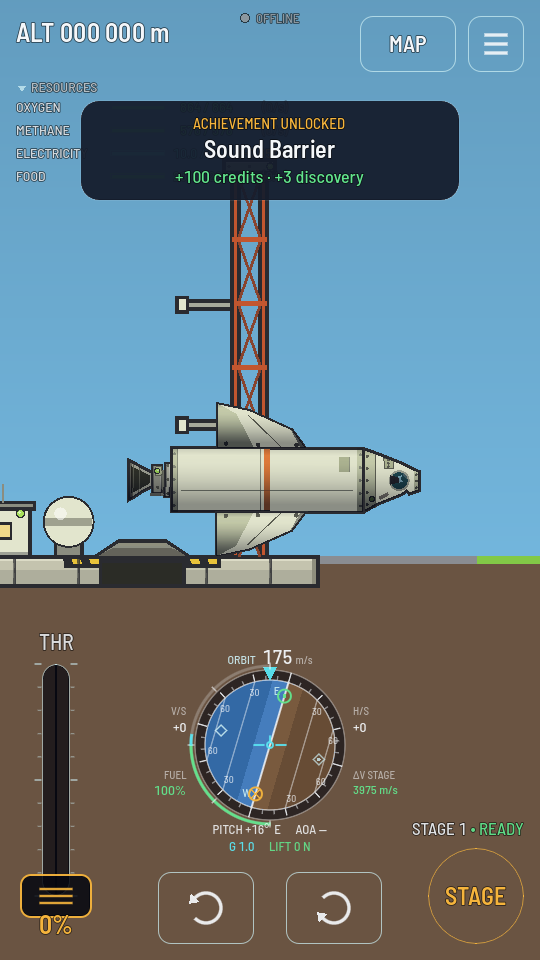
Landing on the flat is worth the effort. ALT at the top left can be tapped to read AGL instead, which is your height above the ground right below you rather than above sea level. On a hill, AGL is the number to land by.
And then you get paid
A landing is not finished until the ship is home. Stand still on the ground of Earth, open the flight menu and tap RECOVER: every part still aboard is refunded in credits and the flight ends. A crash refunds nothing, which is the whole risk of the game in one sentence.
Try it: land the same rocket three ways
Sandbox, the starter rocket, straight up and back down. You are going to watch V/S in the last seconds every time.
- No chute at all. Take the parachute off in the hangar and fly it up and back down. Watch V/S as the ground comes up: the air alone cannot slow a rocket enough, and the engine bell meets the ground far faster than the 14 m/s it can take. This is what a crash looks like.
- Chute, opened too low. Put the parachute back, fly the same flight, and leave the deploy until you are only a few hundred metres up. Either it tears away or it fills too late. Note what V/S reads at touchdown.
- Chute, opened properly. Same flight, deploy while you are high and already falling. V/S settles to a walking pace and stays there all the way down. Touchdown is gentle, nothing breaks, and RECOVER appears in the flight menu once the rocket is still.
- Compare the three V/S readings. That single number is the whole difference between a wreck, a scare and a refund.
What you just proved
- Landing is speed management, not steering.
- The part that touches the ground first is the one that decides whether you landed or crashed.
- A canopy gives you one steady, gentle descent speed, and only if you open it at a sensible moment.
- Legs, and flat ground, are what turn a survivable landing into an easy one.
The words
- Impact speed
- The touchdown speed a part survives when it is the one that hits. On its card as IMPACT.
- Drogue
- A small chute that can open at high speed, used to slow a fall before the main canopy.
- AGL
- Height above the ground right below you, rather than above sea level.
- Recovery
- Bringing a landed ship home from the flight menu, which refunds every part aboard.