Lesson 6: The shape of an orbit
Every path around a world has a high point and a low point, and it has two names you will see all game. The strange part is what happens when you push: the end you are not at is the end that moves.
The idea
Drop a skateboard into a curved bowl and let go. It rolls down one side, races through the bottom, climbs the far side, slows, stops, and comes back. It does that forever if nothing rubs.
An orbit is that bowl, with the world at the bottom of it. Your ship has a low point where it is going fastest and a high point where it is going slowest, and it swaps between them over and over. The two points have names:
- Apoapsis, marked AP on the map: the highest point of the loop, and the slowest.
- Periapsis, marked PE: the lowest point, and the fastest.
"Apo" means far, "peri" means near, and once you have read them twice they stop looking like Greek homework. When AP and PE are the same height, the loop is a circle. The further apart they are, the more of a long stretched egg it is. The map gives that a number too, ECC for eccentricity: 0.000 is a perfect circle, and bigger means longer and thinner.
Faster low, slower high
Falling toward the world speeds you up, climbing away from it slows you down, exactly like the skateboard. So a ship on a stretched orbit rushes through its periapsis and crawls through its apoapsis. That is genuinely useful, and not just trivia:
- You have plenty of time to get things done near apoapsis, and hardly any near periapsis.
- Most careful manoeuvres are therefore planned near the high, slow end.
- Waiting near apoapsis is cheap. If you need to be somewhere at a particular moment, that is where you wait.
The strange bit: you move the far end
Here is the one piece of orbital mechanics that catches everybody out. Push forward at one end of the loop, and it is the opposite end that rises.
Think of a swing. To make a swing go higher at the front, you do not shove it at the front. You give it a push at the back, where you are, and the extra speed carries it further round. An orbit behaves the same way, because you are not steering a car: you are changing how fast the ship goes past this point, and that decides how far it gets on the other side.
| Where you burn | Pushing forward does this |
|---|---|
| At periapsis, the low point | Raises the apoapsis. Cheapest way to go higher or further. |
| At apoapsis, the high point | Raises the periapsis. This is how you turn an arc into an orbit. |
| Anywhere, pushing backwards | Lowers the other end instead. This is how you come home. |
That second row is the whole of lesson 7, and the third is how every re-entry starts.
Where the game says it
Two places, and they agree.
In flight, as soon as you are off the pad, a second line appears under the altitude at the top left with APO and PER on it. Watching those two while you burn is the fastest way to feel the rule above. On a flight that is going to come back down, PER shows a negative height, because the low point of your path is somewhere under the ground.
On the map, the ORBIT panel down the left gives you the figures and your path carries the markers. AP and PE are drawn as diamonds on your line; tap one and a callout opens with its height and a countdown to it. Tap it again to close it.
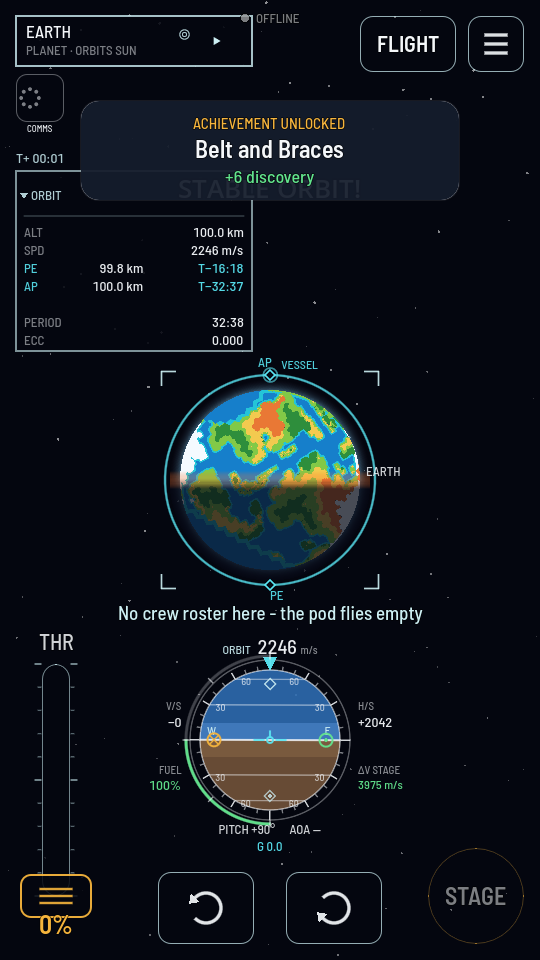
Try it: two burns, one arc
The starter rocket again, and this time you are going to keep some fuel back. Sandbox makes this painless.
- Launch and close the throttle halfway. Tap STAGE as usual, then drag the THR slider at the lower left down to 0 % once the FUEL gauge is down to half. The engine stays lit and ready, but it stops spending.
- Open MAP and write down AP and PE. Your arc has a top, and its PE reads IMPACT because the bottom is underground.
- Watch nothing happen. Coast for a minute without touching anything. Neither figure moves. An orbit does not wear out, sag or decay on its own: only thrust changes it. In sandbox, once you are above the air and coasting, the rate button in the map's top right will speed the clock up so you can be sure.
- Point the way you are going and push. Back in the flight view, steer the nose onto the green mark on the navball, the one facing the way you already travel, and open the throttle for three seconds. Watch APO at the top left climb, and keep an eye on the speed too.
- Now push the other way. Steer onto the amber mark, opposite the green one, and burn for three seconds. APO falls again. You have just spent Δv undoing your own work, which is a lesson in itself.
- Land under the chute and recover.
What you just proved
- A path has two ends, AP high and slow, PE low and fast, and the map names both.
- Coasting never changes them. Only the engine does.
- Pushing forward raises the far end of the loop; pushing backwards lowers it.
- Undoing a burn costs exactly as much Δv as making it. There is no free reverse.
The words
- Apoapsis (AP)
- The highest point of your path around a world, and the slowest.
- Periapsis (PE)
- The lowest point of your path, and the fastest.
- Eccentricity (ECC)
- How stretched the loop is. 0.000 is a circle.
- Period
- How long one full lap takes.