Lesson 7: Getting into orbit: the two burns
Nobody reaches orbit in one push. You throw the ship up out of the thick air, lean it over while it climbs, then push again at the top to lift the bottom of the path clear of the ground.
The idea
You want a ball on a high shelf, and the only thing you can do is throw it. One throw is not enough: thrown hard enough to reach the shelf, it arrives at the shelf's height still going up, sails past and comes back down. What you need is to arrive at shelf height with the ball going sideways along the shelf.
A launch is that, in two parts, and you already know both rules.
First, the ascent. Climb out of the thick air and lean over as you go, until you are flying nearly flat. You keep burning until your apoapsis, the top of your path, is above the air: on Earth that means above 70 km. Then you stop and coast.
Then the circularising burn. Coast up to the apoapsis and push forward again there, at the highest and slowest point. By the rule from lesson 6, a push at the high point lifts the low point. Keep pushing until the low point is above 70 km too, and your path no longer touches the air anywhere. That is an orbit.
Two burns with a quiet coast in between. Everything else about launching is detail.
Why the whole thing costs what it costs
Getting into a low orbit around this Earth costs 3,104 m/s of Δv. The circling speed you are left with is 2,246 m/s. The difference went on three things, and knowing them is how you stop wasting it:
- Gravity, taking 9.81 m/s a second out of your climb for as long as you point upward. Leaning over early is what cuts this bill.
- Air, pushing back hardest low down and fast. Climbing before you accelerate hard is what cuts this one.
- Your head start, which is a discount, not a cost: the pad is already moving at 174 m/s because the world turns. Turn the way the ground is going and you keep it.
Why the number 70 km keeps coming up
Earth's air ends at 70 km. Above that there is nothing to rub against, so a path up there lasts forever. Below it, even a little, your ship sweeps through air on every lap, and every pass takes speed off you until the orbit sags and you come down.
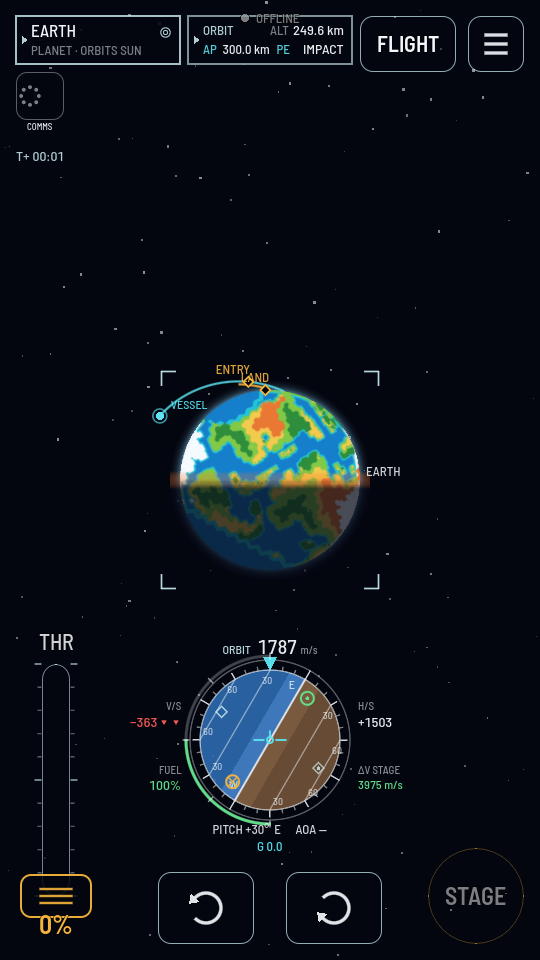
That is why both ends have to clear the line. An apoapsis of 200 km with a periapsis of 40 km is not an orbit, it is a very long fall with one high point, and the game will show you exactly that: markers appear on your path where it enters the air and where it hits the ground.
The lean, and why the ship helps
You do not haul the rocket over in one go. Hold a turn button for a second, let go, and let it drift. The ship keeps easing toward the direction it is already travelling all by itself, so a few short nudges spread over the climb leave you flying nearly flat by the time the air runs out. That drift is the gravity turn, and it is both the cheapest ascent and the least work.
Hauling it over hard, low down, is the classic beginner mistake. The air grabs a rocket that is flying sideways through it, the ship tips, and you either lose control or lose the ship. Gentle and early beats sharp and late.
Try it: fly it, then break it on purpose
The full step-by-step flight is Reaching orbit, including the rocket to build and the two things you need to buy first. Fly that, then add these two measurements to make this lesson stick.
- At apoapsis, before you burn, note both figures. Open MAP as you coast up and write down AP and PE. PE will be somewhere down near the ground or below it.
- Now burn, and watch the right number. Point along the green mark and hold the throttle open. AP barely moves. PE climbs steadily. You are at the high end, so the low end is what your push is lifting, exactly as promised.
- Stop when PE clears 70 km, and check ECC on the map: the closer to 0.000, the rounder your orbit. The Stable Orbit achievement lands here, worth 1,000 cr and 25 discovery.
- Then break it on purpose, in sandbox. Fly the same rocket and deliberately cut the circularising burn short, leaving PE at 40 km. Look at the map: ENTRY and LAND markers on your path, and a countdown to each. Nothing is wrong with the ship. The path is simply going to hit the air, and the game knew it before you did.
If it went wrong
The rocket flipped over during the turn. Too much turn, too low, too fast. Nudge and wait, do not hold.
The fuel ran out before PE cleared the air. The apoapsis was too low when the first stage died, so there was too little left for the second burn. Let AP climb further past 70 km next time before you cut the throttle.
The orbit looked fine and came down a lap later. PE was under 70 km. Even a few kilometres inside the air is enough to bring a ship down over a few laps.
What you just proved
- Orbit is two burns with a coast between them, not one long climb.
- The second burn happens at the top because that is where a push lifts the bottom.
- Both ends of the path must clear the air, or the air will collect the ship eventually.
- The game forecasts the failure for you: ENTRY and LAND markers mean your path ends on the ground.
The words
- Ascent
- The powered climb from the pad to the top of the air.
- Circularise
- To burn at apoapsis until the periapsis rises to meet it, leaving a round orbit.
- Coast
- Flying with the engines off. Free, and it changes nothing about your path.
- ENTRY, LAND
- Map markers for where your path meets the air and where it reaches the ground.