Lesson 3: Fuel, Δv and Isp
A car's fuel gauge tells you how far you can drive. A rocket's tells you how much you can still change your speed, which is a different thing and the only thing that matters out there.
The idea
Space has no road and nothing to rub against. Once you are moving, you keep moving, for free, forever. So distance is not what costs you fuel. Changing speed is what costs you fuel: speeding up, slowing down, turning a path.
Because of that, rocket people measure a ship's range in metres per second. The number is called Δv, said "delta-vee", and the Δ is just the shape mathematicians use for "the change in". A ship with 3,000 m/s of Δv can change its speed by 3,000 m/s in total, in one push or in twenty, and after that it is a passenger.
The useful part is that every job in the game has a fixed price in Δv, and the prices do not care what your rocket looks like:
| Job, starting from Earth's pad | Price |
|---|---|
| Out of the air and back under a chute | 1,087 m/s |
| Into an orbit that stays up | 3,104 m/s |
| Into orbit around the Moon | 4,272 m/s |
| Landed on the Moon | 4,863 m/s |
| Landed on the Moon and home again | 5,766 m/s |
| Landed on Mars | 6,048 m/s |
Those are the rungs of the whole game. Every tech node you buy and every trick you learn is really about carrying more Δv up the ladder.
Why more fuel is not the answer on its own
Here is the catch that makes rockets interesting. The fuel you add has to be carried by the fuel you already have. Doubling the propellant does not double your Δv, it adds a bit and then less and then hardly anything, because you are also doubling the mass that has to be pushed at the start.
The game's own reference figures for a single stage of starter parts say it plainly. With the tank as the hangar sets it up, that stage carries 3,473 m/s of Δv in vacuum. With the tank stretched all the way out, which is twice the propellant, it carries 4,532 m/s. Twice the fuel bought less than a third more Δv, and the ship is now too heavy for your first pad.
Carrying an empty bottle up a mountain is the same problem. The answer is not a bigger bottle. The answer is to put the empty one down, which is lesson 4.
Isp: how far a kilogram of fuel takes you
Two engines burning the same propellant can get very different amounts of Δv out of it. How well an engine uses its propellant is its Isp (say "specific impulse"), and although it is written in seconds, all you need to read it as is miles per gallon for rockets. Higher is thriftier.
Isp is not one number either, because a bell pushes better with less air outside it:
| Engine | Isp at sea level | Isp in vacuum | Good for |
|---|---|---|---|
| Engine | 290 s | 338 s | Anything. The one you start with. |
| Vacuum Engine | 168 s | 420 s | Upper stages only. Dreadful in thick air. |
| Ion Engine | 105 s | 4,200 s | Probes with patience and power. Almost no thrust. |
So thrust and Isp are two separate questions. Thrust is how hard the engine shoves, which decides whether you can lift off (lesson 2). Isp is how long it can keep shoving on the fuel you brought, which decides how far you get. A first stage wants thrust. Everything above it wants Isp.
Where the game says it
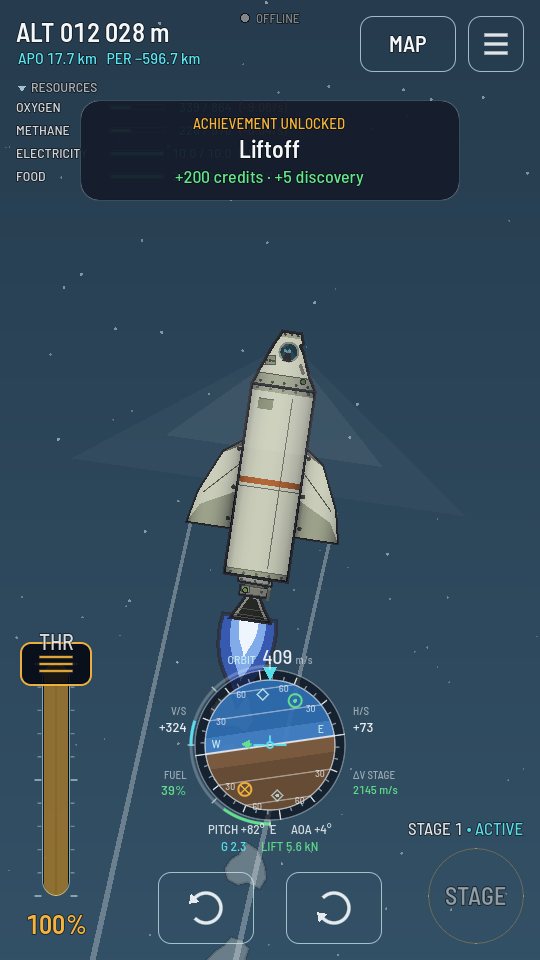
In flight, look to the right of the navball for ΔV STAGE. That is how much Δv the stage flying right now still has, worked out from what is in its tanks, its engines' Isp and the mass it is pushing. It counts down while you burn and stops when you close the throttle. Before anything is lit it is the next stage that lights an engine: the first stage on the pad, the upper stage once the spent one has dropped.
The FUEL gauge on the other side of the navball is the raw amount left in the stage you are burning: the tanks its engines can draw from, not the whole ship. On the pad it shows the first stage; once a stage drops it shows the next one, so it jumps back up when the spent stage falls away. Watch them together for one flight and the difference lands: the fuel gauge falls at a steady rate, the Δv figure falls faster at first and slower later, because every kilogram you burn makes the rest of the ship easier to push.
An engine's card in the hangar states its thrust at both ends and its Isp at both ends, so you can compare two engines before you buy either. Every engine in the game is listed in Engines.
Try it: spend a budget and watch the price
- Fly the starter rocket and read ΔV STAGE on the pad, before you light anything. That is your whole budget for this flight.
- Light it and note the figure at 1 km, at 5 km and at 10 km. Watch how much of the budget the first few kilometres cost. Getting off the ground is the most expensive part of any flight, because you are paying gravity and the thick air at the same time.
- Burn it dry, then compare with the price list. The figure you wrote down on the pad was in the same range as the 3,104 m/s an orbit costs, and yet here you are falling back down. The missing speed went into holding the ship up against gravity and shoving it through thick air while it pointed the wrong way. That gap is why nobody flies straight up, and why one stage of starter parts never quite makes orbit.
- Now do it in the hangar. Stretch the tank a few notches and look at the mass and TWR again. You have bought Δv with mass. Whether that trade is worth it depends on what you are trying to reach, and the price list is how you decide.
What you just proved
- Δv is a budget in metres per second, and every destination has a price tag.
- Adding fuel adds less and less Δv, because the fuel has to carry itself.
- Isp says how thriftily an engine turns fuel into Δv, and it improves as the air thins out.
- A rocket that has run out of Δv is not stuck. It is simply committed to whatever path it is already on.
The words
- Δv (delta-v)
- How much a ship can still change its speed, in metres per second. A rocket's real range.
- Isp
- How much push an engine gets out of each kilogram of propellant. Written in seconds; higher is thriftier.
- Propellant
- The stuff an engine throws out of the back. The Engine burns methane and oxygen together.
- Stage
- One engine and the tanks feeding it, flown as one lump. See the next lesson.