Wubba
The big moon of Squanch: enough pull to need a proper landing budget, at the far end of the longest crossing you will have flown.
The numbers
These are the figures the map's card shows when you hold your finger on Wubba, plus the two speeds that decide what a flight there costs. Low orbit speed is how fast you must be going, sideways, to stay up just above the surface. Escape speed is how fast you must be going to leave altogether. Sphere of influence is how far Wubba's pull reaches before something bigger takes over.
| Figure | Value |
|---|---|
| TYPE | Moon |
| ORBITS | Squanch |
| DISTANCE FROM SQUANCH | 33.41 Mm |
| ORBIT PERIOD | 2d 10:20:45 |
| ORBIT SHAPE | circular |
| RADIUS | 127.5 km |
| GRAVITY | 0.78 m/s² |
| DAY | 2d 10:20:45 |
| STATIONARY ORBIT | none — it turns once per trip round its planet |
| LOW ORBIT SPEED | 304 m/s |
| ESCAPE SPEED | 446 m/s |
| SPHERE OF INFLUENCE | 1.43 Mm |
| ATMOSPHERE | NONE |
Stationary orbit is the height where one trip round takes exactly one of the world’s days, so a ship there hangs over the same spot on the ground. See Stationary orbits.
Its day and its orbit are the same length, so Wubba keeps one face turned toward Squanch for ever. Land on the near side and Squanch hangs in the sky and never moves; land on the far side and you never see it at all.
What it is made of
What the world is built from. It is not something a ship measures, but it is why the ground looks and behaves as it does — an ice moon takes an impact differently from an iron one.
| Material | Share |
|---|---|
| Water ice | 55 % |
| Silicate rock | 45 % |
The air
None. Wubba has no atmosphere whatsoever, and that decides most of what a flight here is like. There is nothing for a parachute to catch, so the whole descent is flown on the engine and the last metres are taken on the landing legs. There is nothing to heat a hull on the way in, so a heat shield is dead weight. And there is nothing to slow a ship on the way up, so the climb off the surface is as cheap as the gravity allows.
It also means there are no air bands to survey: leave the ground and you are straight into low space. See Science and readings for what that is worth.
The ground
Wubba's surface is divided into biomes — bands running round the world, each with its own colour, its own typical height and its own roughness. Which one you come down in is recorded in your flight log, and the first reading taken in each one pays.
| Biome | Where | Typical height | Roughness |
|---|---|---|---|
| Cantaloupe Terrain | −180° to −90° | 100 m | ± 700 m |
| Nitrogen Geysers | −90° to 0° | −100 m | ± 300 m |
| South Cap | 0° to 90° | 200 m | ± 400 m |
| Walled Plains | 90° to 180° | −200 m | ± 850 m |
Where is the band's place round the world, in degrees from the world's own 0°, running out to ±180° on the far side. Typical height is where that biome's ground sits against the datum the map measures altitude from, and roughness is how far it wanders either side of that.
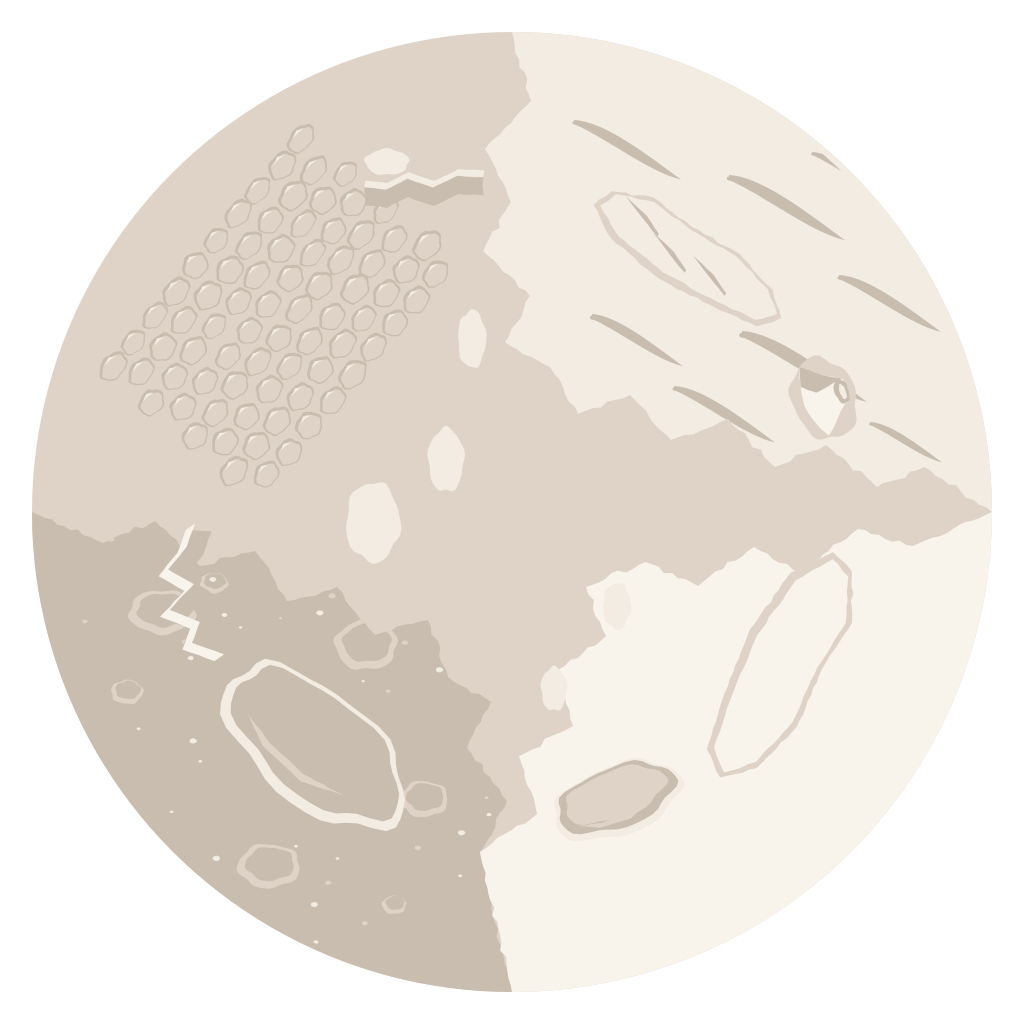
On the map Wubba is drawn from a painted picture, and the four biomes are its four quarters, 90° each: the streaked Nitrogen Geysers just before 0° and the bright South Cap just after, the dimpled Cantaloupe Terrain and the darker, crater-walled Walled Plains filling the far side. The colour under you as you come down is the colour of that quarter.
Named landforms
Wubba's ground is drawn from a table of named features rather than noise alone, as every world you can stand on is. Where you come to rest is recorded by name, which is why some achievements ask for a summit, a crater floor or a plateau rather than just a landing. All 8 of them are below, in order round the world, from the far side back to 0° and on round.
| Landform | Kind | Where | Height | Flat ground |
|---|---|---|---|---|
| Cantaloupe Dimples | Dunes | −140° | 400 m | — |
| Slidr Sulci | Valley | −105° | −800 m | 5,000 m |
| Geyser Plain | Plateau | −55° | 200 m | 25,000 m |
| Mahilani Plume | Volcano | −20° | 1,200 m | 2,000 m |
| South Cap Ice | Plateau | 30° | 900 m | 33,379 m |
| Ruach Planitia | Crater | 70° | 1,000 m | 15,000 m |
| Walled Plain | Crater | 130° | 1,400 m | 20,000 m |
| Cipango Ridge | Mountain range | 165° | 1,800 m | 50 m |
Where is the landform's place round the world, and height is how far it stands above (or below) the ground around it. Flat ground is the level run it promises — the width of the ledge, floor or summit a ship can set down on.
Getting there
The largest world out at that distance, and it has enough pull to matter: the landing and the climb back off it are a proper budget, on a ship that has already crossed the system. Landing pays Wubba Lubba Dub Dub.
What a ship leaving Earth's pad needs, in total change of speed, to do each of these:
| Trip | Δv from Earth's pad |
|---|---|
| Land | 7,023 m/s |
What it pays
Every place nobody has measured before pays discovery the first time an instrument reads it, and how much depends on how far from home the world is. Wubba counts as 7.00 against Earth's 1.00, so every place on it pays that many times what the same place at home would.
| Figure | Value |
|---|---|
| PLACES TO SURVEY | 12 |
| WORTH IN ALL | 86 discovery |
| CREDITS BESIDE IT | 1,720 |
A place is a world, a band of altitude and — on the ground — the biome you are standing in, and each instrument surveys each place separately. Science and readings explains the whole of it.
What it pays out for
One achievement names Wubba: Wubba Lubba Dub Dub.
The full list, with what each one pays, is on the Achievements reference.