Fleeb
The inner and larger of Mars' two moons, and one of the smallest things in the system you can stand on.
The numbers
These are the figures the map's card shows when you hold your finger on Fleeb, plus the two speeds that decide what a flight there costs. Low orbit speed is how fast you must be going, sideways, to stay up just above the surface. Escape speed is how fast you must be going to leave altogether. Sphere of influence is how far Fleeb's pull reaches before something bigger takes over.
| Figure | Value |
|---|---|
| TYPE | Moon |
| ORBITS | Mars |
| DISTANCE FROM MARS | 2.00 Mm |
| ORBIT PERIOD | 8:00:33 |
| ORBIT SHAPE | slightly oval (eccentricity 0.015) |
| RADIUS | 16.0 km |
| GRAVITY | 0.14 m/s² |
| DAY | 8:00:33 |
| STATIONARY ORBIT | none — it turns once per trip round its planet |
| LOW ORBIT SPEED | 37 m/s |
| ESCAPE SPEED | 67 m/s |
| SPHERE OF INFLUENCE | 49.1 km |
| ATMOSPHERE | NONE |
Stationary orbit is the height where one trip round takes exactly one of the world’s days, so a ship there hangs over the same spot on the ground. See Stationary orbits.
Its day and its orbit are the same length, so Fleeb keeps one face turned toward Mars for ever. Land on the near side and Mars hangs in the sky and never moves; land on the far side and you never see it at all.
What it is made of
What the world is built from. It is not something a ship measures, but it is why the ground looks and behaves as it does — an ice moon takes an impact differently from an iron one.
| Material | Share |
|---|---|
| Silicate rock | 80 % |
| Iron core | 20 % |
The air
None. Fleeb has no atmosphere whatsoever, and that decides most of what a flight here is like. There is nothing for a parachute to catch, so the whole descent is flown on the engine and the last metres are taken on the landing legs. There is nothing to heat a hull on the way in, so a heat shield is dead weight. And there is nothing to slow a ship on the way up, so the climb off the surface is as cheap as the gravity allows.
It also means there are no air bands to survey: leave the ground and you are straight into low space. See Science and readings for what that is worth.
The ground
Fleeb's surface is divided into biomes — bands running round the world, each with its own colour, its own typical height and its own roughness. Which one you come down in is recorded in your flight log, and the first reading taken in each one pays.
| Biome | Where | Typical height | Roughness |
|---|---|---|---|
| Grooved Face | −180° to −60° | 200 m | ± 107 m |
| Stickney Basin | −60° to 60° | −400 m | ± 107 m |
| Dust Flats | 60° to 180° | 0 m | ± 107 m |
Where is the band's place round the world, in degrees from the world's own 0°, running out to ±180° on the far side. Typical height is where that biome's ground sits against the datum the map measures altitude from, and roughness is how far it wanders either side of that.
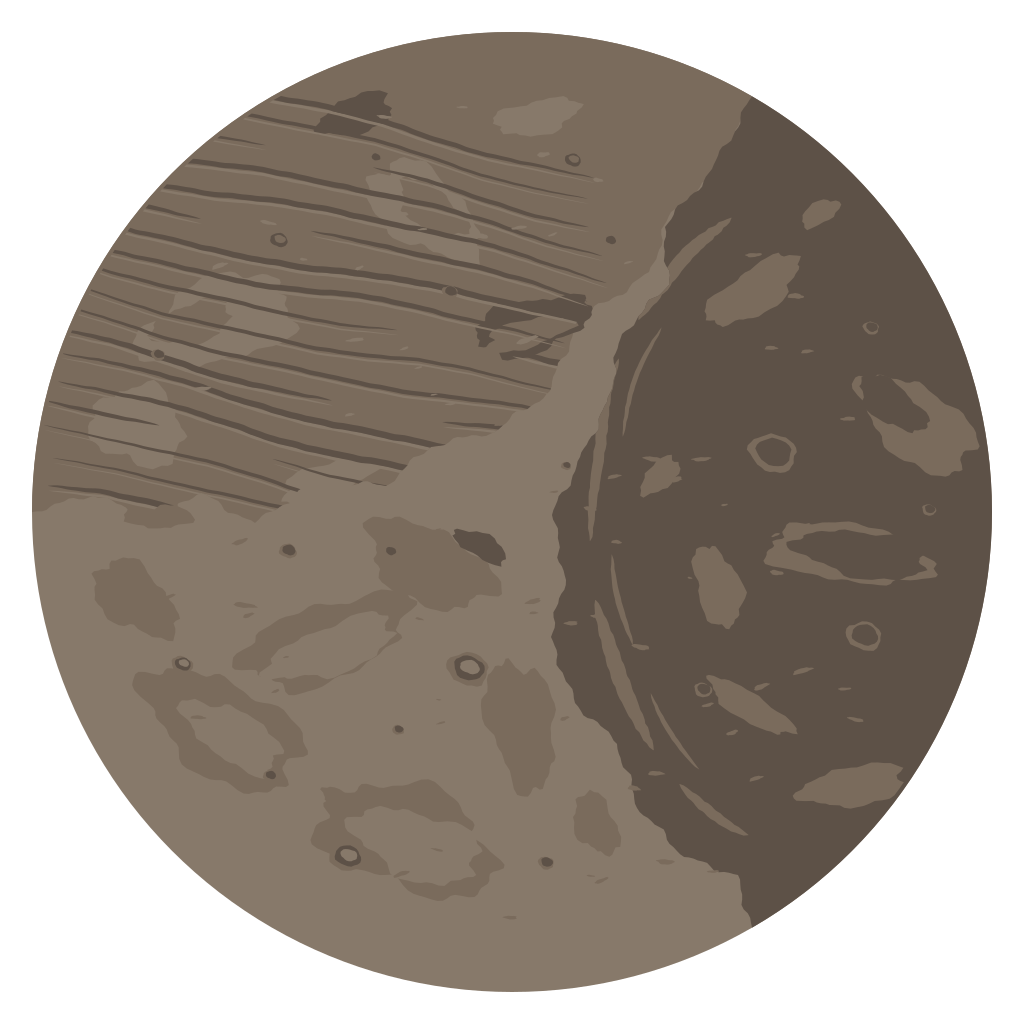
On the map Fleeb is drawn from a painted picture, and the three biomes are its three sectors: the darker Stickney Basin with its shallow terraces faces 0°, the Grooved Face scored with parallel furrows lies on one side of it and the pale, pitted Dust Flats on the other. The colour under you as you come down is the colour of that sector.
Named landforms
Fleeb's ground is drawn from a table of named features rather than noise alone, as every world you can stand on is. Where you come to rest is recorded by name, which is why some achievements ask for a summit, a crater floor or a plateau rather than just a landing. All 6 of them are below, in order round the world, from the far side back to 0° and on round.
| Landform | Kind | Where | Height | Flat ground |
|---|---|---|---|---|
| Grooved Face | Dunes | −150° | 90 m | — |
| Kepler Dorsum | Mountain range | −100° | 320 m | 50 m |
| Stickney Floor | Crater | −25° | 380 m | 3,500 m |
| Stickney Rim | Mountain range | 28° | 350 m | 45 m |
| Dust Flat | Plateau | 90° | 60 m | 4,189 m |
| Limtoc Crater | Crater | 140° | 200 m | 900 m |
Where is the landform's place round the world, and height is how far it stands above (or below) the ground around it. Flat ground is the level run it promises — the width of the ledge, floor or summit a ship can set down on.
Getting there
Everything about it is small. Its sphere of influence reaches only a short way past its own surface, so a ship is caught and on the ground almost in the same breath, and a burn that would be a nudge anywhere else throws you clear of it altogether.
Fleeb has no line of its own on the Δv ladder. The nearest figure is Mars's orbit. Getting down from there and back up again costs about its escape speed — 67 m/s — each way on top of that, less whatever you can save by coming in shallow.
What it pays
Every place nobody has measured before pays discovery the first time an instrument reads it, and how much depends on how far from home the world is. Fleeb counts as 4.52 against Earth's 1.00, so every place on it pays that many times what the same place at home would.
| Figure | Value |
|---|---|
| PLACES TO SURVEY | 10 |
| WORTH IN ALL | 50 discovery |
| CREDITS BESIDE IT | 1,000 |
A place is a world, a band of altitude and — on the ground — the biome you are standing in, and each instrument surveys each place separately. Science and readings explains the whole of it.