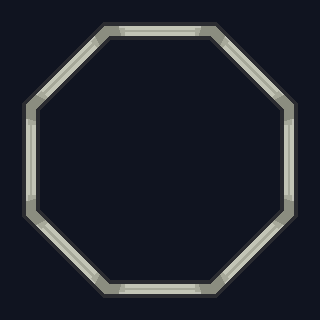
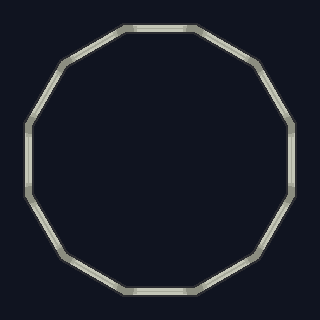
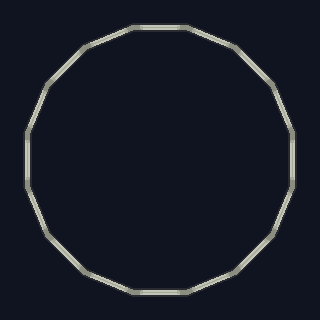
Every part in the Beams category: bare frame that holds the rest of the rocket apart — three straight beams and five rings. Frame carries nothing, burns nothing and does nothing; what it gives you is somewhere to bolt things that a plain stack has no room for.
The category holds two shapes. The three beams are straight: drag the Length slider and the beam grows down its own axis; its mass and its price grow with it, and so do the two lines down its flanks that radial parts attach to. The five ring frames are the same metal bent into a closed polygon, with a mounting face on every side — they are covered further down. Read Building a rocket for how parts join at all, and Staging for what happens when part of the frame is meant to come off.
Where things bolt on
Every straight beam offers the same two kinds of joint, and between them they are the whole reason the category exists.
A point at each end. The top and the bottom are ordinary stack points: put a beam in line with tanks, engines, a pod or another beam and it joins the stack like anything else.
A line down each flank. The left and right sides are not points but rails — the same kind of edge a fuel tank has. A radial part dropped anywhere against the flank sticks where you let it go, so a beam is a long mounting strip: thrusters at one height, a probe at another, a booster halfway down.
None of them carries fuel: a beam is frame, not a pipe. An engine bolted under a beam does not reach the tank above it, and a tank strapped to a beam's flank feeds nothing, until you draw a fuel line across. Electricity, food and thruster propellant run through a beam like any other joint.
No beam holds anything, and none of them stages. A beam that has to come off is a beam with a Decoupler or a Separator between it and the rocket.
Why they survive what the rocket does not
A straight beam is the strongest and the coolest-running thing you can put on a rocket, and it is very hard to destroy. The Truss holds to 1500 g where a fuel tank breaks at 20 g, so no explosion next to a beam breaks it, however short you make it. It survives meeting the ground at 60 to 80 m/s where a tank breaks at 16 m/s, and a hit from another ship at 50 to 70 m/s. Every beam is rated to 3500 K, and their open shape sheds most of the heat a re-entry pushes at them — the Truss takes less than a quarter of the heating a bare tank takes at the same speed. In practice that means a straight beam is never the part that fails: whatever it is holding gives way first.
The ring frames below are the same metal and stand the same 1200 g of sustained load, but they are not as tough in a collision — see what breaks a ring.
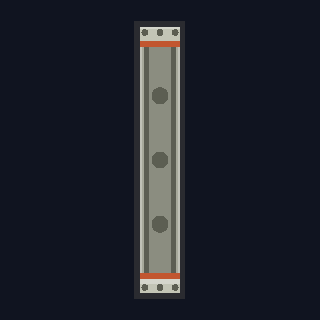
BX-1 Girder
Part · Beams · sold by Structures
A thin plated bar, one metre across, lightened by a row of holes. The cheap way to hold two things a short distance apart, or to run a mounting strip up the side of a rocket.
Figure
Value
MASS
240 kg
COST
30 cr
DRAG NOSE-ON
0.45×
HEAT EXPOSURE
0.35×
MAX TEMP
3500 K
MAX G
1200 g
IMPACT
60 m/s
STRIKE
50 m/s
BLAST
8 kN
NODES
4
The figures above are what a fresh one is placed at: 1 m across and 6 m long. Mass and price are per that length, so a Girder dragged to twice it weighs and costs twice as much.
It has no actions to tap. Its only property is a Length slider, from 32 to 320, hangar only.
Pairs with anything small you want held away from the stack — a thruster block, an antenna, a sensor. Instead of the BX-4 Truss, which is stronger and far wider but three times the mass.
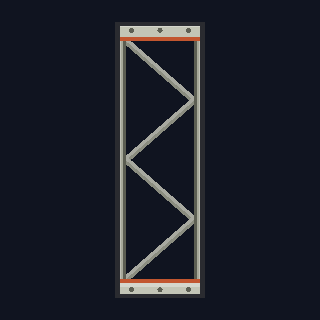
BX-4 Truss
Part · Beams · sold by Heavy Structures
An open lattice two and a half metres across, the piece real spacecraft are built out of. It is what carries an engine below a wide gap, spaces a lander's legs out past its tanks, or gives a station an arm to hang modules off.
Figure
Value
MASS
720 kg
COST
100 cr
DRAG NOSE-ON
0.5×
HEAT EXPOSURE
0.3×
MAX TEMP
3500 K
MAX G
1500 g
IMPACT
80 m/s
STRIKE
70 m/s
BLAST
14 kN
NODES
4
The figures above are what a fresh one is placed at: 2.5 m across and 8 m long. Mass and price are per that length, and the lattice adds a bay as it grows, so a long Truss still reads as a frame rather than a stretched picture.
It has no actions to tap. Its only property is a Length slider, from 48 to 384, hangar only.
Pairs with an engine hung under it and a tank above, or with a pair of them either side of a lander. Instead of the BX-1 Girder, when the thing being held is heavy or has to sit well clear of the stack.
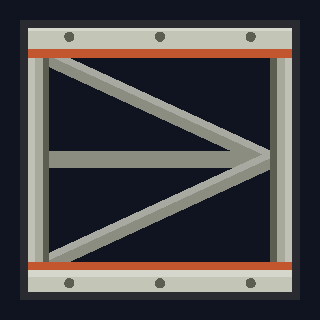
BX-6 Stack Truss
Part · Beams · sold by Stack Trusses
An open lattice four metres across — exactly as wide as a Fuel Tank, with its ends and its flank lines where a tank has them — for the place in a stack where a tank would go but nothing needs to be carried. It spaces a stack out: an engine further from what it would scorch, a pod further up a tall rocket, a gap to fit radial parts into.
Figure
Value
MASS
570 kg
COST
60 cr
DRAG NOSE-ON
0.5×
HEAT EXPOSURE
0.3×
MAX TEMP
3500 K
MAX G
1200 g
IMPACT
70 m/s
STRIKE
60 m/s
BLAST
16 kN
NODES
4
The figures above are what a fresh one is placed at: 4 m across and 4 m long, the size of a fresh Fuel Tank. Mass and price are per that length, and like the Truss it adds a bay as it grows.
It has no actions to tap. Its only property is a Length slider, from 32 to 256, hangar only.
Pairs with a tank above and a tank or an engine below — and with a fuel line across it, since it carries no fuel. Instead of the BX-4 Truss, whose narrower frame does not match a tank's width. It is all metal, so it is no lighter than an empty Fuel Tank: choose it for the gap, not to save weight.
A ring frame is the same metal as a beam, bent into a closed polygon. Where a beam gives you a line to build along, a ring gives you a circuit: one mounting face on every side, all pointing outward, evenly spaced round the middle. Bolt something to each one and the ship stops being a stack and becomes a wheel.
They come in five side counts — 4, 6, 8, 12 and 16 — and the side count is the whole difference between them. More sides means more places to bolt something and a wider ring to bolt them to.
Every side has two faces: one out, one in. The outer face is where a ship spreads outward from. The inner one looks back into the hole, and on a big ring that hole is the largest clear space anywhere on the vessel — hang tanks, a probe or a whole capsule inside the wheel rather than only around it. Both are marked by a pad in the middle of the side.
Every face is a point, not a rail. What you attach lands in the middle of its face, so the parts round a ring are spaced exactly evenly whether you were careful or not.
Parts turn onto the angled faces. Most of a ring's faces do not point up, down, left or right. Rotate the part in your hand until it is roughly facing the side you want (the Rotate button, or R), bring it close, and it swings the rest of the way on its own — up to 45°. If it will not take, you are more than a quarter turn out: rotate once more.
The top and bottom faces are ordinary stack points. Every ring has one face pointing straight up and one straight down, so a ring drops into a stack between a tank and an engine like any other part.
The middle is empty, and so are the corners. A ring is a frame, not a plate: only the band round the edge is metal. You can see through the middle, anything you build inside it is simply inside it, and nothing that leans out past an angled face is touching the ring — so none of it is ever flagged as overlapping.
The air goes through it. A ring shelters nothing. Whatever is mounted inside it, or in line behind it, meets exactly the air it would have met with no ring there — the same drag, the same heating, and a fin keeps its full authority. The frame pays its own drag, and is itself shaded by anything ahead of it, but it never casts a shadow of its own. A solid part of the same size would hide the whole stack behind it; a frame is bars and holes, and the air knows the difference.
A ring has two sliders, and they do quite different things.
Face width is how wide a part each side will take. The default, 64, is one ordinary stack part, so tanks bolted round a fresh ring sit edge to edge; 128 takes the wide stack. It moves the whole polygon out — a bigger ring with more room in the middle — and since that only makes each bar longer, the mass and price follow it straight: twice the face is twice the ring.
Beam width is how thick the frame's own bars are, from 6 to 32; a fresh ring comes with slim 8 bars, half a metre of metal, and that is what the figures above are for. A ring built when they came at 14 keeps the bars it was built with, and weighs and costs what bars that thick do: about three times a fresh one. The ring stays the same size across and the outer faces stay exactly where they are; only the inner faces move, inward, because thicker bars eat into the hole. Thickness is a cross-section, so it counts twice: twice the beam width is four times the mass and price. Build a wide, spidery hoop to carry solar panels, or a short heavy one where the mass is worth it — though a thicker bar buys you no more tolerance in a crash than a thin one does.
The two together are an honest scale model: double both and you get eight times the metal, the same rule the wide stack follows.
Rings carry no fuel across their joints, stage nothing and hold nothing, exactly like the beams above.
What breaks a ring
A hoop is not a strut. A ring stands the same 1200 g of sustained load a straight beam does — no burn, no spin and no explosion beside it will break one — but a blow is a different thing, and a closed hoop folds where a bar in line with the load holds. So a ring frame survives meeting the ground at 30 m/s and a hit from another ship at 25 m/s, where the straight beams take 60 to 80.
What that means when you fly:
Land on legs, not on a ring. A landing leg takes 30 to 45 m/s and has suspension to spread the blow over; a ring has neither. Set a wheel-shaped ship down so its legs meet the ground first and the frame never enters into it.
A ring is a poor bumper. Nudging a station with the outside of a ring at more than 25 m/s loses the ring, and with it everything that was only held on by it. Close on a dock at the speeds the docking pages give and nothing is at risk.
Only the part that is hit breaks. A lost ring does not destroy what was bolted round it — those parts come loose and fly on as debris, which on a landing is usually the same thing in the end.
Heat is not the weakness. Rings are rated to 3500 K like every beam, and the air goes straight through them. A ring will not burn off a re-entry; it will break on what you land it on.
BR-4 Square Frame
Part · Beams · sold by Ring Frames
A square of frame four metres across, a mounting face on each side. The smallest ring, and the one that turns a stack into a cross: an engine below, a tank above and something bolted out to the left and the right.
Figure
Value
MASS
235 kg
COST
42 cr
DRAG NOSE-ON
0.5×
HEAT EXPOSURE
0.3×
MAX TEMP
3500 K
MAX G
1200 g
IMPACT
30 m/s
STRIKE
25 m/s
BLAST
12 kN
NODES
8
The figures above are what a fresh one is placed at: 4 sides — so 8 mounting faces, one out and one in on each — each 4 m wide, making a ring 4.0 m across the flats. It has two properties, both hangar only: a Face width slider from 32 to 128, which moves the whole ring out and takes the mass and price with it in step, and a Beam width slider from 6 to 32, which sets how thick the frame’s own bars are without moving anything — and being a cross-section, doubling THAT is four times the mass and price.
Pairs with anything you want held out to both sides at once. Instead of a pair of Girders, when the two arms should be exactly opposite.
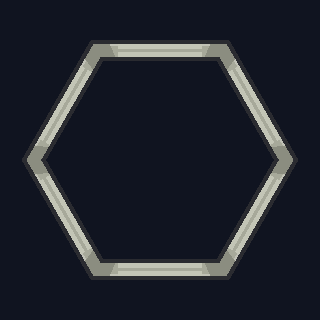
BR-6 Hex Frame
Part · Beams · sold by Ring Frames
Six faces, seven metres across the flats. The first ring wide enough to be a hub rather than a junction — four modules round the sides with the stack still running through the top and bottom faces.
Figure
Value
MASS
353 kg
COST
63 cr
DRAG NOSE-ON
0.5×
HEAT EXPOSURE
0.3×
MAX TEMP
3500 K
MAX G
1200 g
IMPACT
30 m/s
STRIKE
25 m/s
BLAST
12 kN
NODES
12
The figures above are what a fresh one is placed at: 6 sides — so 12 mounting faces, one out and one in on each — each 4 m wide, making a ring 6.9 m across the flats. It has two properties, both hangar only: a Face width slider from 32 to 128, which moves the whole ring out and takes the mass and price with it in step, and a Beam width slider from 6 to 32, which sets how thick the frame’s own bars are without moving anything — and being a cross-section, doubling THAT is four times the mass and price.
Pairs with solar arrays or radiators on the slanted faces and the stack through the axis. Instead of the BR-8, when six modules is all the ship needs.
BR-8 Octa Frame
Part · Beams · sold by Ring Frames
Eight faces, ten metres across. The ring most stations are built on: enough sides to spread tanks, panels and thrusters evenly round a centre, and still small enough to fit a fairing.
Figure
Value
MASS
470 kg
COST
84 cr
DRAG NOSE-ON
0.5×
HEAT EXPOSURE
0.3×
MAX TEMP
3500 K
MAX G
1200 g
IMPACT
30 m/s
STRIKE
25 m/s
BLAST
12 kN
NODES
16
The figures above are what a fresh one is placed at: 8 sides — so 16 mounting faces, one out and one in on each — each 4 m wide, making a ring 9.7 m across the flats. It has two properties, both hangar only: a Face width slider from 32 to 128, which moves the whole ring out and takes the mass and price with it in step, and a Beam width slider from 6 to 32, which sets how thick the frame’s own bars are without moving anything — and being a cross-section, doubling THAT is four times the mass and price.
Pairs with docking ports on the side faces: a hub that takes visitors on every quarter. Instead of the BR-12, which is half as wide again for the same job.
BR-12 Dodeca Frame
Part · Beams · sold by Station Rings
Twelve faces, fifteen metres across. Past this the ring reads as a circle rather than a polygon, and what you bolt to it makes a wheel rather than a cluster.
Figure
Value
MASS
705 kg
COST
125 cr
DRAG NOSE-ON
0.5×
HEAT EXPOSURE
0.3×
MAX TEMP
3500 K
MAX G
1200 g
IMPACT
30 m/s
STRIKE
25 m/s
BLAST
12 kN
NODES
24
The figures above are what a fresh one is placed at: 12 sides — so 24 mounting faces, one out and one in on each — each 4 m wide, making a ring 14.9 m across the flats. It has two properties, both hangar only: a Face width slider from 32 to 128, which moves the whole ring out and takes the mass and price with it in step, and a Beam width slider from 6 to 32, which sets how thick the frame’s own bars are without moving anything — and being a cross-section, doubling THAT is four times the mass and price.
Pairs with a full set of tanks or cabins round the rim. Instead of the BR-16, when the ring has to fit inside something.
BR-16 Round Frame
Part · Beams · sold by Station Rings
Sixteen faces, twenty metres across. The largest frame in the catalogue and the one that has to be assembled in orbit more often than launched whole — a full ring of modules, each on its own face.
Figure
Value
MASS
940 kg
COST
167 cr
DRAG NOSE-ON
0.5×
HEAT EXPOSURE
0.3×
MAX TEMP
3500 K
MAX G
1200 g
IMPACT
30 m/s
STRIKE
25 m/s
BLAST
12 kN
NODES
32
The figures above are what a fresh one is placed at: 16 sides — so 32 mounting faces, one out and one in on each — each 4 m wide, making a ring 20.1 m across the flats. It has two properties, both hangar only: a Face width slider from 32 to 128, which moves the whole ring out and takes the mass and price with it in step, and a Beam width slider from 6 to 32, which sets how thick the frame’s own bars are without moving anything — and being a cross-section, doubling THAT is four times the mass and price.
Pairs with a Grappling Claw or docking ports and a lot of patience. Instead of the BR-12, when sixteen faces is what the station needs.