Lesson 1: Gravity, weight and falling
Every world in the game pulls everything near it toward its middle, all the time, and never gets tired. Your engine can beat that pull for a minute. Gravity has all day.
The idea
Hold a pencil out and let go. It goes down. Not sideways, not up: toward the middle of the Earth. That pull is gravity, and it comes from the planet simply being big. Every world in this game has it, and none of them can be switched off.
Two things about it are worth knowing before you fly anything.
It never stops. There is no height where it lets go. It gets weaker the further out you are, but a ship 100 km up is still being pulled, and so is the Moon. Later on you will learn that an orbiting ship is not a ship that escaped gravity. It is a ship that is falling and keeps missing the ground.
It pulls on speed, not on position. Gravity does not drag your rocket back to the ground like a rubber band. It changes your speed a bit every second. On Earth, something falling freely goes 9.81 m/s faster every second: after one second it is doing 9.81 m/s, after two 19.6 m/s, after three 29.4 m/s. That is why a fall that starts gently ends badly, and it is the whole reason a landing needs planning.
Mass and weight are not the same thing
Mass is how much stuff there is, measured in kilograms. It is the same everywhere in the universe. It is what makes a thing hard to shove: an empty shopping trolley and a full one both roll, but the full one takes real effort to get moving and real effort to stop.
Weight is how hard a world pulls on that mass, measured here in kilonewtons (kN). Take your rocket somewhere with a gentler pull and its mass has not changed by a gram, but it weighs less, so it is easier to lift off and easier to set down.
| World | Pull at the surface | What that means |
|---|---|---|
| Earth | 9.81 m/s² | Home. Everything here is measured against it. |
| Mars | 3.71 m/s² | A bit over a third of Earth's. Landing there is far kinder. |
| The Moon | 1.63 m/s² | A sixth of Earth's. A small engine can lift a real ship. |
Those numbers are on every world's page in the manual, and they are the first thing to look at before you plan a trip. A lander that would never leave Earth's pad flies perfectly well off the Moon.
Where the game says it
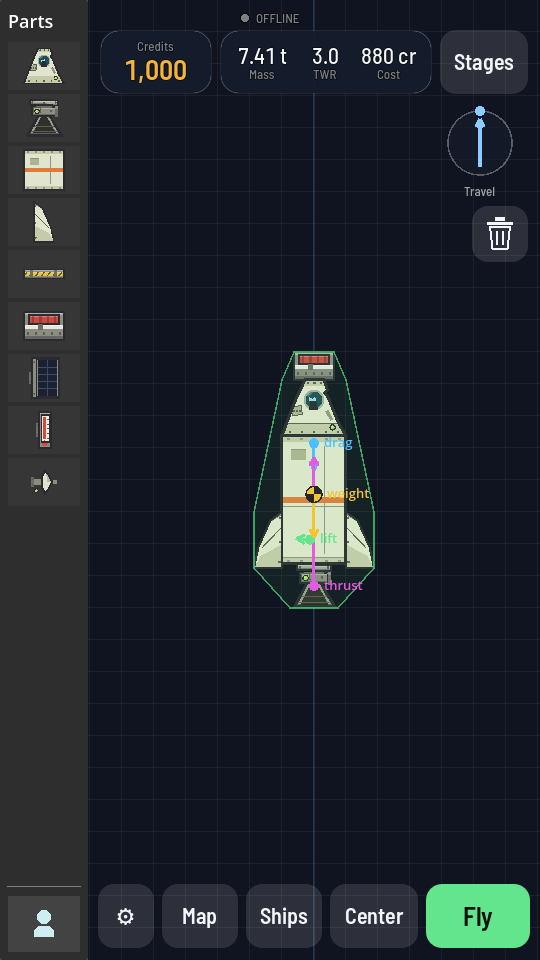
In the hangar, one of the coloured arrows on your rocket is labelled weight, in yellow, and it points straight down from a small quartered circle. That circle is the ship's centre of mass: the one point the whole ship balances around, and the point gravity may as well be pulling on. Add a heavy part low down and the circle slides down to meet it.
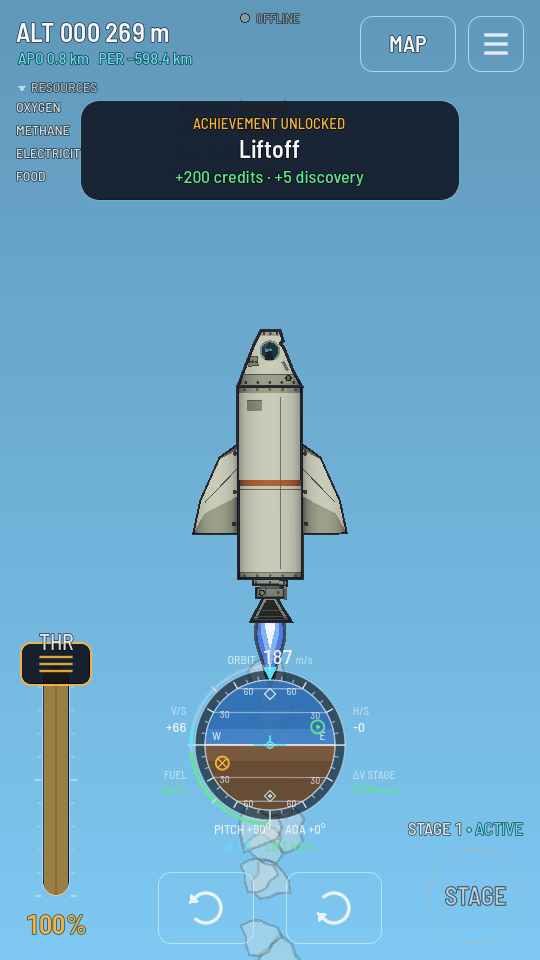
In flight, the number that tells you what gravity is doing to you is V/S, beside the navball on the left. It is your vertical speed: how fast you are going up (a plus) or down (a minus), in metres per second. Gravity's whole job is to make that number smaller, every second, until it goes negative.
Try it: let gravity win
You need the starter rocket, as the hangar hands it to you. Do it in sandbox if you would rather not pay for it.
- Fly it straight up. Tap Fly, then STAGE. Do not touch the turn buttons at all. The rocket goes up and stays pointing up.
- Watch V/S while the engine burns. It climbs into the hundreds. The engine is winning: it is adding more speed each second than gravity is taking away.
- Note the altitude when the flame goes out. The FUEL gauge beside the navball reaches 0 % and the engine goes quiet. Write down the ALT reading at the top left, and the V/S reading. Nothing is pushing you any more.
- Keep watching. The altitude carries on rising for a long time, while V/S falls steadily. Gravity is still taking its 9.81 m/s a second out of your vertical speed, and it did not stop just because the engine did.
- Catch the top of the arc. There is one instant where V/S reads 0 and the altitude stops. That is the highest you got. One second later V/S is negative and getting worse.
- Open the parachute and land. Tap the parachute on the nose, then Deploy, while you are falling and still high. Then the flight menu and RECOVER once the rocket is standing still, to get its parts refunded.
What you just proved
- The engine does not hold the rocket up. It adds speed while it burns, and that is all.
- Your highest point comes long after the engine stops, because the ship keeps the speed it was given.
- Gravity takes the same bite out of your vertical speed every second, whether you are going up, standing still in the air or falling.
- Going up and coming back down, on its own, is not going to space in any useful sense. It is a very tall throw. Lesson 5 is about what is missing.
The words
- Gravity
- A world's pull on everything near it, toward its middle. Never switches off.
- Mass
- How much stuff a ship is made of, in kilograms. The same on every world.
- Weight
- How hard a world pulls on that mass, in kilonewtons. Changes from world to world.
- Centre of mass
- The single point a ship balances around, drawn in the hangar as a small quartered circle.
- V/S
- Vertical speed: how fast you are rising or falling, in metres per second.