MultiplayerOne solar system for everyone29 worldsAnd what is not on the charts
ONE SKY. EVERYONE IN IT.
The first multiplayer rocket game with real orbital mechanics. Every player builds, launches and flies in one persistent solar system, on one clock that never stops. Your ship is still up there when you close the app, and so is everyone else’s. And not all of that solar system is on the charts yet.
iOS · Android · macOS · Free preview · One shared world
The big one
The first multiplayer game of its kind
Rocket-building games with real orbital mechanics have always been played alone. Orbital Frontier is one solar system for everyone: one persistent world, one clock, one server that runs it whether or not anybody is looking.
World · shared
One world, one clock
Every player’s ships share the same solar system and the same real-time clock. It runs while you sleep and while the app is closed. A burn planned for tomorrow happens tomorrow.
Fleet · persistent
Your fleet is real
Every orbit you settle into is written to the world server, not to a save file. Come back on any device and your ship is exactly where physics left it.
Server · authoritative
One referee for everyone
Launches are priced, pad limits checked, contracts judged and achievements paid by the server, never by your phone. Everyone flies under the same rules in the same sky.
Traffic · real
Other people’s ships are up there
Raise your Comm Station to level 2 and every coasting ship in the world is on your map, whoever launched it: follow it, target it, fly to it. Its owner decides whether it is a ghost you pass through or OPEN and solid — and an OPEN ship can be docked with: the two are held together as one body and stay two ships, each its owner’s to fly, so your engine moves their station and theirs moves you. A station’s owner can share its tanks and put a price on each load: dock, pay their price, and fill up far from home. When two players’ ships meet, the server flies the encounter itself and decides what became of each. Touching anyone takes insurance cover, paid by the day at a price your pilot rating sets: break somebody’s station and the insurer rebuilds it while your rating — and your premiums — pay for it.
Shared solar systemNever pausesReal orbitsDock your shipsCross-platform
The other big one
A solar system that keeps secrets
The charts show twenty-nine worlds. They do not show everything. Some of what is out there has never been drawn on any map, and some of it is waiting on worlds you have already landed on. Nothing in the game tells you where. You go out, and you look.
Bodies · uncharted
Not on any chart
Too small, too dark, or too far from where anyone has looked. Not everything going round the Sun has a name yet, and some of it is still out there, unseen.
Surface · hidden
Places nobody has stood
No marker, no survey, no pin on the map. Some places only show themselves to a ship that flies low enough, lands close enough, or watches from orbit long enough.
Origin · unknown
Someone was here before
Not all of it looks as if it got there on its own. Some of it looks as if it was left behind. Who left it, and why, is not written down anywhere.
Discovery · earned
Every find moves you further out
Every place you reach, measure or photograph for the first time pays discovery, and discovery buys the tech tree that takes you to the next place nobody has charted.
Uncharted bodiesHidden placesOrigin unknown
What you actually do
Build a rocket, fly it, and find out whether the numbers on the hangar card were telling the truth. They were.
Build from parts
115 procedural parts. Two stack diameters, and an adapter that tapers between them; tanks stretch by dragging, fairings must fit what they cover, wings lift on a real airfoil curve. Add a propeller, a tail and wheels and it is an aeroplane, rolling off a runway beside the pad; swap in an intake and a jet and it goes through the sound barrier. Mass and price come from the shape you draw.
Orbits that are orbits
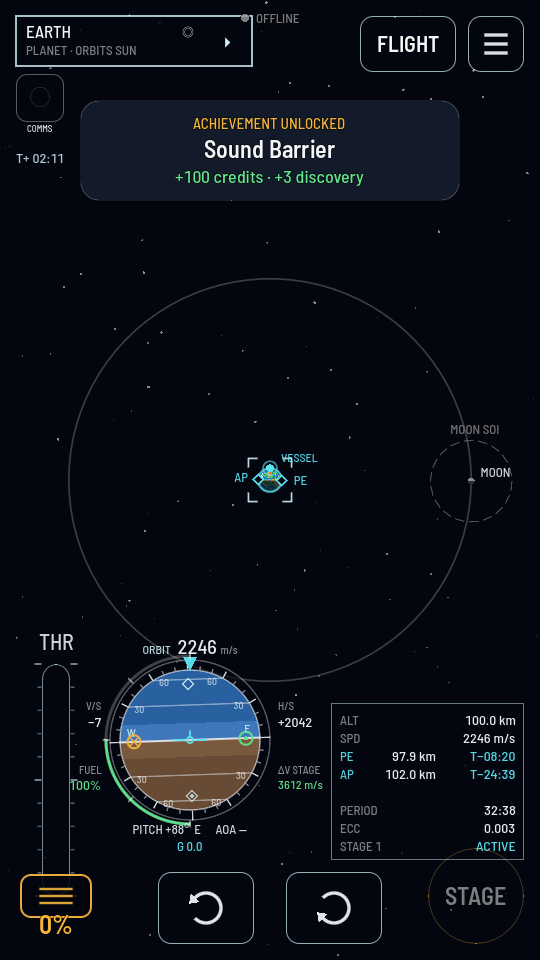
Every ship is six Keplerian elements and a clock. Patched conics, maneuver nodes, encounters. A ship you leave tumbling is still tumbling when you come back — and the burn you planned for it is still on its forecast, on any device.
Shared, and never paused
One solar system for every player, on one real-time clock nobody can stop. Your capture burn happens at 03:40 whether you are awake or not, so you set a reminder, the phone wakes you, and one tap on it puts you back at that ship's controls. A mining rig left running on a lunar helium-3 field keeps filling its tanks while the app is shut.
Meet the Meek
Astronauts, scientists, engineers, tourists. Each has a G-tolerance, blacks out past it, and grows only by coming home. A scientist aboard makes every reading achievement pay more. Move them between the ship's modules in flight — or between two ships, once the two have docked.
Credits, contracts, discovery
Lighting the first stage costs the ship's price. A ship recovered whole refunds what came back. Fly tourists to a different orbit or a different world, and get paid for it — the board always keeps a seat's worth of work on it, and no two offers ask quite the same: every job draws its own height, distance or count, and pays for how hard it came out. Discovery buys the tech tree, and you earn it by measuring places nobody has measured — every biome, every band of air, every world — by flying research contracts that keep coming back, and by reaching named points of interest, from a ten-metre landing back on the pad to a hundred-kilometre canyon on Mars, or by photographing them from orbit with a ground imager parked one world radius up. Short of discovery, the tech tree tells you where the rest of it is.
Dock, undock, rendezvous
Find another of your ships, close the range on thrusters, bring the rings together and they latch on their own — or close a grappling claw on a ship with no ring at all. A joined pair is one plumbing network: pump a tanker's propellant, a battery's charge or a cabin's waste across to the other ship. A stage you drop keeps flying, and it is solid.
By the numbers
What is in the shared world
Counted from the game's own data files on the day this page was built. Every one of them is editable online by the operator, so they only ever go up.
World telemetry · build 0.353.7
115
Parts in 13 categories
29
Worlds: star, 11 planets, 17 moons
73
Tech nodes
235
Achievements
177
Contract templates
64
Campaign missions in 10 chapters
7
Crew roles
Δv ladderSuborbital → orbit → Moon → Mars → beyond
Launch padEarth
Audio files shipped0 · every sound is synthesised
Scale
Kerbin-sized on purpose
Earth is 600 km across the radius, every planet sits at its real distance ratio, and gravity is the real surface gravity. Isp, mass fractions, drag and heat stay inside chemistry's range. The gas giants are the one written-down cheat: a giant's mass without a giant's grip, so their moons are reachable.
Latest release
“Ramming Speed”
Build 84 · New contracts ask you to destroy a ship, some of them races between pilots; the map turns under two fingers; and splashdowns make a splash.
The loop
A flight, end to end
1
Build in the hangar
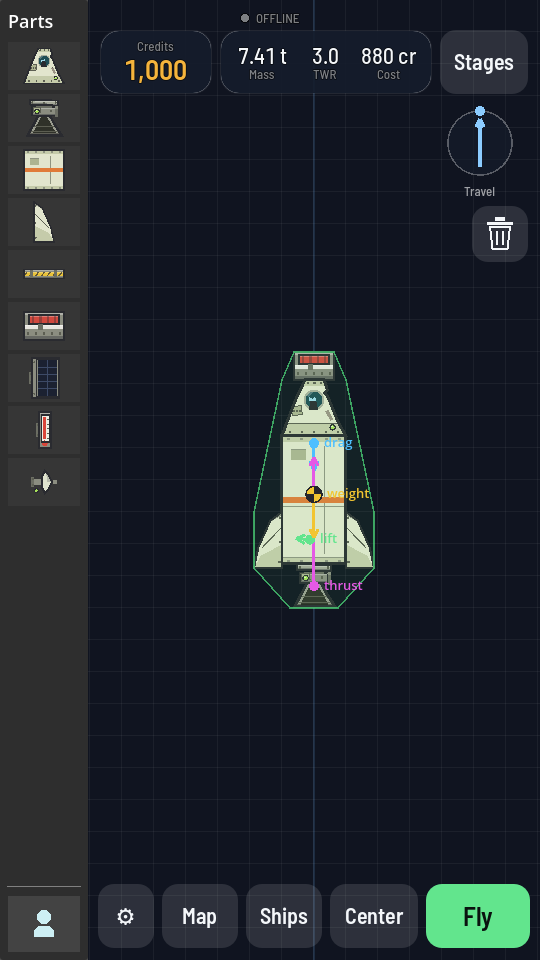
Snap parts onto attachment points, mirror the fins, order the stages. Save a satellite once and bolt it onto any rocket after. The card under the ship tells you its mass, its Δv and what it will cost to light.
2
Light the first stage
That is the moment you pay. The server prices the ship against the catalog, checks your pad can take it, and spends your credits. Standing on the pad is free.
3
Fly it on rails
Burn, coast, plan a node, cross a sphere of influence. Between burns the ship rides its conic exactly, so time warp is a leap and not a guess.
4
Bring it home
Come down under a canopy, on legs, on a heat shield. A ship standing whole on Earth is recovered for the price of what is still aboard, and so is the debris you left lying beside it. A crash refunds nothing.
HangarLiftoffMap
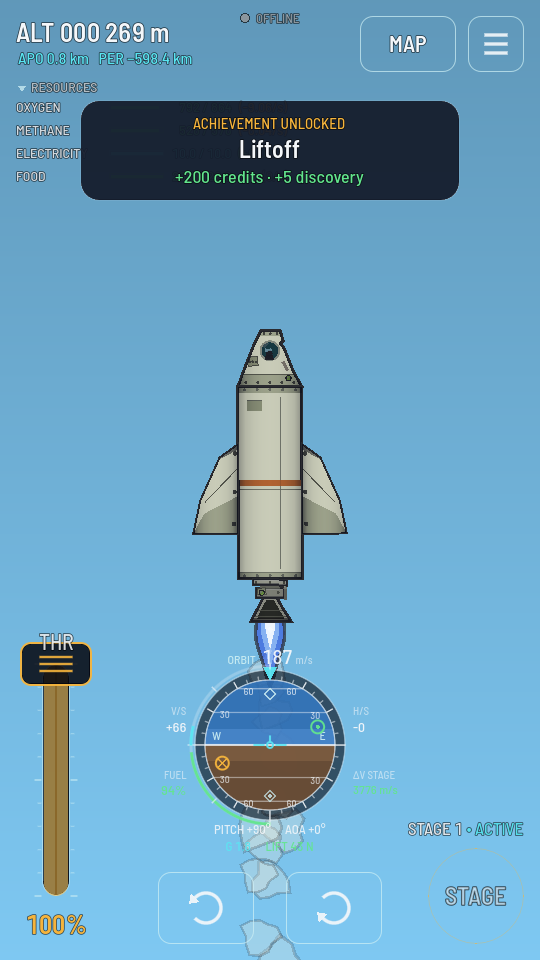
Live telemetry · Earth · stage 1 active
Throttle100 %
Fuel86 %
Orbit187 m/s · ALT 269 m
Liftoff · +200 cr1 Meek aboard
Twenty-nine worlds, one real shape
The real solar system's layout: the same planets in the same order at the same relative distances, with the same families of moons. The names are the Meeseeks'. Earth, its Moon and Mars keep theirs.
And those are only the ones on the charts. The system keeps more than it shows: things nobody has drawn, places nobody has stood, and a few that should not be there at all. Nothing in the game tells you where. You go and look.
Pilots answer pilots
Ask Anything
Stuck below orbit, out of fuel at the Moon, or looking at a part you have never flown? Ask on the game’s Discord. One question per post, a tag for what it is about, and anyone who has flown it can answer. Posting needs a free Discord account.
 Nothing in the game tells you where. You go and look.