Build from parts
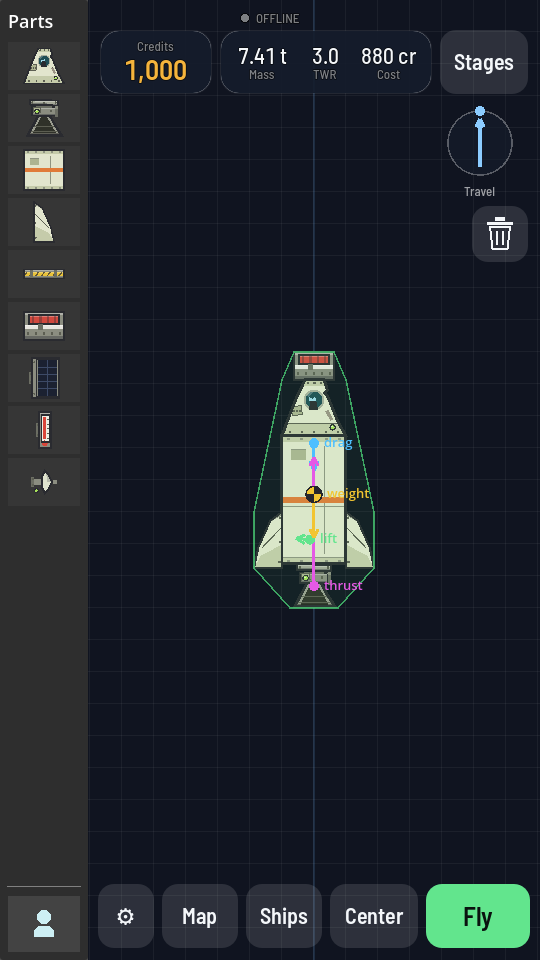
69 procedural parts. Two stack diameters, and an adapter that tapers between them; tanks stretch by dragging, fairings must fit what they cover, wings lift on a real airfoil curve. Mass and price come from the shape you draw.
The first multiplayer rocket game with real orbital mechanics. Every player builds, launches and flies in one persistent solar system, on one clock that never stops. Your ship is still up there when you close the app, and so is everyone else’s.
Rocket-building games with real orbital mechanics have always been played alone. Orbital Frontier is one solar system for everyone: one persistent world, one clock, one server that runs it whether or not anybody is looking.
Every player’s ships share the same solar system and the same real-time clock. It runs while you sleep and while the app is closed. A burn planned for tomorrow happens tomorrow.
Every orbit you settle into is written to the world server, not to a save file. Come back on any device and your ship is exactly where physics left it.
Launches are priced, pad limits checked, contracts judged and achievements paid by the server, never by your phone. Everyone flies under the same rules in the same sky.
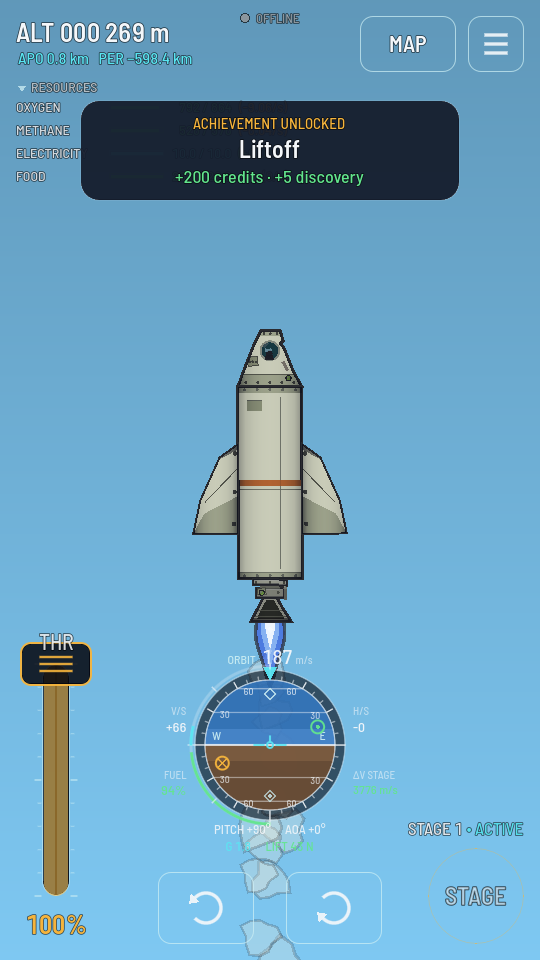
Build a rocket, fly it, and find out whether the numbers on the hangar card were telling the truth. They were.
69 procedural parts. Two stack diameters, and an adapter that tapers between them; tanks stretch by dragging, fairings must fit what they cover, wings lift on a real airfoil curve. Mass and price come from the shape you draw.
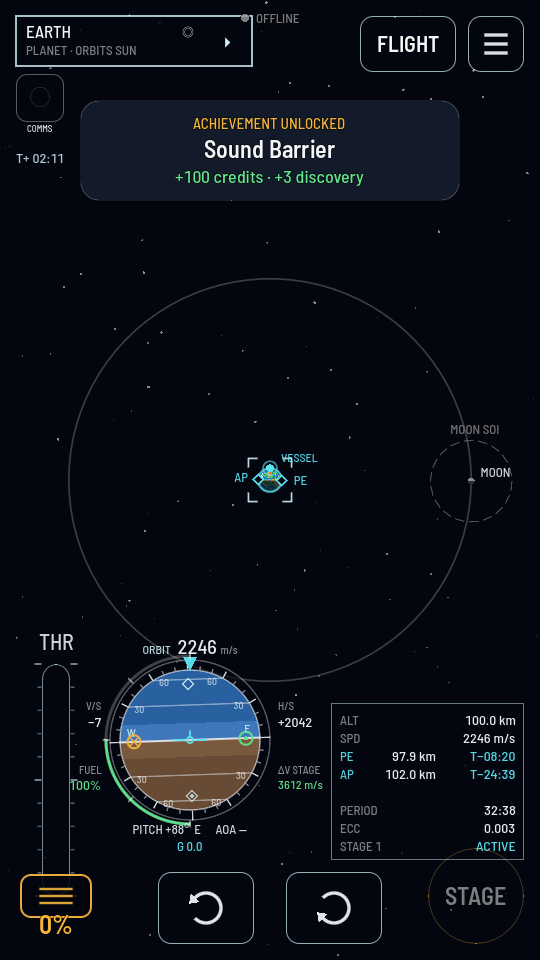
Every ship is six Keplerian elements and a clock. Patched conics, maneuver nodes, encounters. A ship you leave tumbling is still tumbling when you come back — and the burn you planned for it is still on its forecast, on any device.
One solar system for every player, on one real-time clock nobody can stop. Your capture burn happens at 03:40 whether you are awake or not, so you set a reminder, the phone wakes you, and one tap on it puts you back at that ship's controls.
Astronauts, scientists, engineers, tourists. Each has a G-tolerance, blacks out past it, and grows only by coming home. A scientist aboard makes every reading achievement pay more. Move them between the ship's modules in flight — or between two ships, once the two have docked.
Lighting the first stage costs the ship's price. A ship recovered whole refunds what came back. Fly tourists to a different orbit or a different world, and get paid for it — the board always keeps a seat's worth of work on it, and no two offers ask quite the same: every job draws its own height, distance or count, and pays for how hard it came out. Discovery buys the tech tree, and you earn it by measuring places nobody has measured — every biome, every band of air, every world — by flying research contracts that keep coming back, and by reaching named points of interest, from a ten-metre landing back on the pad to a hundred-kilometre canyon on Mars, or by photographing them from orbit with a ground imager parked one world radius up. Short of discovery, the tech tree tells you where the rest of it is.
Find another of your ships, close the range on thrusters, bring the rings together and they latch on their own — or close a grappling claw on a ship with no ring at all. A joined pair is one plumbing network: pump a tanker's propellant, a battery's charge or a cabin's waste across to the other ship. A stage you drop keeps flying, and it is solid.
Counted from the game's own data files on the day this page was built. Every one of them is editable online by the operator, so they only ever go up.
Snap parts onto attachment points, mirror the fins, order the stages. The card under the ship tells you its mass, its Δv and what it will cost to light.
That is the moment you pay. The server prices the ship against the catalog, checks your pad can take it, and spends your credits. Standing on the pad is free.
Burn, coast, plan a node, cross a sphere of influence. Between burns the ship rides its conic exactly, so time warp is a leap and not a guess.
Come down under a canopy, on legs, on a heat shield. A ship standing whole on Earth is recovered for the price of what is still aboard, and so is the debris you left lying beside it. A crash refunds nothing.
The real solar system's layout: the same planets in the same order at the same relative distances, with the same families of moons. The names are the Meeseeks'. Earth, its Moon and Mars keep theirs.
It is early, it is free, and it changes most days. Pick your platform, build something, and put it into the same solar system as everyone else.